

384
9 Forced Vibration of Continuous Systems
y j (t) =
1
mp j
1 − ζ 2
t
0
P j (τ ) exp [−ζ p j (t − τ ) ]
sin
p
1 − ζ 2 (t − τ )
dτ
(9.66)
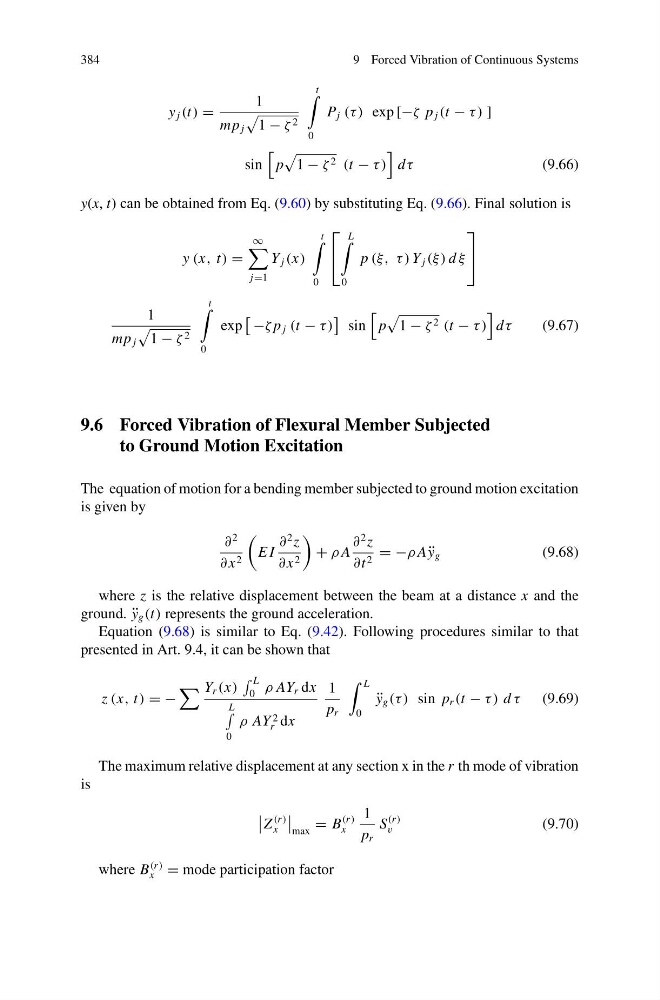
y(x, t) can be obtained from Eq. (9.60) by substituting Eq. (9.66). Final solution is
y (x, t) =
∞
j=1
Y j (x)
t
0
⎡
⎣
L
0
p (ξ, τ ) Y j (ξ ) d ξ
⎤
⎦
1
mp j
1 − ζ 2
t
0
exp
−ζ p j (t − τ )
sin
p
1 − ζ 2 (t − τ )
dτ
(9.67)
9.6 Forced Vibration of Flexural Member Subjected
to Ground Motion Excitation
The equation of motion for a bending member subjected to ground motion excitation
is given by
∂
2
∂ x 2
E I
∂
2 z
∂ x 2
+ ρ A
∂
2 z
∂t 2 = −ρ A ¨
y g
(9.68)
where z is the relative displacement between the beam at a distance x and the
ground. ¨
y g (t) represents the ground acceleration.
Equation (9.68) is similar to Eq. (9.42). Following procedures similar to that
presented in Art. 9.4, it can be shown that
z (x, t) = −
Y r (x)
L
0 ρ AY r dx
L
0
ρ AY 2
r dx
1
p r
L
0
¨
y g (τ ) sin p r (t − τ ) d τ
(9.69)
The maximum relative displacement at any section x in the r th mode of vibration
is
Z
(r )
x
max
= B
(r )
x
1
p r
S
(r )
v
(9.70)
where B
(r )
x = mode participation factor
9 Forced Vibration of Continuous Systems
y j (t) =
1
mp j
1 − ζ 2
t
0
P j (τ ) exp [−ζ p j (t − τ ) ]
sin
p
1 − ζ 2 (t − τ )
dτ
(9.66)
y(x, t) can be obtained from Eq. (9.60) by substituting Eq. (9.66). Final solution is
y (x, t) =
∞
j=1
Y j (x)
t
0
⎡
⎣
L
0
p (ξ, τ ) Y j (ξ ) d ξ
⎤
⎦
1
mp j
1 − ζ 2
t
0
exp
−ζ p j (t − τ )
sin
p
1 − ζ 2 (t − τ )
dτ
(9.67)
9.6 Forced Vibration of Flexural Member Subjected
to Ground Motion Excitation
The equation of motion for a bending member subjected to ground motion excitation
is given by
∂
2
∂ x 2
E I
∂
2 z
∂ x 2
+ ρ A
∂
2 z
∂t 2 = −ρ A ¨
y g
(9.68)
where z is the relative displacement between the beam at a distance x and the
ground. ¨
y g (t) represents the ground acceleration.
Equation (9.68) is similar to Eq. (9.42). Following procedures similar to that
presented in Art. 9.4, it can be shown that
z (x, t) = −
Y r (x)
L
0 ρ AY r dx
L
0
ρ AY 2
r dx
1
p r
L
0
¨
y g (τ ) sin p r (t − τ ) d τ
(9.69)
The maximum relative displacement at any section x in the r th mode of vibration
is
Z
(r )
x
max
= B
(r )
x
1
p r
S
(r )
v
(9.70)
where B
(r )
x = mode participation factor