

364
8 Free Vibration Analysis of Continuous Systems
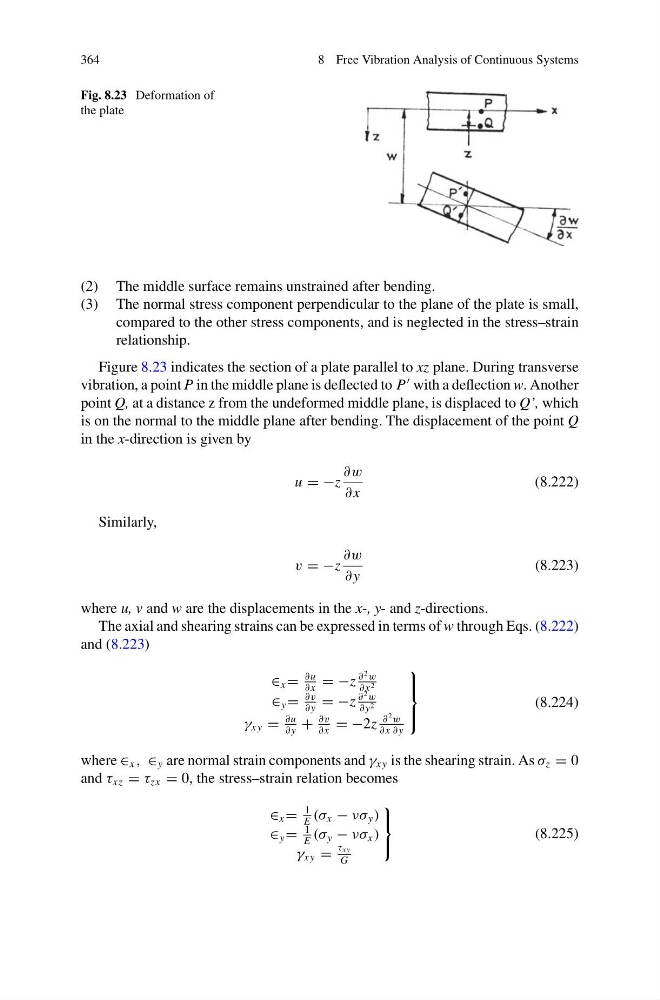
Fig. 8.23 Deformation of
the plate
(2) The middle surface remains unstrained after bending.
(3) The normal stress component perpendicular to the plane of the plate is small,
compared to the other stress components, and is neglected in the stress–strain
relationship.
Figure 8.23 indicates the section of a plate parallel to xz plane. During transverse
vibration, a point P in the middle plane is deflected to P
with a deflection w. Another
point Q, at a distance z from the undeformed middle plane, is displaced to Q’, which
is on the normal to the middle plane after bending. The displacement of the point Q
in the x-direction is given by
u = −z
∂w
∂ x
(8.222)
Similarly,
v = −z
∂w
∂ y
(8.223)
where u, v and w are the displacements in the x-, y- and z-directions.
The axial and shearing strains can be expressed in terms of w through Eqs. (8.222)
and (8.223)
∈ x =
∂u
∂ x
= −z
∂
2 w
∂ x 2
∈ y =
∂v
∂ y
= −z
∂
2 w
∂ y 2
γ xy =
∂u
∂ y
+
∂v
∂ x
= −2z
∂
2 w
∂ x ∂ y
⎫
⎪ ⎬
⎪ ⎭
(8.224)
where ∈ x , ∈ y are normal strain components and γ xy is the shearing strain. As σ z = 0
and τ xz = τ zx = 0, the stress–strain relation becomes
∈ x =
1
E
(σ x − νσ y )
∈ y =
1
E
(σ y − νσ x )
γ xy =
τ xy
G
⎫
⎬
⎭
(8.225)
8 Free Vibration Analysis of Continuous Systems
Fig. 8.23 Deformation of
the plate
(2) The middle surface remains unstrained after bending.
(3) The normal stress component perpendicular to the plane of the plate is small,
compared to the other stress components, and is neglected in the stress–strain
relationship.
Figure 8.23 indicates the section of a plate parallel to xz plane. During transverse
vibration, a point P in the middle plane is deflected to P
with a deflection w. Another
point Q, at a distance z from the undeformed middle plane, is displaced to Q’, which
is on the normal to the middle plane after bending. The displacement of the point Q
in the x-direction is given by
u = −z
∂w
∂ x
(8.222)
Similarly,
v = −z
∂w
∂ y
(8.223)
where u, v and w are the displacements in the x-, y- and z-directions.
The axial and shearing strains can be expressed in terms of w through Eqs. (8.222)
and (8.223)
∈ x =
∂u
∂ x
= −z
∂
2 w
∂ x 2
∈ y =
∂v
∂ y
= −z
∂
2 w
∂ y 2
γ xy =
∂u
∂ y
+
∂v
∂ x
= −2z
∂
2 w
∂ x ∂ y
⎫
⎪ ⎬
⎪ ⎭
(8.224)
where ∈ x , ∈ y are normal strain components and γ xy is the shearing strain. As σ z = 0
and τ xz = τ zx = 0, the stress–strain relation becomes
∈ x =
1
E
(σ x − νσ y )
∈ y =
1
E
(σ y − νσ x )
γ xy =
τ xy
G
⎫
⎬
⎭
(8.225)