

352
8 Free Vibration Analysis of Continuous Systems
Let f ij be the flexibility coefficient for the station x i , x j [ f (x i , x j )]. The integrand
on the left-hand side is approximated as follows:
L
0
f (x i , ξ)ρ A(ξ )Y (ξ )dξ =
n
j=1
w j f i j ρ A j Y j
(8.186)
where A(x j ) = A j and Y (x j ) = Y j
and w j is a weighing factor.
Therefore, Eq. (8.186) can be written as
Y i = p
2
n
j=1
w j f i j ρ A j Y j
(8.187)
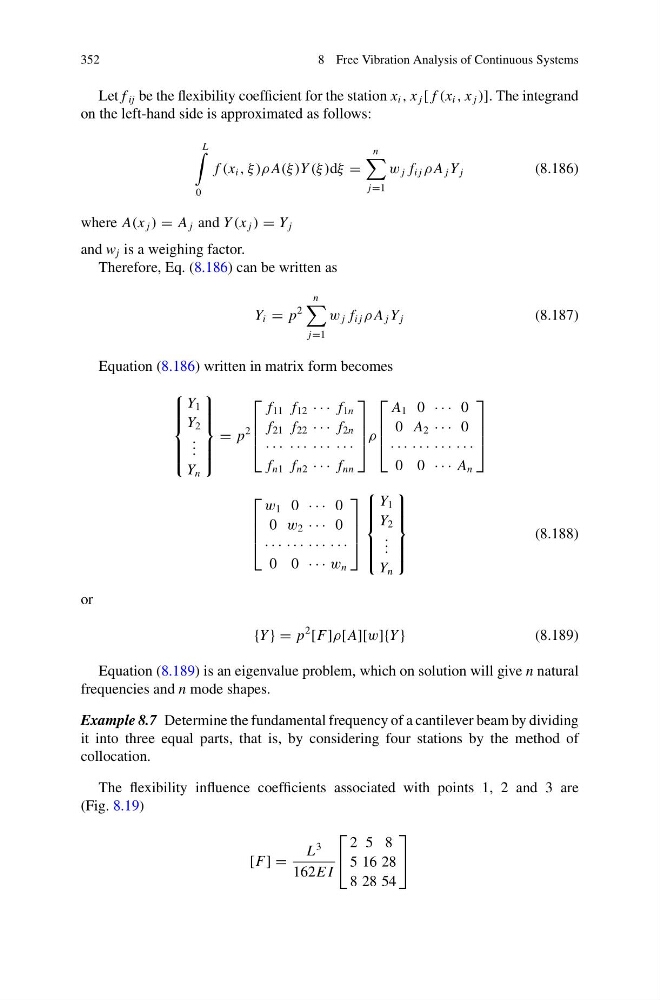
Equation (8.186) written in matrix form becomes
⎧
⎪ ⎪ ⎪ ⎨
⎪ ⎪ ⎪ ⎩
Y 1
Y 2
. . .
Y n
⎫
⎪ ⎪ ⎪ ⎬
⎪ ⎪ ⎪ ⎭
= p
2
⎡
⎢
⎢
⎣
f 11 f 12 · · · f 1n
f 21 f 22 · · · f 2n
· · · · · · · · · · · ·
f n1 f n2 · · · f nn
⎤
⎥
⎥
⎦ ρ
⎡
⎢
⎢
⎣
A 1 0 · · · 0
0 A 2 · · · 0
· · · · · · · · · · · ·
0 0 · · · A n
⎤
⎥
⎥
⎦
⎡
⎢
⎢
⎣
w 1 0 · · · 0
0 w 2 · · · 0
· · · · · · · · · · · ·
0 0 · · · w n
⎤
⎥
⎥
⎦
⎧
⎪ ⎪ ⎪ ⎨
⎪ ⎪ ⎪ ⎩
Y 1
Y 2
. . .
Y n
⎫
⎪ ⎪ ⎪ ⎬
⎪ ⎪ ⎪ ⎭
(8.188)
or
{Y } = p
2
[F]ρ[A][w]{Y }
(8.189)
Equation (8.189) is an eigenvalue problem, which on solution will give n natural
frequencies and n mode shapes.
Example 8.7 Determine the fundamental frequency of a cantilever beam by dividing
it into three equal parts, that is, by considering four stations by the method of
collocation.
The flexibility influence coefficients associated with points 1, 2 and 3 are
(Fig. 8.19)
[F] =
L
3
162E I
⎡
⎣
2 5 8
5 16 28
8 28 54
⎤
⎦
8 Free Vibration Analysis of Continuous Systems
Let f ij be the flexibility coefficient for the station x i , x j [ f (x i , x j )]. The integrand
on the left-hand side is approximated as follows:
L
0
f (x i , ξ)ρ A(ξ )Y (ξ )dξ =
n
j=1
w j f i j ρ A j Y j
(8.186)
where A(x j ) = A j and Y (x j ) = Y j
and w j is a weighing factor.
Therefore, Eq. (8.186) can be written as
Y i = p
2
n
j=1
w j f i j ρ A j Y j
(8.187)
Equation (8.186) written in matrix form becomes
⎧
⎪ ⎪ ⎪ ⎨
⎪ ⎪ ⎪ ⎩
Y 1
Y 2
. . .
Y n
⎫
⎪ ⎪ ⎪ ⎬
⎪ ⎪ ⎪ ⎭
= p
2
⎡
⎢
⎢
⎣
f 11 f 12 · · · f 1n
f 21 f 22 · · · f 2n
· · · · · · · · · · · ·
f n1 f n2 · · · f nn
⎤
⎥
⎥
⎦ ρ
⎡
⎢
⎢
⎣
A 1 0 · · · 0
0 A 2 · · · 0
· · · · · · · · · · · ·
0 0 · · · A n
⎤
⎥
⎥
⎦
⎡
⎢
⎢
⎣
w 1 0 · · · 0
0 w 2 · · · 0
· · · · · · · · · · · ·
0 0 · · · w n
⎤
⎥
⎥
⎦
⎧
⎪ ⎪ ⎪ ⎨
⎪ ⎪ ⎪ ⎩
Y 1
Y 2
. . .
Y n
⎫
⎪ ⎪ ⎪ ⎬
⎪ ⎪ ⎪ ⎭
(8.188)
or
{Y } = p
2
[F]ρ[A][w]{Y }
(8.189)
Equation (8.189) is an eigenvalue problem, which on solution will give n natural
frequencies and n mode shapes.
Example 8.7 Determine the fundamental frequency of a cantilever beam by dividing
it into three equal parts, that is, by considering four stations by the method of
collocation.
The flexibility influence coefficients associated with points 1, 2 and 3 are
(Fig. 8.19)
[F] =
L
3
162E I
⎡
⎣
2 5 8
5 16 28
8 28 54
⎤
⎦