

350
8 Free Vibration Analysis of Continuous Systems
8.14 Collocation Method for Obtaining Normal Modes
of Vibration of a Continuous System
The integral equation of motion is to be formed first. The equation is derived on the
basis of the flexibility function. The flexibility coefficient f i j is the displacement at
point i due to a unit load placed at point j. In the case of continuous systems, the term
coefficient is replaced by function, as here we deal with infinite number of points.
The flexibility function f (x, ξ) represents the displacement at x due to a unit load
applied at ξ .
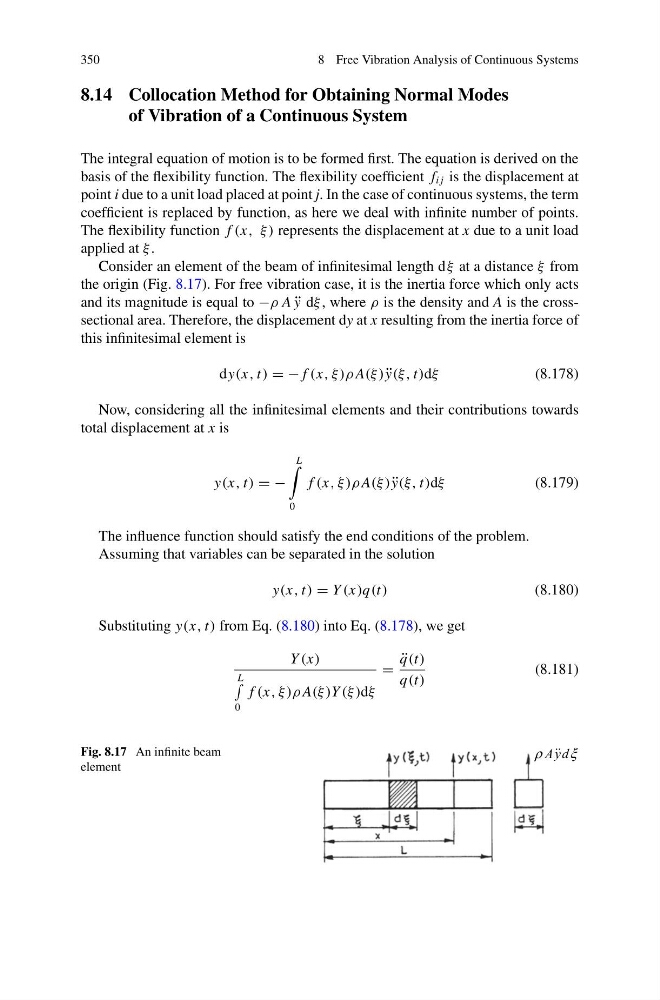
Consider an element of the beam of infinitesimal length dξ at a distance ξ from
the origin (Fig. 8.17). For free vibration case, it is the inertia force which only acts
and its magnitude is equal to −ρ A ¨
y dξ , where ρ is the density and A is the crosssectional area. Therefore, the displacement dy at x resulting from the inertia force of
this infinitesimal element is
dy(x, t) = − f (x, ξ)ρ A(ξ ) ¨
y(ξ, t)dξ
(8.178)
Now, considering all the infinitesimal elements and their contributions towards
total displacement at x is
y(x, t) = −
L
0
f (x, ξ)ρ A(ξ ) ¨
y(ξ, t)dξ
(8.179)
The influence function should satisfy the end conditions of the problem.
Assuming that variables can be separated in the solution
y(x, t) = Y (x)q(t)
(8.180)
Substituting y(x, t) from Eq. (8.180) into Eq. (8.178), we get
Y (x)
L
0
f (x, ξ)ρ A(ξ )Y (ξ )dξ
=
¨
q(t)
q(t)
(8.181)
Fig. 8.17 An infinite beam
element
8 Free Vibration Analysis of Continuous Systems
8.14 Collocation Method for Obtaining Normal Modes
of Vibration of a Continuous System
The integral equation of motion is to be formed first. The equation is derived on the
basis of the flexibility function. The flexibility coefficient f i j is the displacement at
point i due to a unit load placed at point j. In the case of continuous systems, the term
coefficient is replaced by function, as here we deal with infinite number of points.
The flexibility function f (x, ξ) represents the displacement at x due to a unit load
applied at ξ .
Consider an element of the beam of infinitesimal length dξ at a distance ξ from
the origin (Fig. 8.17). For free vibration case, it is the inertia force which only acts
and its magnitude is equal to −ρ A ¨
y dξ , where ρ is the density and A is the crosssectional area. Therefore, the displacement dy at x resulting from the inertia force of
this infinitesimal element is
dy(x, t) = − f (x, ξ)ρ A(ξ ) ¨
y(ξ, t)dξ
(8.178)
Now, considering all the infinitesimal elements and their contributions towards
total displacement at x is
y(x, t) = −
L
0
f (x, ξ)ρ A(ξ ) ¨
y(ξ, t)dξ
(8.179)
The influence function should satisfy the end conditions of the problem.
Assuming that variables can be separated in the solution
y(x, t) = Y (x)q(t)
(8.180)
Substituting y(x, t) from Eq. (8.180) into Eq. (8.178), we get
Y (x)
L
0
f (x, ξ)ρ A(ξ )Y (ξ )dξ
=
¨
q(t)
q(t)
(8.181)
Fig. 8.17 An infinite beam
element