

8.9 Orthogonality Properties of Normal Modes
337
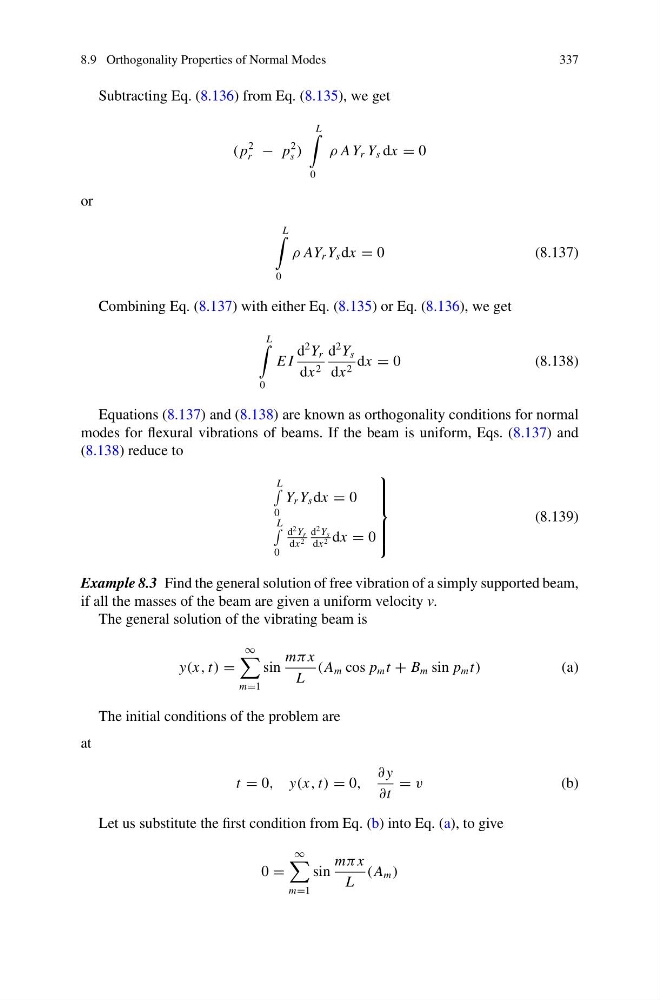
Subtracting Eq. (8.136) from Eq. (8.135), we get
( p
2
r − p
2
s )
L
0
ρ A Y r Y s dx = 0
or
L
0
ρ AY r Y s dx = 0
(8.137)
Combining Eq. (8.137) with either Eq. (8.135) or Eq. (8.136), we get
L
0
E I
d
2 Y r
dx 2
d
2 Y s
dx 2 dx = 0
(8.138)
Equations (8.137) and (8.138) are known as orthogonality conditions for normal
modes for flexural vibrations of beams. If the beam is uniform, Eqs. (8.137) and
(8.138) reduce to
L
0
Y r Y s dx = 0
L
0
d
2 Y r
dx 2
d
2 Y s
dx 2 dx = 0
⎫
⎪ ⎪ ⎪ ⎬
⎪ ⎪ ⎪ ⎭
(8.139)
Example 8.3 Find the general solution of free vibration of a simply supported beam,
if all the masses of the beam are given a uniform velocity v.
The general solution of the vibrating beam is
y(x, t) =
∞
m=1
sin
mπ x
L
(A m cos p m t + B m sin p m t)
(a)
The initial conditions of the problem are
at
t = 0, y(x, t) = 0,
∂ y
∂t
= v
(b)
Let us substitute the first condition from Eq. (b) into Eq. (a), to give
0 =
∞
m=1
sin
mπ x
L
(A m )
337
Subtracting Eq. (8.136) from Eq. (8.135), we get
( p
2
r − p
2
s )
L
0
ρ A Y r Y s dx = 0
or
L
0
ρ AY r Y s dx = 0
(8.137)
Combining Eq. (8.137) with either Eq. (8.135) or Eq. (8.136), we get
L
0
E I
d
2 Y r
dx 2
d
2 Y s
dx 2 dx = 0
(8.138)
Equations (8.137) and (8.138) are known as orthogonality conditions for normal
modes for flexural vibrations of beams. If the beam is uniform, Eqs. (8.137) and
(8.138) reduce to
L
0
Y r Y s dx = 0
L
0
d
2 Y r
dx 2
d
2 Y s
dx 2 dx = 0
⎫
⎪ ⎪ ⎪ ⎬
⎪ ⎪ ⎪ ⎭
(8.139)
Example 8.3 Find the general solution of free vibration of a simply supported beam,
if all the masses of the beam are given a uniform velocity v.
The general solution of the vibrating beam is
y(x, t) =
∞
m=1
sin
mπ x
L
(A m cos p m t + B m sin p m t)
(a)
The initial conditions of the problem are
at
t = 0, y(x, t) = 0,
∂ y
∂t
= v
(b)
Let us substitute the first condition from Eq. (b) into Eq. (a), to give
0 =
∞
m=1
sin
mπ x
L
(A m )