

8.8 Free Flexural Vibration of Beams with General End Conditions
329
8.8 Free Flexural Vibration of Beams with General End
Conditions
A beam end may not have only classical boundary conditions, such as hinged support,
clamped support or free support. The support at one end may be elastically restrained
in translation, or rotation, or both. In addition, the end may have a concentrated mass.
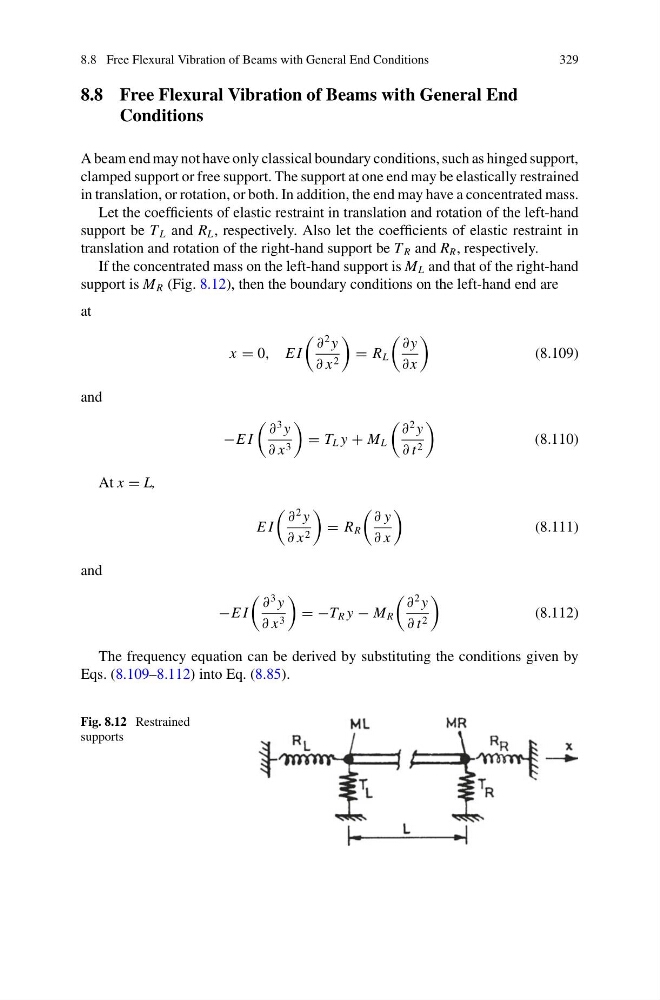
Let the coefficients of elastic restraint in translation and rotation of the left-hand
support be T L and R L , respectively. Also let the coefficients of elastic restraint in
translation and rotation of the right-hand support be T R and R R , respectively.
If the concentrated mass on the left-hand support is M L and that of the right-hand
support is M R (Fig. 8.12), then the boundary conditions on the left-hand end are
at
x = 0, E I
∂
2 y
∂ x 2
= R L
∂ y
∂ x
(8.109)
and
−E I
∂
3 y
∂ x 3
= T L y + M L
∂
2 y
∂ t 2
(8.110)
At x = L,
E I
∂
2 y
∂ x 2
= R R
∂ y
∂ x
(8.111)
and
−E I
∂
3 y
∂ x 3
= −T R y − M R
∂
2 y
∂ t 2
(8.112)
The frequency equation can be derived by substituting the conditions given by
Eqs. (8.109–8.112) into Eq. (8.85).
Fig. 8.12 Restrained
supports
329
8.8 Free Flexural Vibration of Beams with General End
Conditions
A beam end may not have only classical boundary conditions, such as hinged support,
clamped support or free support. The support at one end may be elastically restrained
in translation, or rotation, or both. In addition, the end may have a concentrated mass.
Let the coefficients of elastic restraint in translation and rotation of the left-hand
support be T L and R L , respectively. Also let the coefficients of elastic restraint in
translation and rotation of the right-hand support be T R and R R , respectively.
If the concentrated mass on the left-hand support is M L and that of the right-hand
support is M R (Fig. 8.12), then the boundary conditions on the left-hand end are
at
x = 0, E I
∂
2 y
∂ x 2
= R L
∂ y
∂ x
(8.109)
and
−E I
∂
3 y
∂ x 3
= T L y + M L
∂
2 y
∂ t 2
(8.110)
At x = L,
E I
∂
2 y
∂ x 2
= R R
∂ y
∂ x
(8.111)
and
−E I
∂
3 y
∂ x 3
= −T R y − M R
∂
2 y
∂ t 2
(8.112)
The frequency equation can be derived by substituting the conditions given by
Eqs. (8.109–8.112) into Eq. (8.85).
Fig. 8.12 Restrained
supports