

328
8 Free Vibration Analysis of Continuous Systems
C 2 (− cos λL + cosh λL) = C 1 (sin λL − sinh λL)
C 2 (sin λL + sinh λL) = C 1 (cos λL − cosh λL)
(8.105)
Combining the two equations given above in Eq. (8.105), we get the frequency
equation as
(sin λL + sinh λL)(sin λL − sinh λL) = (cos λL − cosh λL)
× (− cos λL + cosh λL)
or
cos λL cosh λL = 1
(8.106)
Equation (8.106) is a transcendental equation. The roots of this equation are
λL = 4.730, 7.853, 10.996, 14.137, 17.219 2 . . .
(8.107)
The mode shape for the free beam is given by
Y = cos λx + cosh λx +
cos λL − cosh λL
sin λL + sinh λL
(sin λx + sinh λx)
(8.108)
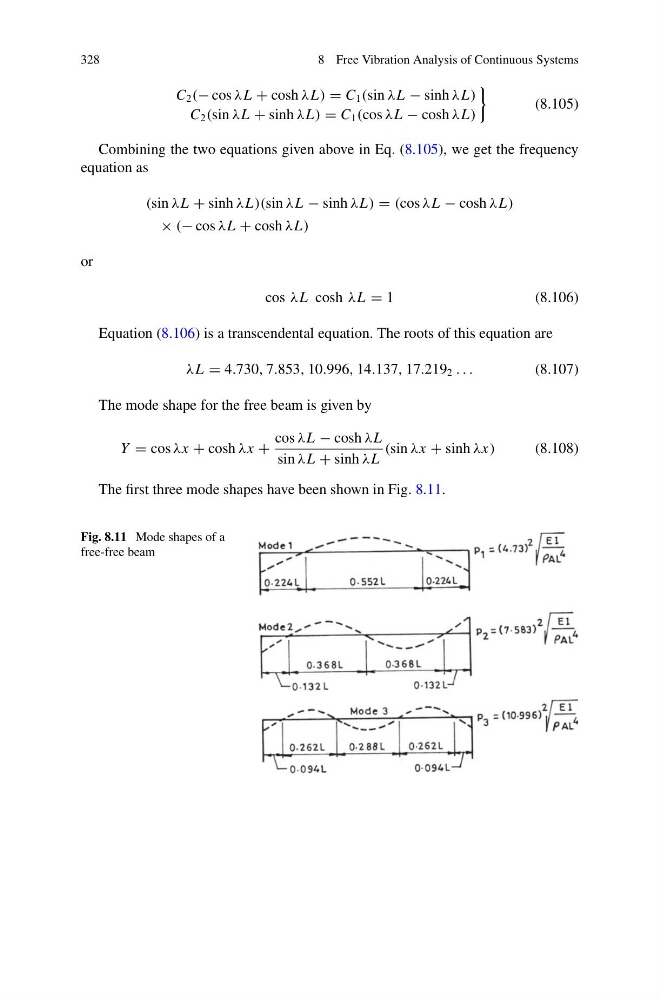
The first three mode shapes have been shown in Fig. 8.11.
Fig. 8.11 Mode shapes of a
free-free beam
8 Free Vibration Analysis of Continuous Systems
C 2 (− cos λL + cosh λL) = C 1 (sin λL − sinh λL)
C 2 (sin λL + sinh λL) = C 1 (cos λL − cosh λL)
(8.105)
Combining the two equations given above in Eq. (8.105), we get the frequency
equation as
(sin λL + sinh λL)(sin λL − sinh λL) = (cos λL − cosh λL)
× (− cos λL + cosh λL)
or
cos λL cosh λL = 1
(8.106)
Equation (8.106) is a transcendental equation. The roots of this equation are
λL = 4.730, 7.853, 10.996, 14.137, 17.219 2 . . .
(8.107)
The mode shape for the free beam is given by
Y = cos λx + cosh λx +
cos λL − cosh λL
sin λL + sinh λL
(sin λx + sinh λx)
(8.108)
The first three mode shapes have been shown in Fig. 8.11.
Fig. 8.11 Mode shapes of a
free-free beam