

324
8 Free Vibration Analysis of Continuous Systems
where Y (x) is a function of x only and represents the mode shape.
Substituting y (x, t) from Eq. (8.81) into Eq. (8.80) for the uniform beam, we
get
E I
d
4 Y
dx 4 − ρ A p
2 Y = 0
(8.82)
or
d
4 Y
dx 4 − λ
4 Y = 0
(8.83)
where
λ
4
=
ρ Ap
2
E I
(8.84)
The general solution of Eq. (8.84) is
Y = C 1 sin λx + C 2 cos λx + C 3 sinh λx + C 4 cosh λx
(8.85)
where C 1 , C 2 , C 3 and C 4 are constants and they depend upon the boundary conditions
for the problem.
8.6 Free Flexural Vibration of the Simply Supported Beam
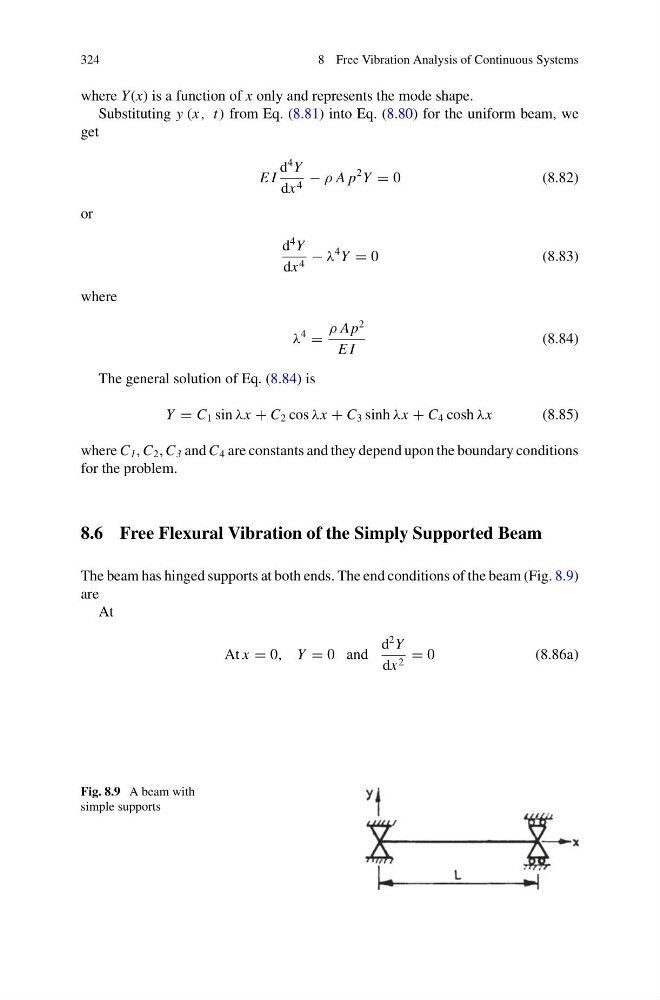
The beam has hinged supports at both ends. The end conditions of the beam (Fig. 8.9)
are
At
At x = 0, Y = 0 and
d
2 Y
dx 2 = 0
(8.86a)
Fig. 8.9 A beam with
simple supports
8 Free Vibration Analysis of Continuous Systems
where Y (x) is a function of x only and represents the mode shape.
Substituting y (x, t) from Eq. (8.81) into Eq. (8.80) for the uniform beam, we
get
E I
d
4 Y
dx 4 − ρ A p
2 Y = 0
(8.82)
or
d
4 Y
dx 4 − λ
4 Y = 0
(8.83)
where
λ
4
=
ρ Ap
2
E I
(8.84)
The general solution of Eq. (8.84) is
Y = C 1 sin λx + C 2 cos λx + C 3 sinh λx + C 4 cosh λx
(8.85)
where C 1 , C 2 , C 3 and C 4 are constants and they depend upon the boundary conditions
for the problem.
8.6 Free Flexural Vibration of the Simply Supported Beam
The beam has hinged supports at both ends. The end conditions of the beam (Fig. 8.9)
are
At
At x = 0, Y = 0 and
d
2 Y
dx 2 = 0
(8.86a)
Fig. 8.9 A beam with
simple supports