

8.5 Free Flexural Vibration of Beams
323
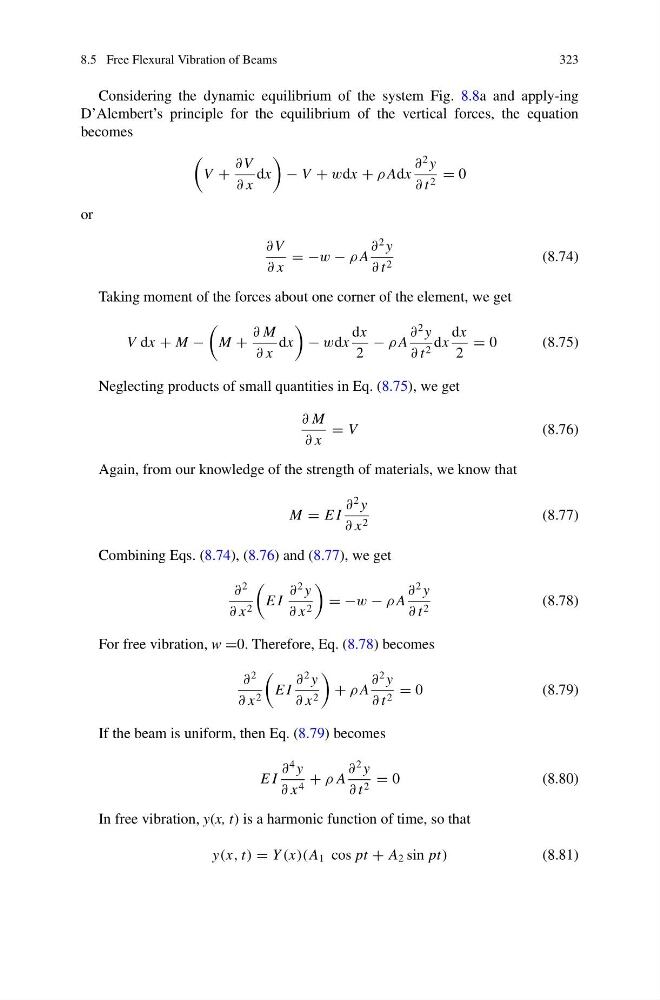
Considering the dynamic equilibrium of the system Fig. 8.8a and apply-ing
D’Alembert’s principle for the equilibrium of the vertical forces, the equation
becomes
V +
∂ V
∂ x
dx
− V + wdx + ρ Adx
∂
2 y
∂ t 2 = 0
or
∂ V
∂ x
= −w − ρ A
∂
2 y
∂ t 2
(8.74)
Taking moment of the forces about one corner of the element, we get
V dx + M −
M +
∂ M
∂ x
dx
− wdx
dx
2
− ρ A
∂
2 y
∂ t 2 dx
dx
2
= 0
(8.75)
Neglecting products of small quantities in Eq. (8.75), we get
∂ M
∂ x
= V
(8.76)
Again, from our knowledge of the strength of materials, we know that
M = E I
∂
2 y
∂ x 2
(8.77)
Combining Eqs. (8.74), (8.76) and (8.77), we get
∂
2
∂ x 2
E I
∂
2 y
∂ x 2
= −w − ρ A
∂
2 y
∂ t 2
(8.78)
For free vibration, w =0. Therefore, Eq. (8.78) becomes
∂
2
∂ x 2
E I
∂
2 y
∂ x 2
+ ρ A
∂
2 y
∂ t 2 = 0
(8.79)
If the beam is uniform, then Eq. (8.79) becomes
E I
∂
4 y
∂ x 4 + ρ A
∂
2 y
∂ t 2 = 0
(8.80)
In free vibration, y(x, t) is a harmonic function of time, so that
y(x, t) = Y (x)(A 1 cos pt + A 2 sin pt)
(8.81)
323
Considering the dynamic equilibrium of the system Fig. 8.8a and apply-ing
D’Alembert’s principle for the equilibrium of the vertical forces, the equation
becomes
V +
∂ V
∂ x
dx
− V + wdx + ρ Adx
∂
2 y
∂ t 2 = 0
or
∂ V
∂ x
= −w − ρ A
∂
2 y
∂ t 2
(8.74)
Taking moment of the forces about one corner of the element, we get
V dx + M −
M +
∂ M
∂ x
dx
− wdx
dx
2
− ρ A
∂
2 y
∂ t 2 dx
dx
2
= 0
(8.75)
Neglecting products of small quantities in Eq. (8.75), we get
∂ M
∂ x
= V
(8.76)
Again, from our knowledge of the strength of materials, we know that
M = E I
∂
2 y
∂ x 2
(8.77)
Combining Eqs. (8.74), (8.76) and (8.77), we get
∂
2
∂ x 2
E I
∂
2 y
∂ x 2
= −w − ρ A
∂
2 y
∂ t 2
(8.78)
For free vibration, w =0. Therefore, Eq. (8.78) becomes
∂
2
∂ x 2
E I
∂
2 y
∂ x 2
+ ρ A
∂
2 y
∂ t 2 = 0
(8.79)
If the beam is uniform, then Eq. (8.79) becomes
E I
∂
4 y
∂ x 4 + ρ A
∂
2 y
∂ t 2 = 0
(8.80)
In free vibration, y(x, t) is a harmonic function of time, so that
y(x, t) = Y (x)(A 1 cos pt + A 2 sin pt)
(8.81)