

7.6 Response of MDF Systems to Support Motion
283
{z} = []{ξ }
(7.44)
Substituting {z} from Eq. (7.44) into Eq. (7.43) and premultiplying both sides by
[]
T , it can be shown as demonstrated in the previous sections that it results in a
series of uncoupled differential equations. For the response due to support motion,
the rth equation will be
¨
ξ r + 2 p r ζ r ˙
ξ r + p
2
r ξ r = −
¯
f yr
¯
m r
(7.45)
where
¯
f yr =
n
j=1
φ
(r )
j m j ¨
x s
(7.46)
and
¯
m r =
n
j=1
m j
φ
(r )
j
2
(7.47)
From Eq. (7.44), the displacement of the ith mass is
z i =
n
r =1
φ
(r )
i ξ r
(7.48)
Solution of Eq. (7.45) is
ξ r = −
t
o
¯
f yr
¯
m r p dr
exp[− p r ζ r (t − τ )] sin p dr (t − τ )dτ
(7.49)
where p dr is the damped natural frequency in the rth mode. Substituting ξ r from
Eq. (7.44), and ¯
f yr and ¯
m r from Eqs. (7.46) and (7.47) respectively, into Eq. (7.48),
we get
z i = −
n
r =1
φ
(r )
i
n
j=1 m j φ
(r )
j
n
j=1 m j
φ
(r )
j
2
1
p dr
t
o
¨
x s (τ )
exp[− p r ζ r (t − τ )] sin p dr (t − τ )dτ
(7.50)
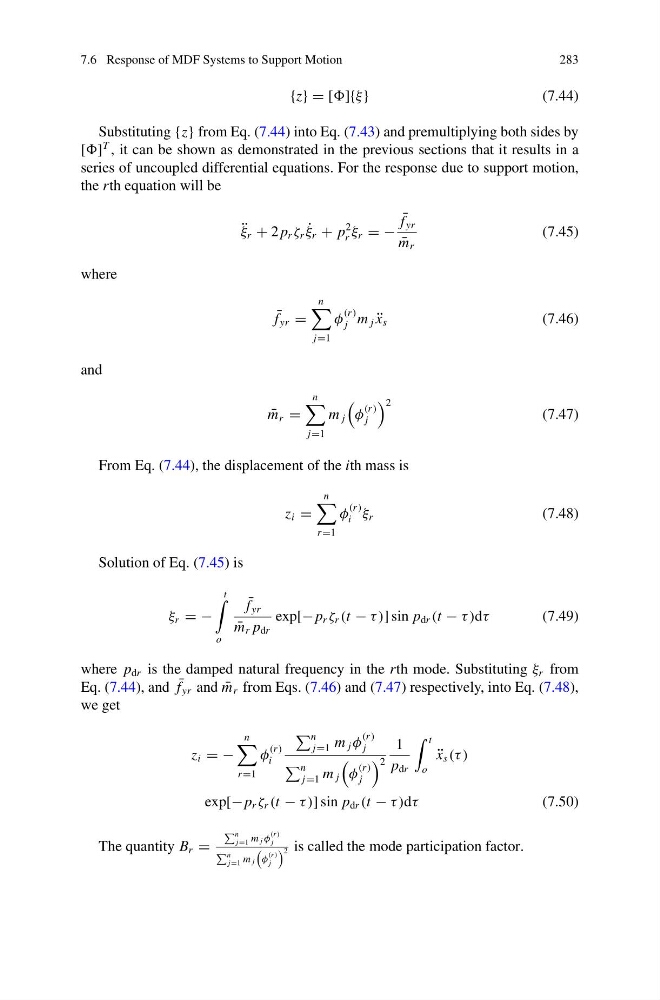
The quantity B r =
n
j=1 m j φ
(r )
j
n
j=1 m j
φ
(r )
j
2 is called the mode participation factor.
283
{z} = []{ξ }
(7.44)
Substituting {z} from Eq. (7.44) into Eq. (7.43) and premultiplying both sides by
[]
T , it can be shown as demonstrated in the previous sections that it results in a
series of uncoupled differential equations. For the response due to support motion,
the rth equation will be
¨
ξ r + 2 p r ζ r ˙
ξ r + p
2
r ξ r = −
¯
f yr
¯
m r
(7.45)
where
¯
f yr =
n
j=1
φ
(r )
j m j ¨
x s
(7.46)
and
¯
m r =
n
j=1
m j
φ
(r )
j
2
(7.47)
From Eq. (7.44), the displacement of the ith mass is
z i =
n
r =1
φ
(r )
i ξ r
(7.48)
Solution of Eq. (7.45) is
ξ r = −
t
o
¯
f yr
¯
m r p dr
exp[− p r ζ r (t − τ )] sin p dr (t − τ )dτ
(7.49)
where p dr is the damped natural frequency in the rth mode. Substituting ξ r from
Eq. (7.44), and ¯
f yr and ¯
m r from Eqs. (7.46) and (7.47) respectively, into Eq. (7.48),
we get
z i = −
n
r =1
φ
(r )
i
n
j=1 m j φ
(r )
j
n
j=1 m j
φ
(r )
j
2
1
p dr
t
o
¨
x s (τ )
exp[− p r ζ r (t − τ )] sin p dr (t − τ )dτ
(7.50)
The quantity B r =
n
j=1 m j φ
(r )
j
n
j=1 m j
φ
(r )
j
2 is called the mode participation factor.