

282
7 Forced Vibration Analysis of Multiple Degrees of Freedom System
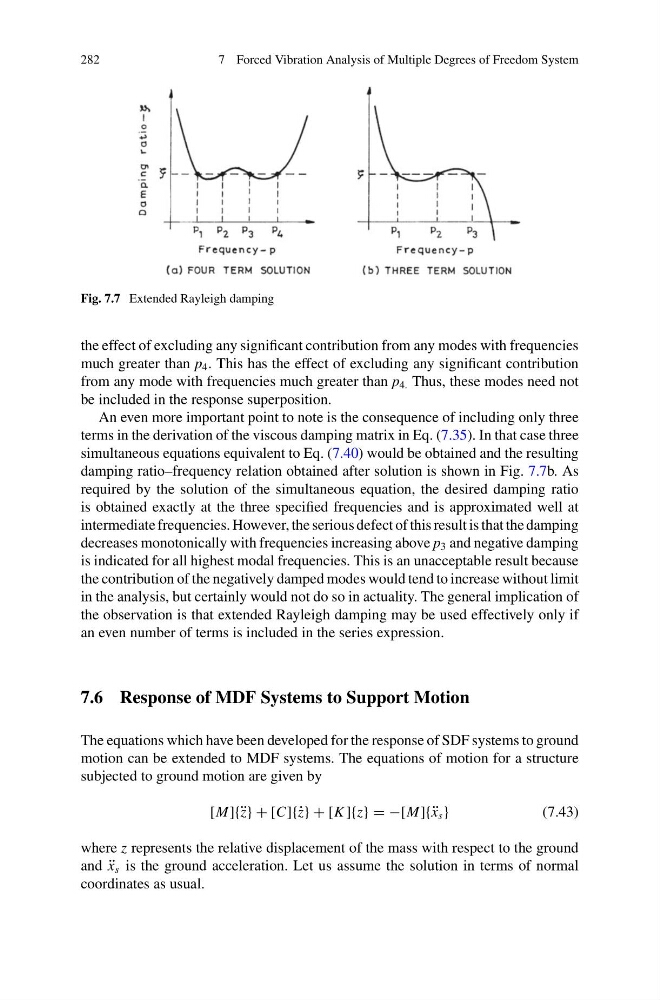
Fig. 7.7 Extended Rayleigh damping
the effect of excluding any significant contribution from any modes with frequencies
much greater than p 4 . This has the effect of excluding any significant contribution
from any mode with frequencies much greater than p 4. Thus, these modes need not
be included in the response superposition.
An even more important point to note is the consequence of including only three
terms in the derivation of the viscous damping matrix in Eq. (7.35). In that case three
simultaneous equations equivalent to Eq. (7.40) would be obtained and the resulting
damping ratio–frequency relation obtained after solution is shown in Fig. 7.7b. As
required by the solution of the simultaneous equation, the desired damping ratio
is obtained exactly at the three specified frequencies and is approximated well at
intermediate frequencies. However, the serious defect of this result is that the damping
decreases monotonically with frequencies increasing above p 3 and negative damping
is indicated for all highest modal frequencies. This is an unacceptable result because
the contribution of the negatively damped modes would tend to increase without limit
in the analysis, but certainly would not do so in actuality. The general implication of
the observation is that extended Rayleigh damping may be used effectively only if
an even number of terms is included in the series expression.
7.6 Response of MDF Systems to Support Motion
The equations which have been developed for the response of SDF systems to ground
motion can be extended to MDF systems. The equations of motion for a structure
subjected to ground motion are given by
[M]{¨ z} + [C]{˙ z} + [K ]{z} = −[M]{ ¨
x s }
(7.43)
where z represents the relative displacement of the mass with respect to the ground
and ¨
x s is the ground acceleration. Let us assume the solution in terms of normal
coordinates as usual.
7 Forced Vibration Analysis of Multiple Degrees of Freedom System
Fig. 7.7 Extended Rayleigh damping
the effect of excluding any significant contribution from any modes with frequencies
much greater than p 4 . This has the effect of excluding any significant contribution
from any mode with frequencies much greater than p 4. Thus, these modes need not
be included in the response superposition.
An even more important point to note is the consequence of including only three
terms in the derivation of the viscous damping matrix in Eq. (7.35). In that case three
simultaneous equations equivalent to Eq. (7.40) would be obtained and the resulting
damping ratio–frequency relation obtained after solution is shown in Fig. 7.7b. As
required by the solution of the simultaneous equation, the desired damping ratio
is obtained exactly at the three specified frequencies and is approximated well at
intermediate frequencies. However, the serious defect of this result is that the damping
decreases monotonically with frequencies increasing above p 3 and negative damping
is indicated for all highest modal frequencies. This is an unacceptable result because
the contribution of the negatively damped modes would tend to increase without limit
in the analysis, but certainly would not do so in actuality. The general implication of
the observation is that extended Rayleigh damping may be used effectively only if
an even number of terms is included in the series expression.
7.6 Response of MDF Systems to Support Motion
The equations which have been developed for the response of SDF systems to ground
motion can be extended to MDF systems. The equations of motion for a structure
subjected to ground motion are given by
[M]{¨ z} + [C]{˙ z} + [K ]{z} = −[M]{ ¨
x s }
(7.43)
where z represents the relative displacement of the mass with respect to the ground
and ¨
x s is the ground acceleration. Let us assume the solution in terms of normal
coordinates as usual.