

280
7 Forced Vibration Analysis of Multiple Degrees of Freedom System
[C] = 3.474
⎡
⎣
1 0 0
0 1 0
0 0 1
⎤
⎦ × 20,000 + 4.74 × 10
−4
× 8 × 10
7
×
⎡
⎣
2 −2 0
−2 4 −2
0 −2 5
⎤
⎦
=
⎡
⎣
145,320 −75,840
0
−75,840 221,160 −75,840
0
−75,840 259,080
⎤
⎦ Ns/m
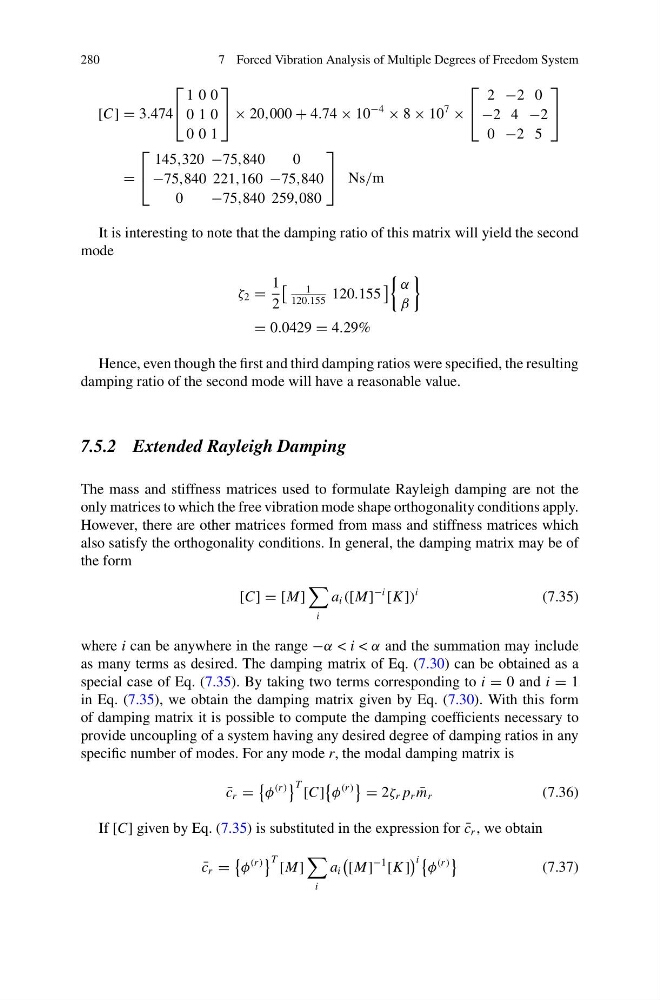
It is interesting to note that the damping ratio of this matrix will yield the second
mode
ζ 2 =
1
2
1
120.155
120.155
α
β
= 0.0429 = 4.29%
Hence, even though the first and third damping ratios were specified, the resulting
damping ratio of the second mode will have a reasonable value.
7.5.2 Extended Rayleigh Damping
The mass and stiffness matrices used to formulate Rayleigh damping are not the
only matrices to which the free vibration mode shape orthogonality conditions apply.
However, there are other matrices formed from mass and stiffness matrices which
also satisfy the orthogonality conditions. In general, the damping matrix may be of
the form
[C] = [M]
i
a i ([M]
−i
[K ])
i
(7.35)
where i can be anywhere in the range −α < i < α and the summation may include
as many terms as desired. The damping matrix of Eq. (7.30) can be obtained as a
special case of Eq. (7.35). By taking two terms corresponding to i = 0 and i = 1
in Eq. (7.35), we obtain the damping matrix given by Eq. (7.30). With this form
of damping matrix it is possible to compute the damping coefficients necessary to
provide uncoupling of a system having any desired degree of damping ratios in any
specific number of modes. For any mode r, the modal damping matrix is
¯
c r =
φ
(r )
T [C]
φ
(r )
= 2ζ r p r ¯
m r
(7.36)
If [C] given by Eq. (7.35) is substituted in the expression for ¯
c r , we obtain
¯
c r =
φ
(r )
T [M]
i
a i
[M]
−1 [K ]
i φ
(r )
(7.37)
7 Forced Vibration Analysis of Multiple Degrees of Freedom System
[C] = 3.474
⎡
⎣
1 0 0
0 1 0
0 0 1
⎤
⎦ × 20,000 + 4.74 × 10
−4
× 8 × 10
7
×
⎡
⎣
2 −2 0
−2 4 −2
0 −2 5
⎤
⎦
=
⎡
⎣
145,320 −75,840
0
−75,840 221,160 −75,840
0
−75,840 259,080
⎤
⎦ Ns/m
It is interesting to note that the damping ratio of this matrix will yield the second
mode
ζ 2 =
1
2
1
120.155
120.155
α
β
= 0.0429 = 4.29%
Hence, even though the first and third damping ratios were specified, the resulting
damping ratio of the second mode will have a reasonable value.
7.5.2 Extended Rayleigh Damping
The mass and stiffness matrices used to formulate Rayleigh damping are not the
only matrices to which the free vibration mode shape orthogonality conditions apply.
However, there are other matrices formed from mass and stiffness matrices which
also satisfy the orthogonality conditions. In general, the damping matrix may be of
the form
[C] = [M]
i
a i ([M]
−i
[K ])
i
(7.35)
where i can be anywhere in the range −α < i < α and the summation may include
as many terms as desired. The damping matrix of Eq. (7.30) can be obtained as a
special case of Eq. (7.35). By taking two terms corresponding to i = 0 and i = 1
in Eq. (7.35), we obtain the damping matrix given by Eq. (7.30). With this form
of damping matrix it is possible to compute the damping coefficients necessary to
provide uncoupling of a system having any desired degree of damping ratios in any
specific number of modes. For any mode r, the modal damping matrix is
¯
c r =
φ
(r )
T [C]
φ
(r )
= 2ζ r p r ¯
m r
(7.36)
If [C] given by Eq. (7.35) is substituted in the expression for ¯
c r , we obtain
¯
c r =
φ
(r )
T [M]
i
a i
[M]
−1 [K ]
i φ
(r )
(7.37)