

272
7 Forced Vibration Analysis of Multiple Degrees of Freedom System
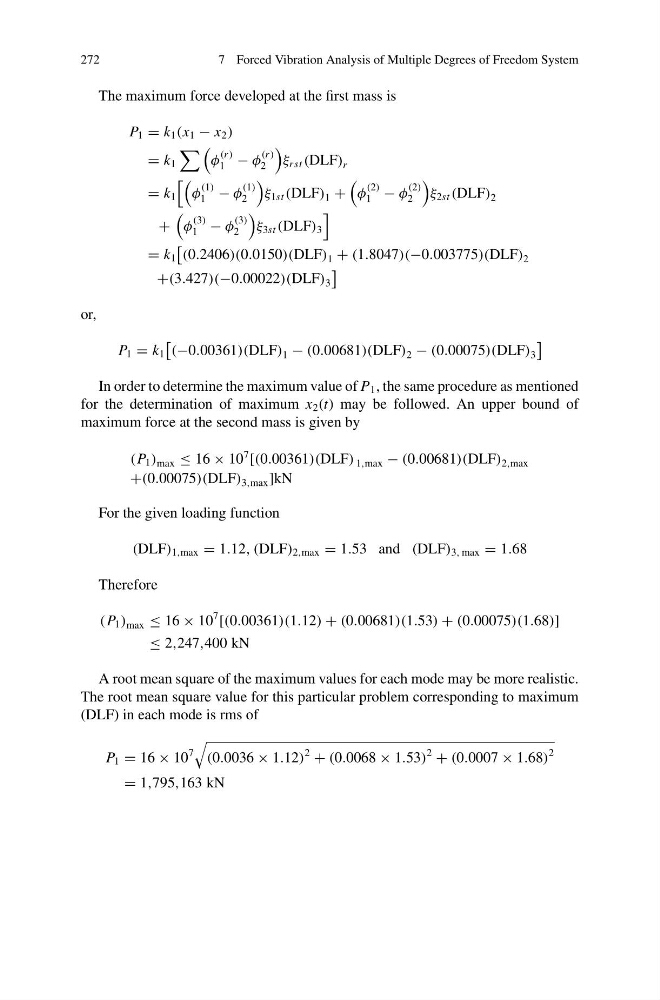
The maximum force developed at the first mass is
P 1 = k 1 (x 1 − x 2 )
= k 1
φ
(r )
1 − φ
(r )
2
ξ rst (DLF) r
= k 1
φ
(1)
1 − φ
(1)
2
ξ 1st (DLF) 1 +
φ
(2)
1 − φ
(2)
2
ξ 2st (DLF) 2
+
φ
(3)
1 − φ
(3)
2
ξ 3st (DLF) 3
= k 1
(0.2406)(0.0150)(DLF) 1 + (1.8047)(−0.003775)(DLF) 2
+(3.427)(−0.00022)(DLF) 3
or,
P 1 = k 1
(−0.00361)(DLF) 1 − (0.00681)(DLF) 2 − (0.00075)(DLF) 3
In order to determine the maximum value of P 1 , the same procedure as mentioned
for the determination of maximum x 2 (t) may be followed. An upper bound of
maximum force at the second mass is given by
(P 1 ) max ≤ 16 × 10
7 [(0.00361)(DLF) 1,max − (0.00681)(DLF) 2,max
+(0.00075)(DLF) 3,max ]kN
For the given loading function
(DLF) 1,max = 1.12, (DLF) 2,max = 1.53 and (DLF) 3, max = 1.68
Therefore
(P 1 ) max ≤ 16 × 10
7 [(0.00361)(1.12) + (0.00681)(1.53) + (0.00075)(1.68)]
≤ 2,247,400 kN
A root mean square of the maximum values for each mode may be more realistic.
The root mean square value for this particular problem corresponding to maximum
(DLF) in each mode is rms of
P 1 = 16 × 10
7
(0.0036 × 1.12)
2
+ (0.0068 × 1.53)
2
+ (0.0007 × 1.68)
2
= 1,795,163 kN
7 Forced Vibration Analysis of Multiple Degrees of Freedom System
The maximum force developed at the first mass is
P 1 = k 1 (x 1 − x 2 )
= k 1
φ
(r )
1 − φ
(r )
2
ξ rst (DLF) r
= k 1
φ
(1)
1 − φ
(1)
2
ξ 1st (DLF) 1 +
φ
(2)
1 − φ
(2)
2
ξ 2st (DLF) 2
+
φ
(3)
1 − φ
(3)
2
ξ 3st (DLF) 3
= k 1
(0.2406)(0.0150)(DLF) 1 + (1.8047)(−0.003775)(DLF) 2
+(3.427)(−0.00022)(DLF) 3
or,
P 1 = k 1
(−0.00361)(DLF) 1 − (0.00681)(DLF) 2 − (0.00075)(DLF) 3
In order to determine the maximum value of P 1 , the same procedure as mentioned
for the determination of maximum x 2 (t) may be followed. An upper bound of
maximum force at the second mass is given by
(P 1 ) max ≤ 16 × 10
7 [(0.00361)(DLF) 1,max − (0.00681)(DLF) 2,max
+(0.00075)(DLF) 3,max ]kN
For the given loading function
(DLF) 1,max = 1.12, (DLF) 2,max = 1.53 and (DLF) 3, max = 1.68
Therefore
(P 1 ) max ≤ 16 × 10
7 [(0.00361)(1.12) + (0.00681)(1.53) + (0.00075)(1.68)]
≤ 2,247,400 kN
A root mean square of the maximum values for each mode may be more realistic.
The root mean square value for this particular problem corresponding to maximum
(DLF) in each mode is rms of
P 1 = 16 × 10
7
(0.0036 × 1.12)
2
+ (0.0068 × 1.53)
2
+ (0.0007 × 1.68)
2
= 1,795,163 kN