

270
7 Forced Vibration Analysis of Multiple Degrees of Freedom System
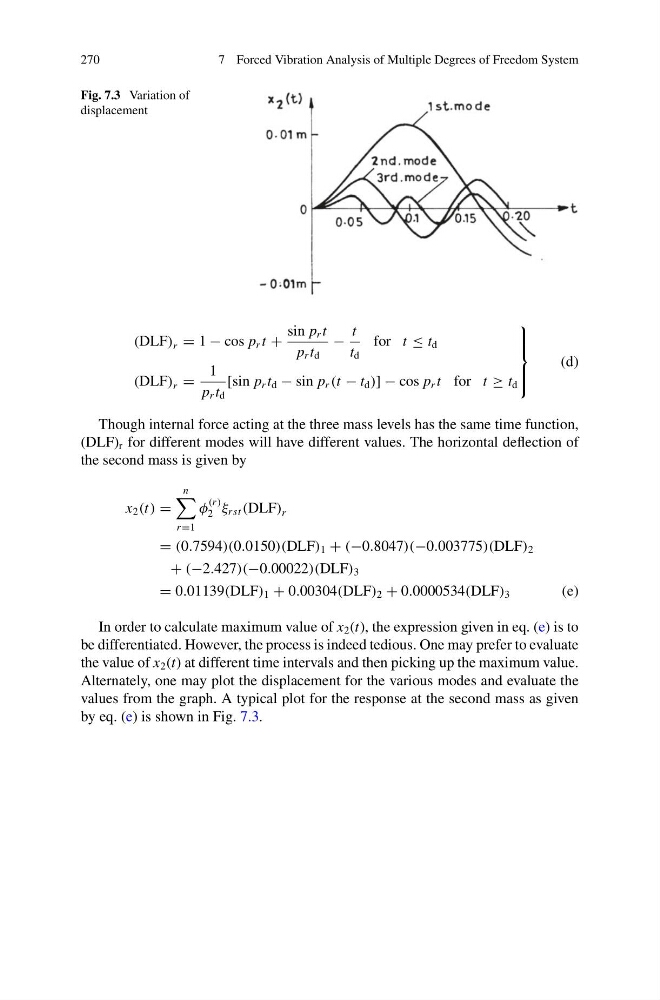
Fig. 7.3 Variation of
displacement
(DLF) r = 1 − cos p r t +
sin p r t
p r t d
−
t
t d
for t ≤ t d
(DLF) r =
1
p r t d
[sin p r t d − sin p r (t − t d )] − cos p r t for t ≥ t d
⎫
⎪ ⎪ ⎬
⎪ ⎪ ⎭
(d)
Though internal force acting at the three mass levels has the same time function,
(DLF) r for different modes will have different values. The horizontal deflection of
the second mass is given by
x 2 (t) =
n
r =1
φ
(r )
2 ξ rst (DLF) r
= (0.7594)(0.0150)(DLF) 1 + (−0.8047)(−0.003775)(DLF) 2
+ (−2.427)(−0.00022)(DLF) 3
= 0.01139(DLF) 1 + 0.00304(DLF) 2 + 0.0000534(DLF) 3
(e)
In order to calculate maximum value of x 2 (t), the expression given in eq. (e) is to
be differentiated. However, the process is indeed tedious. One may prefer to evaluate
the value of x 2 (t) at different time intervals and then picking up the maximum value.
Alternately, one may plot the displacement for the various modes and evaluate the
values from the graph. A typical plot for the response at the second mass as given
by eq. (e) is shown in Fig. 7.3.
7 Forced Vibration Analysis of Multiple Degrees of Freedom System
Fig. 7.3 Variation of
displacement
(DLF) r = 1 − cos p r t +
sin p r t
p r t d
−
t
t d
for t ≤ t d
(DLF) r =
1
p r t d
[sin p r t d − sin p r (t − t d )] − cos p r t for t ≥ t d
⎫
⎪ ⎪ ⎬
⎪ ⎪ ⎭
(d)
Though internal force acting at the three mass levels has the same time function,
(DLF) r for different modes will have different values. The horizontal deflection of
the second mass is given by
x 2 (t) =
n
r =1
φ
(r )
2 ξ rst (DLF) r
= (0.7594)(0.0150)(DLF) 1 + (−0.8047)(−0.003775)(DLF) 2
+ (−2.427)(−0.00022)(DLF) 3
= 0.01139(DLF) 1 + 0.00304(DLF) 2 + 0.0000534(DLF) 3
(e)
In order to calculate maximum value of x 2 (t), the expression given in eq. (e) is to
be differentiated. However, the process is indeed tedious. One may prefer to evaluate
the value of x 2 (t) at different time intervals and then picking up the maximum value.
Alternately, one may plot the displacement for the various modes and evaluate the
values from the graph. A typical plot for the response at the second mass as given
by eq. (e) is shown in Fig. 7.3.