

256
6 Free Vibration of Multiple Degrees of Freedom System
[] =
√
m
⎡
⎣
0.269 0.878 0.395
0.501 − 0.223 − 0.836
0.582 0.299 0.269
⎤
⎦
Show that when used as a transformation matrix, [] diagonalises [M] and
[K] simultaneously.
6.14 Estimate the fundamental frequency by means of Rayleigh’s quotient using
the data of Prob. 6.13
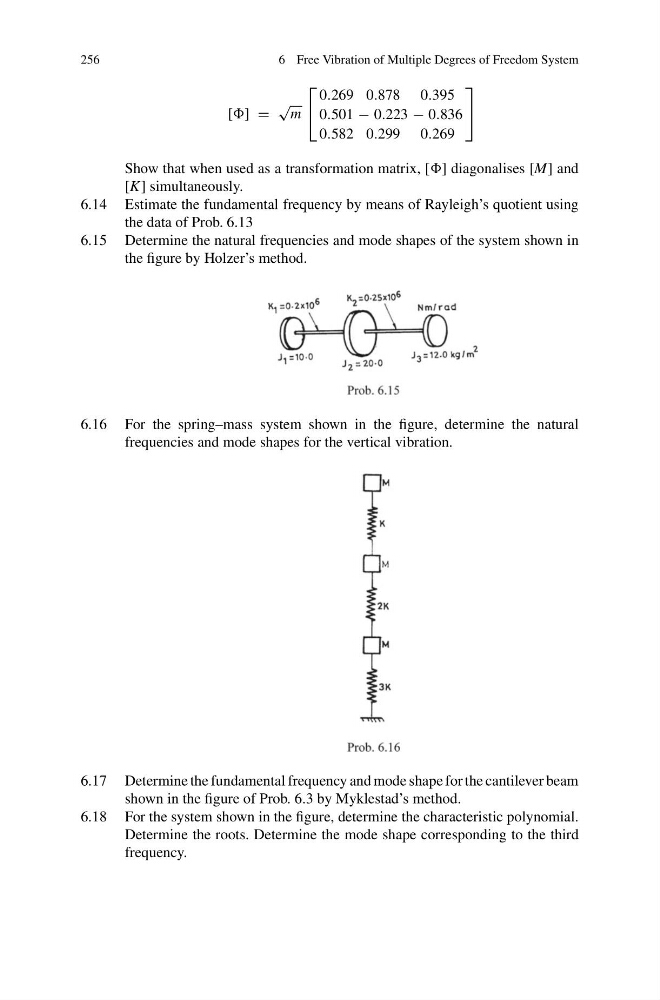
6.15 Determine the natural frequencies and mode shapes of the system shown in
the figure by Holzer’s method.
6.16 For the spring–mass system shown in the figure, determine the natural
frequencies and mode shapes for the vertical vibration.
6.17 Determine the fundamental frequency and mode shape for the cantilever beam
shown in the figure of Prob. 6.3 by Myklestad’s method.
6.18 For the system shown in the figure, determine the characteristic polynomial.
Determine the roots. Determine the mode shape corresponding to the third
frequency.
6 Free Vibration of Multiple Degrees of Freedom System
[] =
√
m
⎡
⎣
0.269 0.878 0.395
0.501 − 0.223 − 0.836
0.582 0.299 0.269
⎤
⎦
Show that when used as a transformation matrix, [] diagonalises [M] and
[K] simultaneously.
6.14 Estimate the fundamental frequency by means of Rayleigh’s quotient using
the data of Prob. 6.13
6.15 Determine the natural frequencies and mode shapes of the system shown in
the figure by Holzer’s method.
6.16 For the spring–mass system shown in the figure, determine the natural
frequencies and mode shapes for the vertical vibration.
6.17 Determine the fundamental frequency and mode shape for the cantilever beam
shown in the figure of Prob. 6.3 by Myklestad’s method.
6.18 For the system shown in the figure, determine the characteristic polynomial.
Determine the roots. Determine the mode shape corresponding to the third
frequency.