

252
6 Free Vibration of Multiple Degrees of Freedom System
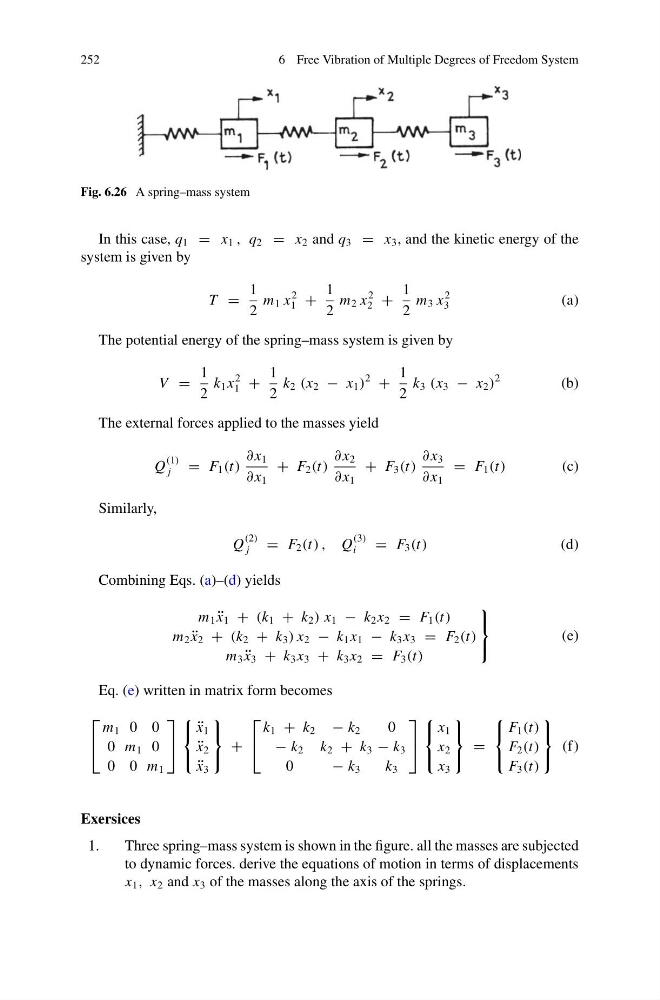
Fig. 6.26 A spring–mass system
In this case, q 1 = x 1 , q 2 = x 2 and q 3 = x 3 , and the kinetic energy of the
system is given by
T =
1
2
m 1 x
2
1 +
1
2
m 2 x
2
2 +
1
2
m 3 x
2
3
(a)
The potential energy of the spring–mass system is given by
V =
1
2
k 1 x
2
1 +
1
2
k 2 (x 2 − x 1 )
2
+
1
2
k 3 (x 3 − x 2 )
2
(b)
The external forces applied to the masses yield
Q
(1)
j
= F 1 (t)
∂ x 1
∂ x 1
+ F 2 (t)
∂ x 2
∂ x 1
+ F 3 (t)
∂ x 3
∂ x 1
= F 1 (t)
(c)
Similarly,
Q
(2)
j
= F 2 (t) , Q
(3)
i
= F 3 (t)
(d)
Combining Eqs. (a)–(d) yields
m 1 ¨
x 1 + (k 1 + k 2 ) x 1 − k 2 x 2 = F 1 (t)
m 2 ¨
x 2 + (k 2 + k 3 ) x 2 − k 1 x 1 − k 3 x 3 = F 2 (t)
m 3 ¨
x 3 + k 3 x 3 + k 3 x 2 = F 3 (t)
⎫
⎬
⎭
(e)
Eq. (e) written in matrix form becomes
⎡
⎣
m 1 0 0
0 m 1 0
0 0 m 1
⎤
⎦
⎧
⎨
⎩
¨
x 1
¨
x 2
¨
x 3
⎫
⎬
⎭
+
⎡
⎣
k 1 + k 2 − k 2
0
− k 2 k 2 + k 3 − k 3
0
− k 3
k 3
⎤
⎦
⎧
⎨
⎩
x 1
x 2
x 3
⎫
⎬
⎭
=
⎧
⎨
⎩
F 1 (t)
F 2 (t)
F 3 (t)
⎫
⎬
⎭
(f)
Exersices
1.
Three spring–mass system is shown in the figure. all the masses are subjected
to dynamic forces. derive the equations of motion in terms of displacements
x 1 , x 2 and x 3 of the masses along the axis of the springs.
6 Free Vibration of Multiple Degrees of Freedom System
Fig. 6.26 A spring–mass system
In this case, q 1 = x 1 , q 2 = x 2 and q 3 = x 3 , and the kinetic energy of the
system is given by
T =
1
2
m 1 x
2
1 +
1
2
m 2 x
2
2 +
1
2
m 3 x
2
3
(a)
The potential energy of the spring–mass system is given by
V =
1
2
k 1 x
2
1 +
1
2
k 2 (x 2 − x 1 )
2
+
1
2
k 3 (x 3 − x 2 )
2
(b)
The external forces applied to the masses yield
Q
(1)
j
= F 1 (t)
∂ x 1
∂ x 1
+ F 2 (t)
∂ x 2
∂ x 1
+ F 3 (t)
∂ x 3
∂ x 1
= F 1 (t)
(c)
Similarly,
Q
(2)
j
= F 2 (t) , Q
(3)
i
= F 3 (t)
(d)
Combining Eqs. (a)–(d) yields
m 1 ¨
x 1 + (k 1 + k 2 ) x 1 − k 2 x 2 = F 1 (t)
m 2 ¨
x 2 + (k 2 + k 3 ) x 2 − k 1 x 1 − k 3 x 3 = F 2 (t)
m 3 ¨
x 3 + k 3 x 3 + k 3 x 2 = F 3 (t)
⎫
⎬
⎭
(e)
Eq. (e) written in matrix form becomes
⎡
⎣
m 1 0 0
0 m 1 0
0 0 m 1
⎤
⎦
⎧
⎨
⎩
¨
x 1
¨
x 2
¨
x 3
⎫
⎬
⎭
+
⎡
⎣
k 1 + k 2 − k 2
0
− k 2 k 2 + k 3 − k 3
0
− k 3
k 3
⎤
⎦
⎧
⎨
⎩
x 1
x 2
x 3
⎫
⎬
⎭
=
⎧
⎨
⎩
F 1 (t)
F 2 (t)
F 3 (t)
⎫
⎬
⎭
(f)
Exersices
1.
Three spring–mass system is shown in the figure. all the masses are subjected
to dynamic forces. derive the equations of motion in terms of displacements
x 1 , x 2 and x 3 of the masses along the axis of the springs.