

244
6 Free Vibration of Multiple Degrees of Freedom System
6.21 Component Mode Synthesis Method
In this section, another technique for reducing a number of degrees of freedom is
introduced. The method is known as component mode synthesis method, substructure
analysis or building block approach. These methods are very suitable for solving
very large structural dynamics problems. This will prove to be useful for structures
having natural components, for example, building with a surrounding soil and the
Space Shuttle orbiter with its payloads.
Like the substructure method of static analysis, instead of catering large number
of equations at one time, a set of smaller size problems are to be encountered in this
method. A complete structure is divided into a number of substructures (component),
each of which is idealised as a finite element model. Total number of degrees of
freedom in each substructure is reduced by modal substitution. All the components
are then assembled together, and the complete structure is analysed. In the following,
two types of component mode synthesis methods will be discussed. They are the fixed
interface method and the free interface method.
6.21.1 Fixed Interface Method
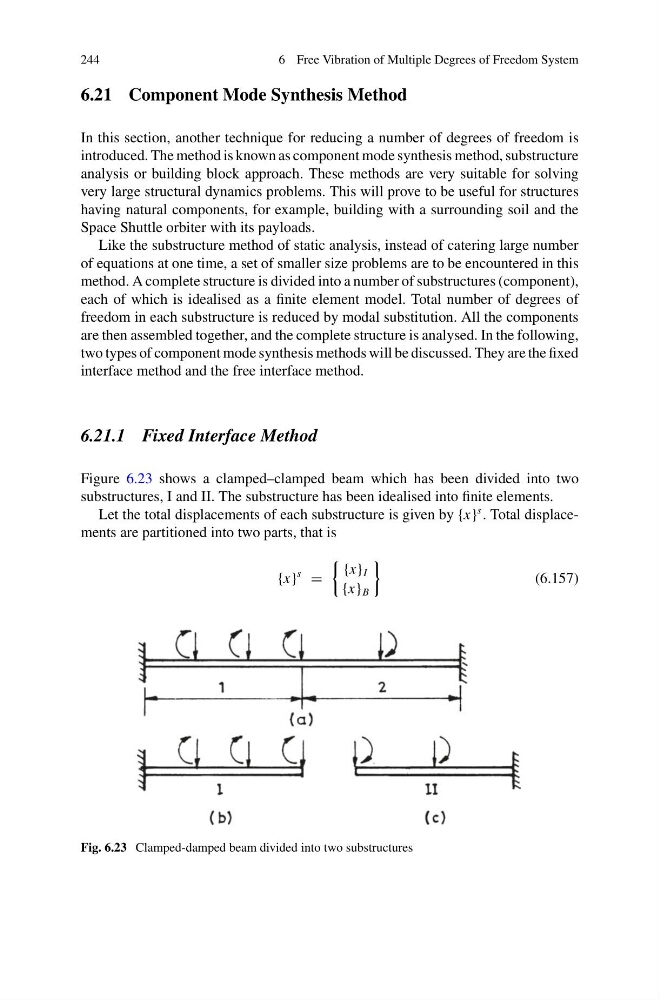
Figure 6.23 shows a clamped–clamped beam which has been divided into two
substructures, I and II. The substructure has been idealised into finite elements.
Let the total displacements of each substructure is given by {x}
s . Total displacements are partitioned into two parts, that is
{x}
s
=
{x} I
{x} B
(6.157)
Fig. 6.23 Clamped-damped beam divided into two substructures
6 Free Vibration of Multiple Degrees of Freedom System
6.21 Component Mode Synthesis Method
In this section, another technique for reducing a number of degrees of freedom is
introduced. The method is known as component mode synthesis method, substructure
analysis or building block approach. These methods are very suitable for solving
very large structural dynamics problems. This will prove to be useful for structures
having natural components, for example, building with a surrounding soil and the
Space Shuttle orbiter with its payloads.
Like the substructure method of static analysis, instead of catering large number
of equations at one time, a set of smaller size problems are to be encountered in this
method. A complete structure is divided into a number of substructures (component),
each of which is idealised as a finite element model. Total number of degrees of
freedom in each substructure is reduced by modal substitution. All the components
are then assembled together, and the complete structure is analysed. In the following,
two types of component mode synthesis methods will be discussed. They are the fixed
interface method and the free interface method.
6.21.1 Fixed Interface Method
Figure 6.23 shows a clamped–clamped beam which has been divided into two
substructures, I and II. The substructure has been idealised into finite elements.
Let the total displacements of each substructure is given by {x}
s . Total displacements are partitioned into two parts, that is
{x}
s
=
{x} I
{x} B
(6.157)
Fig. 6.23 Clamped-damped beam divided into two substructures