

6.17 Simultaneous Iteration Method and Algorithm
235
2. Back substitute [L] [X ] = [U ],
3. Multiply [Y ] = [M] [X ],
4. Forward substitute [L]
T
[V ] = [Y ],
5. Form [B] = [U ]
T
[V ],
6. Construct [T ] so that t ¨
u = 1 and t i j = − 2b i j / [b ii − b i j + S (b ii − b i j )
2
],
Where S = sign of (b ii − b i j ),
7. Multiply [W ] = [U ] [T ],
8. Perform Schmidt orthonormalisation to derive [U ],
9. Check tolerance [U ] − [U ],
10. If not satisfactory, go to step 2.
6.18 Geared Systems
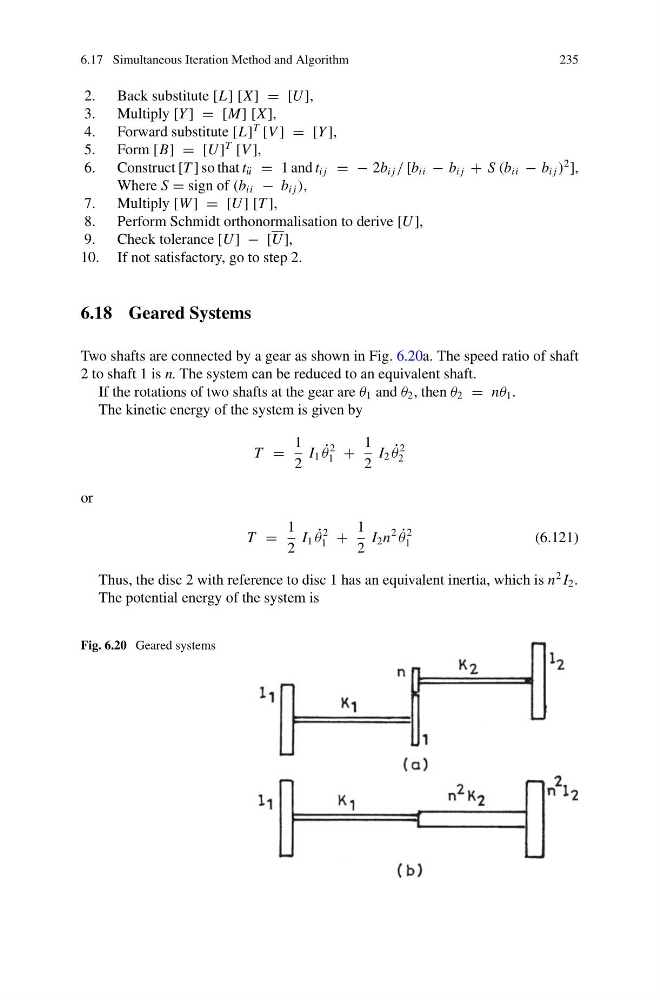
Two shafts are connected by a gear as shown in Fig. 6.20a. The speed ratio of shaft
2 to shaft 1 is n. The system can be reduced to an equivalent shaft.
If the rotations of two shafts at the gear are θ 1 and θ 2 , then θ 2 = nθ 1 .
The kinetic energy of the system is given by
T =
1
2
I 1 ˙
θ
2
1 +
1
2
I 2 ˙
θ
2
2
or
T =
1
2
I 1 ˙
θ
2
1 +
1
2
I 2 n
2 ˙
θ
2
1
(6.121)
Thus, the disc 2 with reference to disc 1 has an equivalent inertia, which is n
2 I 2 .
The potential energy of the system is
Fig. 6.20 Geared systems
235
2. Back substitute [L] [X ] = [U ],
3. Multiply [Y ] = [M] [X ],
4. Forward substitute [L]
T
[V ] = [Y ],
5. Form [B] = [U ]
T
[V ],
6. Construct [T ] so that t ¨
u = 1 and t i j = − 2b i j / [b ii − b i j + S (b ii − b i j )
2
],
Where S = sign of (b ii − b i j ),
7. Multiply [W ] = [U ] [T ],
8. Perform Schmidt orthonormalisation to derive [U ],
9. Check tolerance [U ] − [U ],
10. If not satisfactory, go to step 2.
6.18 Geared Systems
Two shafts are connected by a gear as shown in Fig. 6.20a. The speed ratio of shaft
2 to shaft 1 is n. The system can be reduced to an equivalent shaft.
If the rotations of two shafts at the gear are θ 1 and θ 2 , then θ 2 = nθ 1 .
The kinetic energy of the system is given by
T =
1
2
I 1 ˙
θ
2
1 +
1
2
I 2 ˙
θ
2
2
or
T =
1
2
I 1 ˙
θ
2
1 +
1
2
I 2 n
2 ˙
θ
2
1
(6.121)
Thus, the disc 2 with reference to disc 1 has an equivalent inertia, which is n
2 I 2 .
The potential energy of the system is
Fig. 6.20 Geared systems