

6.15 Rayleigh–Ritz Method
233
k
0.88 − 0.4
− 0.4 11.12
− p
2 m
1.80 − 0.12
− 0.12 3.08
ξ 1
ξ 2
=
0
0
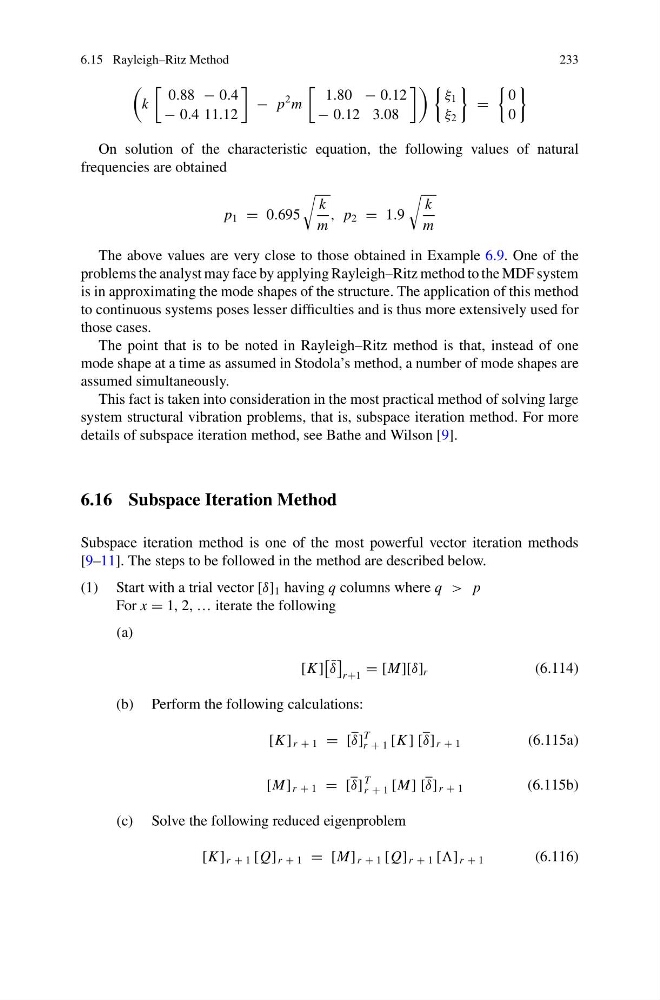
On solution of the characteristic equation, the following values of natural
frequencies are obtained
p 1 = 0.695
k
m
, p 2 = 1.9
k
m
The above values are very close to those obtained in Example 6.9. One of the
problems the analyst may face by applying Rayleigh–Ritz method to the MDF system
is in approximating the mode shapes of the structure. The application of this method
to continuous systems poses lesser difficulties and is thus more extensively used for
those cases.
The point that is to be noted in Rayleigh–Ritz method is that, instead of one
mode shape at a time as assumed in Stodola’s method, a number of mode shapes are
assumed simultaneously.
This fact is taken into consideration in the most practical method of solving large
system structural vibration problems, that is, subspace iteration method. For more
details of subspace iteration method, see Bathe and Wilson [9].
6.16 Subspace Iteration Method
Subspace iteration method is one of the most powerful vector iteration methods
[9–11]. The steps to be followed in the method are described below.
(1) Start with a trial vector [δ] 1 having q columns where q > p
For x = 1, 2, … iterate the following
(a)
[K ]
¯
δ
r +1
= [M][δ] r
(6.114)
(b) Perform the following calculations:
[K ] r + 1 = [δ]
T
r + 1 [K ] [δ] r + 1
(6.115a)
[M] r + 1 = [δ]
T
r + 1 [M] [δ] r + 1
(6.115b)
(c) Solve the following reduced eigenproblem
[K ] r + 1 [Q] r + 1 = [M] r + 1 [Q] r + 1 [] r + 1
(6.116)
233
k
0.88 − 0.4
− 0.4 11.12
− p
2 m
1.80 − 0.12
− 0.12 3.08
ξ 1
ξ 2
=
0
0
On solution of the characteristic equation, the following values of natural
frequencies are obtained
p 1 = 0.695
k
m
, p 2 = 1.9
k
m
The above values are very close to those obtained in Example 6.9. One of the
problems the analyst may face by applying Rayleigh–Ritz method to the MDF system
is in approximating the mode shapes of the structure. The application of this method
to continuous systems poses lesser difficulties and is thus more extensively used for
those cases.
The point that is to be noted in Rayleigh–Ritz method is that, instead of one
mode shape at a time as assumed in Stodola’s method, a number of mode shapes are
assumed simultaneously.
This fact is taken into consideration in the most practical method of solving large
system structural vibration problems, that is, subspace iteration method. For more
details of subspace iteration method, see Bathe and Wilson [9].
6.16 Subspace Iteration Method
Subspace iteration method is one of the most powerful vector iteration methods
[9–11]. The steps to be followed in the method are described below.
(1) Start with a trial vector [δ] 1 having q columns where q > p
For x = 1, 2, … iterate the following
(a)
[K ]
¯
δ
r +1
= [M][δ] r
(6.114)
(b) Perform the following calculations:
[K ] r + 1 = [δ]
T
r + 1 [K ] [δ] r + 1
(6.115a)
[M] r + 1 = [δ]
T
r + 1 [M] [δ] r + 1
(6.115b)
(c) Solve the following reduced eigenproblem
[K ] r + 1 [Q] r + 1 = [M] r + 1 [Q] r + 1 [] r + 1
(6.116)