

196
6 Free Vibration of Multiple Degrees of Freedom System
6.6.1 Normalisation of Modes
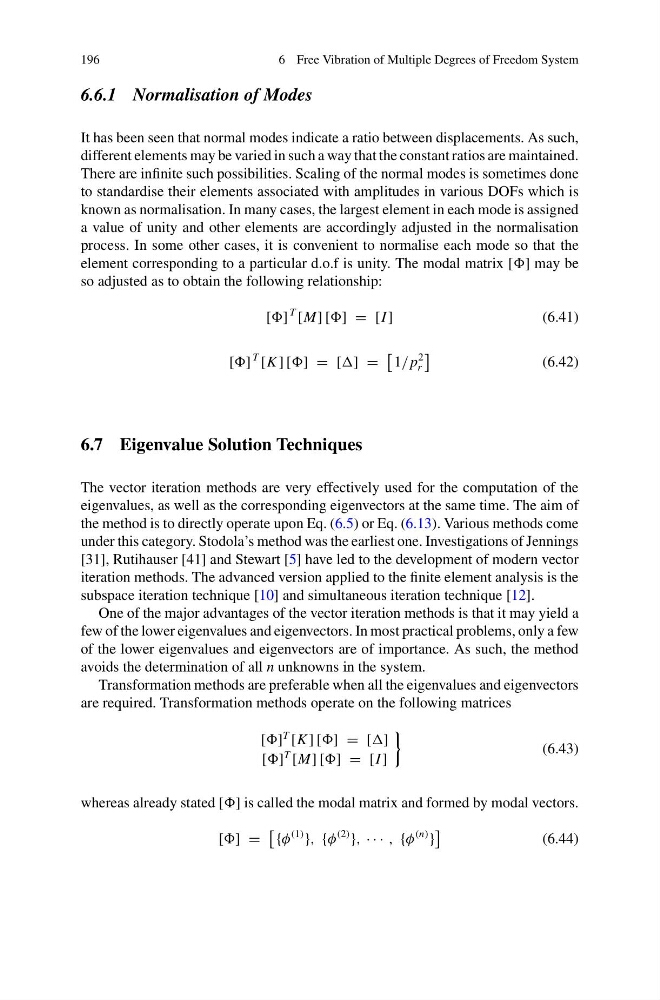
It has been seen that normal modes indicate a ratio between displacements. As such,
different elements may be varied in such a way that the constant ratios are maintained.
There are infinite such possibilities. Scaling of the normal modes is sometimes done
to standardise their elements associated with amplitudes in various DOFs which is
known as normalisation. In many cases, the largest element in each mode is assigned
a value of unity and other elements are accordingly adjusted in the normalisation
process. In some other cases, it is convenient to normalise each mode so that the
element corresponding to a particular d.o.f is unity. The modal matrix [] may be
so adjusted as to obtain the following relationship:
[]
T [M] [] = [I ]
(6.41)
[]
T [K ] [] = [] =
1/ p
2
r
(6.42)
6.7 Eigenvalue Solution Techniques
The vector iteration methods are very effectively used for the computation of the
eigenvalues, as well as the corresponding eigenvectors at the same time. The aim of
the method is to directly operate upon Eq. (6.5) or Eq. (6.13). Various methods come
under this category. Stodola’s method was the earliest one. Investigations of Jennings
[31], Rutihauser [41] and Stewart [5] have led to the development of modern vector
iteration methods. The advanced version applied to the finite element analysis is the
subspace iteration technique [10] and simultaneous iteration technique [12].
One of the major advantages of the vector iteration methods is that it may yield a
few of the lower eigenvalues and eigenvectors. In most practical problems, only a few
of the lower eigenvalues and eigenvectors are of importance. As such, the method
avoids the determination of all n unknowns in the system.
Transformation methods are preferable when all the eigenvalues and eigenvectors
are required. Transformation methods operate on the following matrices
[]
T
[K ] [] = []
[]
T
[M] [] = [I ]
(6.43)
whereas already stated [] is called the modal matrix and formed by modal vectors.
[] =
{φ
(1)
}, {φ
(2)
}, · · · , {φ
(n)
}
(6.44)
6 Free Vibration of Multiple Degrees of Freedom System
6.6.1 Normalisation of Modes
It has been seen that normal modes indicate a ratio between displacements. As such,
different elements may be varied in such a way that the constant ratios are maintained.
There are infinite such possibilities. Scaling of the normal modes is sometimes done
to standardise their elements associated with amplitudes in various DOFs which is
known as normalisation. In many cases, the largest element in each mode is assigned
a value of unity and other elements are accordingly adjusted in the normalisation
process. In some other cases, it is convenient to normalise each mode so that the
element corresponding to a particular d.o.f is unity. The modal matrix [] may be
so adjusted as to obtain the following relationship:
[]
T [M] [] = [I ]
(6.41)
[]
T [K ] [] = [] =
1/ p
2
r
(6.42)
6.7 Eigenvalue Solution Techniques
The vector iteration methods are very effectively used for the computation of the
eigenvalues, as well as the corresponding eigenvectors at the same time. The aim of
the method is to directly operate upon Eq. (6.5) or Eq. (6.13). Various methods come
under this category. Stodola’s method was the earliest one. Investigations of Jennings
[31], Rutihauser [41] and Stewart [5] have led to the development of modern vector
iteration methods. The advanced version applied to the finite element analysis is the
subspace iteration technique [10] and simultaneous iteration technique [12].
One of the major advantages of the vector iteration methods is that it may yield a
few of the lower eigenvalues and eigenvectors. In most practical problems, only a few
of the lower eigenvalues and eigenvectors are of importance. As such, the method
avoids the determination of all n unknowns in the system.
Transformation methods are preferable when all the eigenvalues and eigenvectors
are required. Transformation methods operate on the following matrices
[]
T
[K ] [] = []
[]
T
[M] [] = [I ]
(6.43)
whereas already stated [] is called the modal matrix and formed by modal vectors.
[] =
{φ
(1)
}, {φ
(2)
}, · · · , {φ
(n)
}
(6.44)