

188
6 Free Vibration of Multiple Degrees of Freedom System
where [D] = [K ]
− 1
[M].
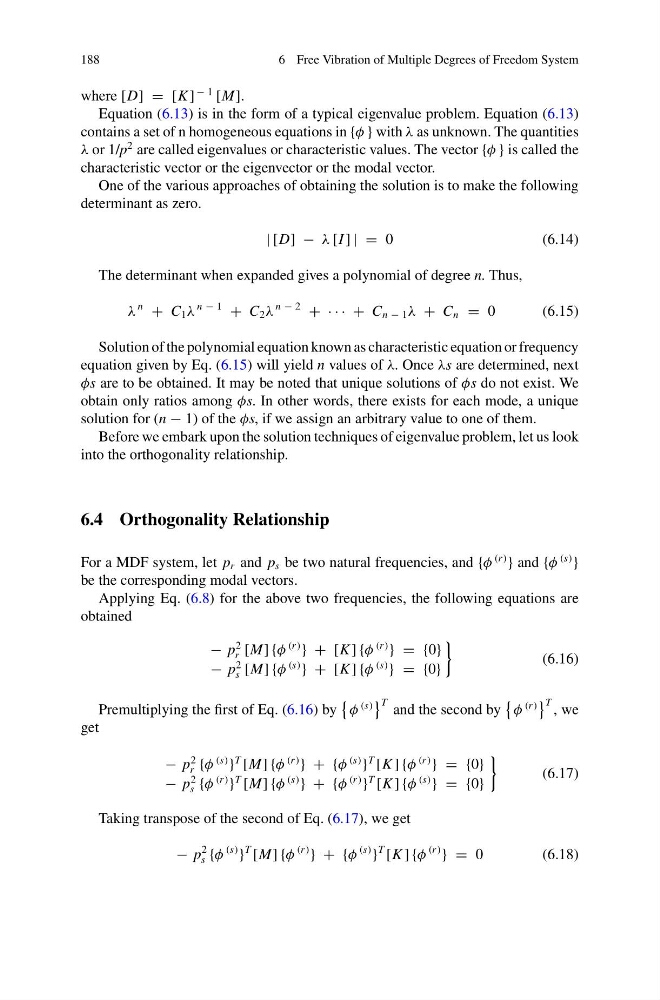
Equation (6.13) is in the form of a typical eigenvalue problem. Equation (6.13)
contains a set of n homogeneous equations in {φ } with λ as unknown. The quantities
λ or 1/p
2 are called eigenvalues or characteristic values. The vector {φ } is called the
characteristic vector or the eigenvector or the modal vector.
One of the various approaches of obtaining the solution is to make the following
determinant as zero.
| [D] − λ [I ] | = 0
(6.14)
The determinant when expanded gives a polynomial of degree n. Thus,
λ
n
+ C 1 λ
n − 1
+ C 2 λ
n − 2
+ · · · + C n − 1 λ + C n = 0
(6.15)
Solution of the polynomial equation known as characteristic equation or frequency
equation given by Eq. (6.15) will yield n values of λ. Once λs are determined, next
φs are to be obtained. It may be noted that unique solutions of φs do not exist. We
obtain only ratios among φs. In other words, there exists for each mode, a unique
solution for (n − 1) of the φs, if we assign an arbitrary value to one of them.
Before we embark upon the solution techniques of eigenvalue problem, let us look
into the orthogonality relationship.
6.4 Orthogonality Relationship
For a MDF system, let p r and p s be two natural frequencies, and {φ
(r )
} and {φ
(s)
}
be the corresponding modal vectors.
Applying Eq. (6.8) for the above two frequencies, the following equations are
obtained
− p
2
r [M] {φ
(r )
} + [K ] {φ
(r )
} = {0}
− p
2
s [M] {φ
(s)
} + [K ] {φ
(s)
} = {0}
(6.16)
Premultiplying the first of Eq. (6.16) by
φ
(s)
T and the second by
φ
(r )
T , we
get
− p
2
r {φ
(s)
}
T
[M] {φ
(r )
} + {φ
(s)
}
T
[K ] {φ
(r )
} = {0}
− p
2
s {φ
(r )
}
T
[M] {φ
(s)
} + {φ
(r )
}
T
[K ] {φ
(s)
} = {0}
(6.17)
Taking transpose of the second of Eq. (6.17), we get
− p
2
s {φ
(s)
}
T
[M] {φ
(r )
} + {φ
(s)
}
T
[K ] {φ
(r )
} = 0
(6.18)
6 Free Vibration of Multiple Degrees of Freedom System
where [D] = [K ]
− 1
[M].
Equation (6.13) is in the form of a typical eigenvalue problem. Equation (6.13)
contains a set of n homogeneous equations in {φ } with λ as unknown. The quantities
λ or 1/p
2 are called eigenvalues or characteristic values. The vector {φ } is called the
characteristic vector or the eigenvector or the modal vector.
One of the various approaches of obtaining the solution is to make the following
determinant as zero.
| [D] − λ [I ] | = 0
(6.14)
The determinant when expanded gives a polynomial of degree n. Thus,
λ
n
+ C 1 λ
n − 1
+ C 2 λ
n − 2
+ · · · + C n − 1 λ + C n = 0
(6.15)
Solution of the polynomial equation known as characteristic equation or frequency
equation given by Eq. (6.15) will yield n values of λ. Once λs are determined, next
φs are to be obtained. It may be noted that unique solutions of φs do not exist. We
obtain only ratios among φs. In other words, there exists for each mode, a unique
solution for (n − 1) of the φs, if we assign an arbitrary value to one of them.
Before we embark upon the solution techniques of eigenvalue problem, let us look
into the orthogonality relationship.
6.4 Orthogonality Relationship
For a MDF system, let p r and p s be two natural frequencies, and {φ
(r )
} and {φ
(s)
}
be the corresponding modal vectors.
Applying Eq. (6.8) for the above two frequencies, the following equations are
obtained
− p
2
r [M] {φ
(r )
} + [K ] {φ
(r )
} = {0}
− p
2
s [M] {φ
(s)
} + [K ] {φ
(s)
} = {0}
(6.16)
Premultiplying the first of Eq. (6.16) by
φ
(s)
T and the second by
φ
(r )
T , we
get
− p
2
r {φ
(s)
}
T
[M] {φ
(r )
} + {φ
(s)
}
T
[K ] {φ
(r )
} = {0}
− p
2
s {φ
(r )
}
T
[M] {φ
(s)
} + {φ
(r )
}
T
[K ] {φ
(s)
} = {0}
(6.17)
Taking transpose of the second of Eq. (6.17), we get
− p
2
s {φ
(s)
}
T
[M] {φ
(r )
} + {φ
(s)
}
T
[K ] {φ
(r )
} = 0
(6.18)