

5.8 Free Vibration of Damped Two Degrees of Freedom System
171
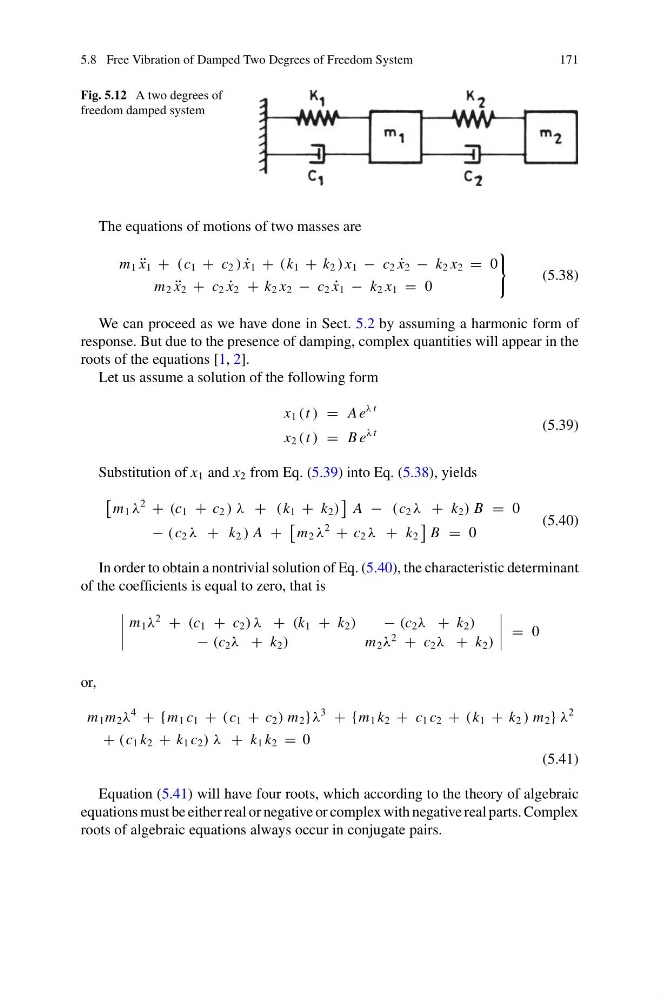
Fig. 5.12 A two degrees of
freedom damped system
The equations of motions of two masses are
m 1 ¨
x 1 + ( c 1 + c 2 ) ˙
x 1 + ( k 1 + k 2 ) x 1 − c 2 ˙
x 2 − k 2 x 2 = 0
m 2 ¨
x 2 + c 2 ˙
x 2 + k 2 x 2 − c 2 ˙
x 1 − k 2 x 1 = 0
(5.38)
We can proceed as we have done in Sect. 5.2 by assuming a harmonic form of
response. But due to the presence of damping, complex quantities will appear in the
roots of the equations [1, 2].
Let us assume a solution of the following form
x 1 ( t ) = A e
λ t
x 2 (t ) = B e
λ t
(5.39)
Substitution of x 1 and x 2 from Eq. (5.39) into Eq. (5.38), yields
m 1 λ
2
+ (c 1 + c 2 ) λ + ( k 1 + k 2 )
A − (c 2 λ + k 2 ) B = 0
− ( c 2 λ + k 2 ) A +
m 2 λ
2
+ c 2 λ + k 2
B = 0
(5.40)
In order to obtain a nontrivial solution of Eq. (5.40), the characteristic determinant
of the coefficients is equal to zero, that is
m 1 λ
2
+ (c 1 + c 2 ) λ + (k 1 + k 2 )
− (c 2 λ + k 2 )
− (c 2 λ + k 2 )
m 2 λ
2
+ c 2 λ + k 2 )
= 0
or,
m 1 m 2 λ
4
+ {m 1 c 1 + (c 1 + c 2 ) m 2 } λ
3
+ { m 1 k 2 + c 1 c 2 + (k 1 + k 2 ) m 2 } λ
2
+ ( c 1 k 2 + k 1 c 2 ) λ + k 1 k 2 = 0
(5.41)
Equation (5.41) will have four roots, which according to the theory of algebraic
equations must be either real or negative or complex with negative real parts. Complex
roots of algebraic equations always occur in conjugate pairs.
171
Fig. 5.12 A two degrees of
freedom damped system
The equations of motions of two masses are
m 1 ¨
x 1 + ( c 1 + c 2 ) ˙
x 1 + ( k 1 + k 2 ) x 1 − c 2 ˙
x 2 − k 2 x 2 = 0
m 2 ¨
x 2 + c 2 ˙
x 2 + k 2 x 2 − c 2 ˙
x 1 − k 2 x 1 = 0
(5.38)
We can proceed as we have done in Sect. 5.2 by assuming a harmonic form of
response. But due to the presence of damping, complex quantities will appear in the
roots of the equations [1, 2].
Let us assume a solution of the following form
x 1 ( t ) = A e
λ t
x 2 (t ) = B e
λ t
(5.39)
Substitution of x 1 and x 2 from Eq. (5.39) into Eq. (5.38), yields
m 1 λ
2
+ (c 1 + c 2 ) λ + ( k 1 + k 2 )
A − (c 2 λ + k 2 ) B = 0
− ( c 2 λ + k 2 ) A +
m 2 λ
2
+ c 2 λ + k 2
B = 0
(5.40)
In order to obtain a nontrivial solution of Eq. (5.40), the characteristic determinant
of the coefficients is equal to zero, that is
m 1 λ
2
+ (c 1 + c 2 ) λ + (k 1 + k 2 )
− (c 2 λ + k 2 )
− (c 2 λ + k 2 )
m 2 λ
2
+ c 2 λ + k 2 )
= 0
or,
m 1 m 2 λ
4
+ {m 1 c 1 + (c 1 + c 2 ) m 2 } λ
3
+ { m 1 k 2 + c 1 c 2 + (k 1 + k 2 ) m 2 } λ
2
+ ( c 1 k 2 + k 1 c 2 ) λ + k 1 k 2 = 0
(5.41)
Equation (5.41) will have four roots, which according to the theory of algebraic
equations must be either real or negative or complex with negative real parts. Complex
roots of algebraic equations always occur in conjugate pairs.