

168
5 Vibration of Two Degrees of Freedom System
and substituting them in Eq. (5.30), results in
A
− m 1 p
2
+ i ( c 1 + c 2 ) p + (k 1 + k 2 )
+ B [ − i pc 2 − k 2 ] = 0
−A [ − i pc 2 − k 2 ] + B
− m 2 p
2
+ i pc 2 + k 2
= 0
(5.32)
A non-trivial solution of Eq. (5.32) is obtained, only when determinant formed
by the coefficients is equal to zero. Expanding the determinant, one obtains
− m 1 p 2 + i ( c 1 + c 2 ) p + ( k 1 + k 2 )
− m 2 p 2 + i pc 2 + k 2
− [ i pc 2 + k 2 ] 2 = 0
(5.33)
Equation (5.33) is an equation of fourth degree of p and has four roots, all of
which are complex. The general solution is written as
x 1 = A 1 e
i p 1 t
+ A 2 e
i p 2 t
+ A 3 e
i p 3 t
+ A 4 e
i p 4 t
x 2 = B 1 e
i p 1 t
+ B 2 e
i p 2 t
+ B 3 e
i p 3 t
+ B 4 e
i p 4 t
(5.34)
We further know from Art. 5.2 and Eq. (5.32) that As and Bs are related.
Further, p 1 and p 2 as also p 3 and p 4 are complex conjugates.
This has been discussed in more details in Sect. 5.8.
5.7 Coordinate Coupling
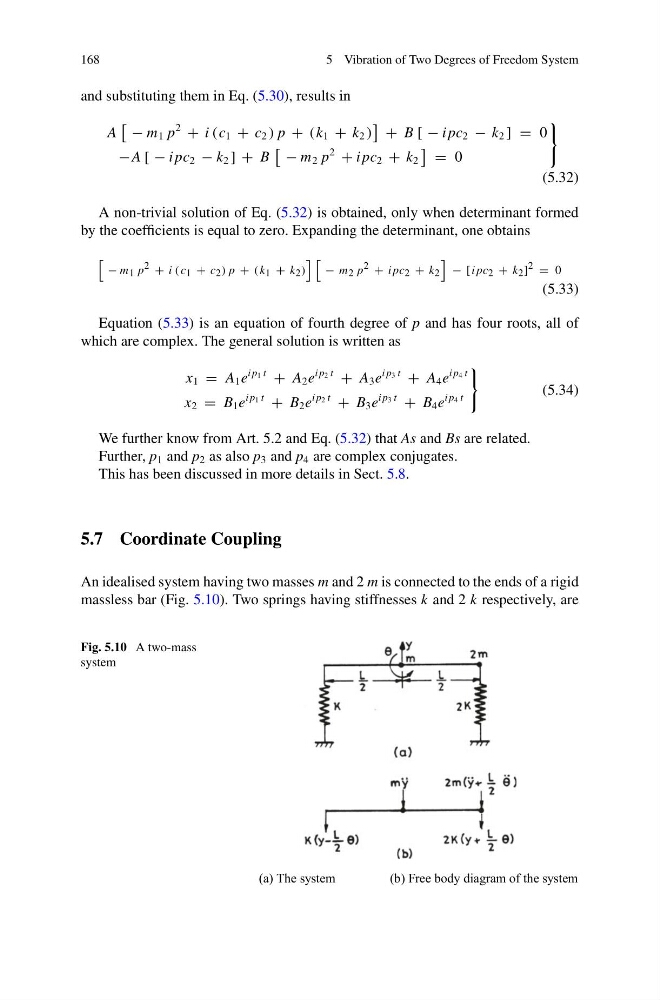
An idealised system having two masses m and 2 m is connected to the ends of a rigid
massless bar (Fig. 5.10). Two springs having stiffnesses k and 2 k respectively, are
Fig. 5.10 A two-mass
system
(a) The system
(b) Free body diagram of the system
5 Vibration of Two Degrees of Freedom System
and substituting them in Eq. (5.30), results in
A
− m 1 p
2
+ i ( c 1 + c 2 ) p + (k 1 + k 2 )
+ B [ − i pc 2 − k 2 ] = 0
−A [ − i pc 2 − k 2 ] + B
− m 2 p
2
+ i pc 2 + k 2
= 0
(5.32)
A non-trivial solution of Eq. (5.32) is obtained, only when determinant formed
by the coefficients is equal to zero. Expanding the determinant, one obtains
− m 1 p 2 + i ( c 1 + c 2 ) p + ( k 1 + k 2 )
− m 2 p 2 + i pc 2 + k 2
− [ i pc 2 + k 2 ] 2 = 0
(5.33)
Equation (5.33) is an equation of fourth degree of p and has four roots, all of
which are complex. The general solution is written as
x 1 = A 1 e
i p 1 t
+ A 2 e
i p 2 t
+ A 3 e
i p 3 t
+ A 4 e
i p 4 t
x 2 = B 1 e
i p 1 t
+ B 2 e
i p 2 t
+ B 3 e
i p 3 t
+ B 4 e
i p 4 t
(5.34)
We further know from Art. 5.2 and Eq. (5.32) that As and Bs are related.
Further, p 1 and p 2 as also p 3 and p 4 are complex conjugates.
This has been discussed in more details in Sect. 5.8.
5.7 Coordinate Coupling
An idealised system having two masses m and 2 m is connected to the ends of a rigid
massless bar (Fig. 5.10). Two springs having stiffnesses k and 2 k respectively, are
Fig. 5.10 A two-mass
system
(a) The system
(b) Free body diagram of the system