

3.18 Response of SDF Systems Related to Earthquakes
113
3.18 Response of SDF Systems Related to Earthquakes
A SDF system is represented by three constants—the mass m, the stiffness k and
damping c. They are combined for the case of viscous damping into two constants p
and n. The quantity of interest due to earthquake for this system is its displacement,
velocity and acceleration, specially their maximum values. If the earthquake treated
on a deterministic basis is the input, then curves can be prepared indicating maximum
values of these quantities for the given disturbance, having prescribed values of m,
k and c. These diagrams are called response spectrum. Thus, the response spectrum
is a graph indicating the maximum responses of all SDF systems, due to the given
disturbance. The abscissa of the spectrum is the natural frequency of the system and
the ordinate is the maximum response. Thus, in order to determine the response for
the particular input, we need to know only the natural frequency of the SDF system,
of whose response we are interested. This can be illustrated with an example.
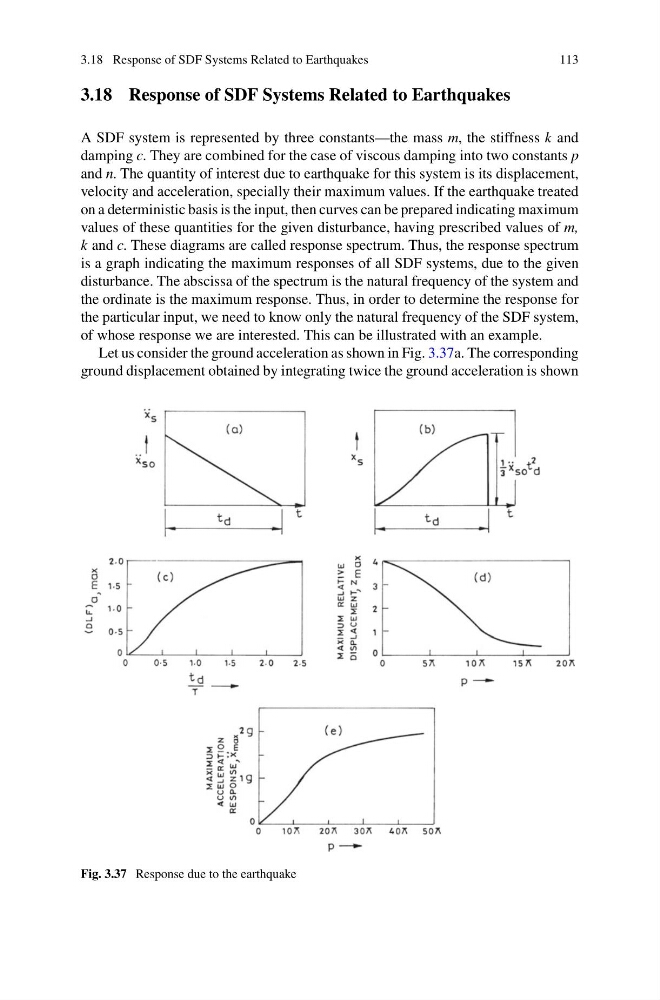
Let us consider the ground acceleration as shown in Fig. 3.37a. The corresponding
ground displacement obtained by integrating twice the ground acceleration is shown
Fig. 3.37 Response due to the earthquake
113
3.18 Response of SDF Systems Related to Earthquakes
A SDF system is represented by three constants—the mass m, the stiffness k and
damping c. They are combined for the case of viscous damping into two constants p
and n. The quantity of interest due to earthquake for this system is its displacement,
velocity and acceleration, specially their maximum values. If the earthquake treated
on a deterministic basis is the input, then curves can be prepared indicating maximum
values of these quantities for the given disturbance, having prescribed values of m,
k and c. These diagrams are called response spectrum. Thus, the response spectrum
is a graph indicating the maximum responses of all SDF systems, due to the given
disturbance. The abscissa of the spectrum is the natural frequency of the system and
the ordinate is the maximum response. Thus, in order to determine the response for
the particular input, we need to know only the natural frequency of the SDF system,
of whose response we are interested. This can be illustrated with an example.
Let us consider the ground acceleration as shown in Fig. 3.37a. The corresponding
ground displacement obtained by integrating twice the ground acceleration is shown
Fig. 3.37 Response due to the earthquake