

112
3 Forced Vibration of Single Degree of Freedom System
x = x s0 p
2
sin ωt
p 2 − ω 2 −
ω
p
sin pt
p 2 − ω 2
(3.139)
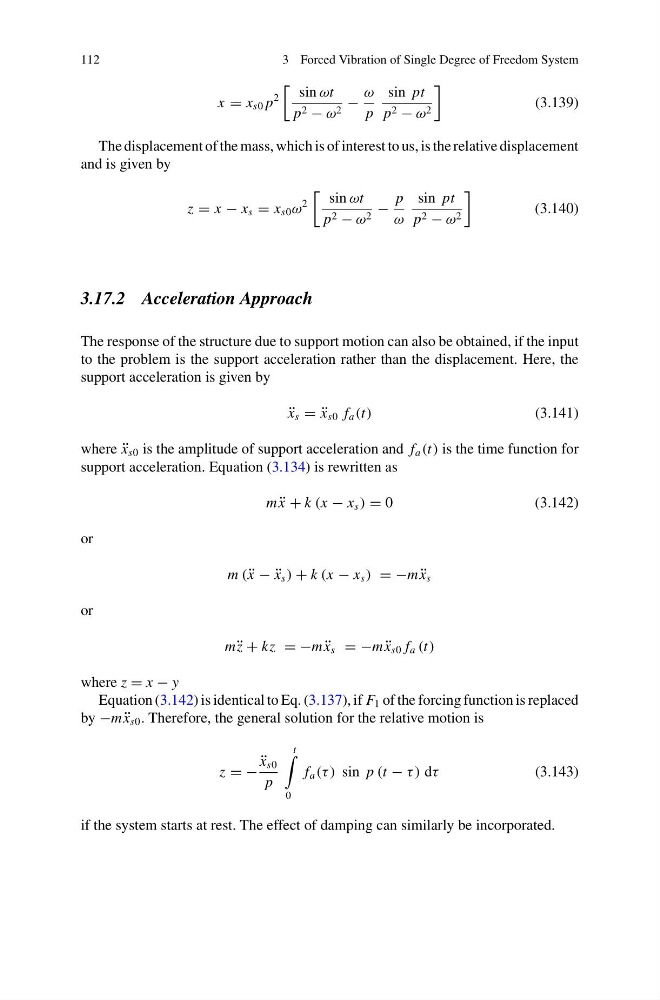
The displacement of the mass, which is of interest to us, is the relative displacement
and is given by
z = x − x s = x s0 ω
2
sin ωt
p 2 − ω 2 −
p
ω
sin pt
p 2 − ω 2
(3.140)
3.17.2 Acceleration Approach
The response of the structure due to support motion can also be obtained, if the input
to the problem is the support acceleration rather than the displacement. Here, the
support acceleration is given by
¨
x s = ¨
x s0 f a (t)
(3.141)
where ¨
x s0 is the amplitude of support acceleration and f a (t) is the time function for
support acceleration. Equation (3.134) is rewritten as
m ¨
x + k (x − x s ) = 0
(3.142)
or
m ( ¨
x − ¨
x s ) + k (x − x s ) = −m ¨
x s
or
m ¨
z + kz = −m ¨
x s = −m ¨
x s0 f a (t)
where z = x − y
Equation (3.142) is identical to Eq. (3.137), if F 1 of the forcing function is replaced
by −m ¨
x s0 . Therefore, the general solution for the relative motion is
z = −
¨
x s0
p
t
0
f a (τ ) sin p (t − τ ) dτ
(3.143)
if the system starts at rest. The effect of damping can similarly be incorporated.
3 Forced Vibration of Single Degree of Freedom System
x = x s0 p
2
sin ωt
p 2 − ω 2 −
ω
p
sin pt
p 2 − ω 2
(3.139)
The displacement of the mass, which is of interest to us, is the relative displacement
and is given by
z = x − x s = x s0 ω
2
sin ωt
p 2 − ω 2 −
p
ω
sin pt
p 2 − ω 2
(3.140)
3.17.2 Acceleration Approach
The response of the structure due to support motion can also be obtained, if the input
to the problem is the support acceleration rather than the displacement. Here, the
support acceleration is given by
¨
x s = ¨
x s0 f a (t)
(3.141)
where ¨
x s0 is the amplitude of support acceleration and f a (t) is the time function for
support acceleration. Equation (3.134) is rewritten as
m ¨
x + k (x − x s ) = 0
(3.142)
or
m ( ¨
x − ¨
x s ) + k (x − x s ) = −m ¨
x s
or
m ¨
z + kz = −m ¨
x s = −m ¨
x s0 f a (t)
where z = x − y
Equation (3.142) is identical to Eq. (3.137), if F 1 of the forcing function is replaced
by −m ¨
x s0 . Therefore, the general solution for the relative motion is
z = −
¨
x s0
p
t
0
f a (τ ) sin p (t − τ ) dτ
(3.143)
if the system starts at rest. The effect of damping can similarly be incorporated.