

3.14 Response Due to Periodic Forces
101
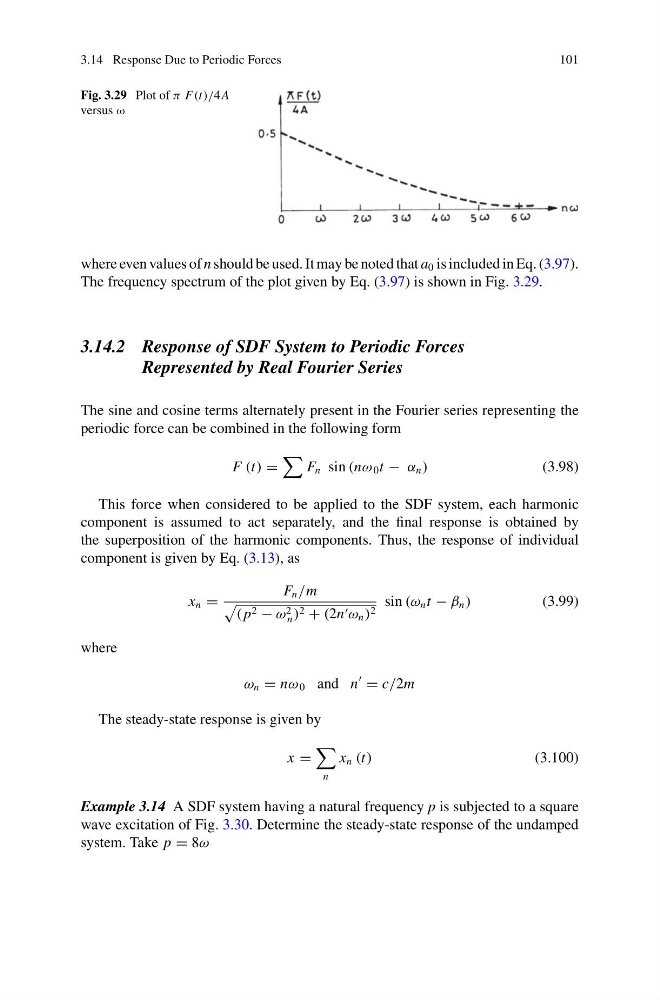
Fig. 3.29 Plot of π F(t)/4 A
versus ω
where even values of n should be used. It may be noted that a 0 is included in Eq. (3.97).
The frequency spectrum of the plot given by Eq. (3.97) is shown in Fig. 3.29.
3.14.2 Response of SDF System to Periodic Forces
Represented by Real Fourier Series
The sine and cosine terms alternately present in the Fourier series representing the
periodic force can be combined in the following form
F (t) =
F n sin (nω 0 t − α n )
(3.98)
This force when considered to be applied to the SDF system, each harmonic
component is assumed to act separately, and the final response is obtained by
the superposition of the harmonic components. Thus, the response of individual
component is given by Eq. (3.13), as
x n =
F n /m
( p 2 − ω 2
n ) 2 + (2n ω n ) 2
sin (ω n t − β n )
(3.99)
where
ω n = nω 0 and n
= c/2m
The steady-state response is given by
x =
n
x n (t)
(3.100)
Example 3.14 A SDF system having a natural frequency p is subjected to a square
wave excitation of Fig. 3.30. Determine the steady-state response of the undamped
system. Take p = 8ω
101
Fig. 3.29 Plot of π F(t)/4 A
versus ω
where even values of n should be used. It may be noted that a 0 is included in Eq. (3.97).
The frequency spectrum of the plot given by Eq. (3.97) is shown in Fig. 3.29.
3.14.2 Response of SDF System to Periodic Forces
Represented by Real Fourier Series
The sine and cosine terms alternately present in the Fourier series representing the
periodic force can be combined in the following form
F (t) =
F n sin (nω 0 t − α n )
(3.98)
This force when considered to be applied to the SDF system, each harmonic
component is assumed to act separately, and the final response is obtained by
the superposition of the harmonic components. Thus, the response of individual
component is given by Eq. (3.13), as
x n =
F n /m
( p 2 − ω 2
n ) 2 + (2n ω n ) 2
sin (ω n t − β n )
(3.99)
where
ω n = nω 0 and n
= c/2m
The steady-state response is given by
x =
n
x n (t)
(3.100)
Example 3.14 A SDF system having a natural frequency p is subjected to a square
wave excitation of Fig. 3.30. Determine the steady-state response of the undamped
system. Take p = 8ω