

90
3 Forced Vibration of Single Degree of Freedom System
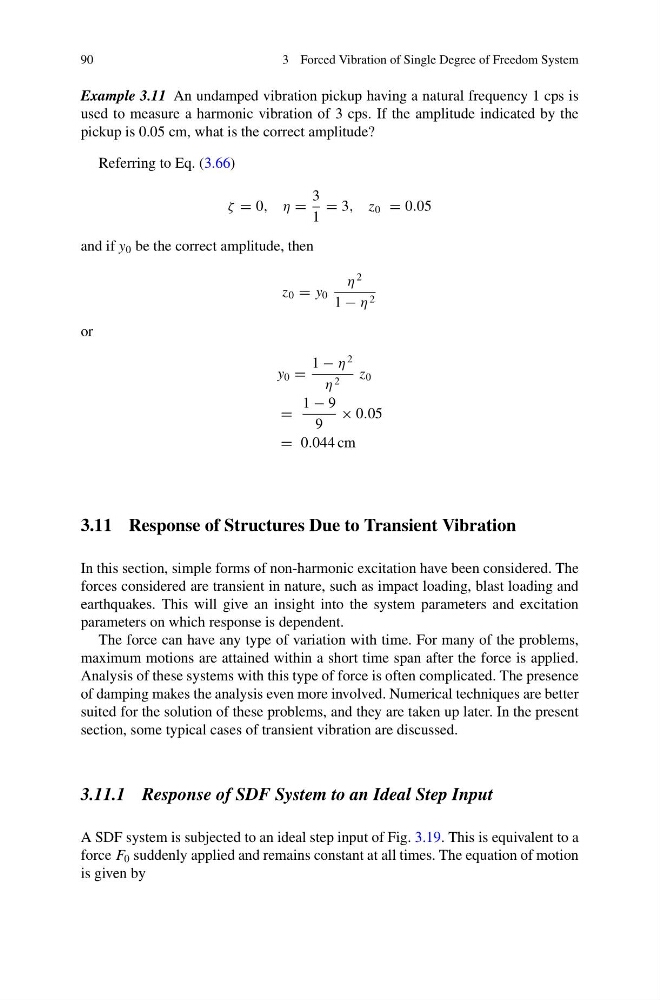
Example 3.11 An undamped vibration pickup having a natural frequency 1 cps is
used to measure a harmonic vibration of 3 cps. If the amplitude indicated by the
pickup is 0.05 cm, what is the correct amplitude?
Referring to Eq. (3.66)
ζ = 0, η =
3
1
= 3, z 0 = 0.05
and if y 0 be the correct amplitude, then
z 0 = y 0
η
2
1 − η 2
or
y 0 =
1 − η
2
η 2 z 0
=
1 − 9
9
× 0.05
= 0.044 cm
3.11 Response of Structures Due to Transient Vibration
In this section, simple forms of non-harmonic excitation have been considered. The
forces considered are transient in nature, such as impact loading, blast loading and
earthquakes. This will give an insight into the system parameters and excitation
parameters on which response is dependent.
The force can have any type of variation with time. For many of the problems,
maximum motions are attained within a short time span after the force is applied.
Analysis of these systems with this type of force is often complicated. The presence
of damping makes the analysis even more involved. Numerical techniques are better
suited for the solution of these problems, and they are taken up later. In the present
section, some typical cases of transient vibration are discussed.
3.11.1 Response of SDF System to an Ideal Step Input
A SDF system is subjected to an ideal step input of Fig. 3.19. This is equivalent to a
force F 0 suddenly applied and remains constant at all times. The equation of motion
is given by
3 Forced Vibration of Single Degree of Freedom System
Example 3.11 An undamped vibration pickup having a natural frequency 1 cps is
used to measure a harmonic vibration of 3 cps. If the amplitude indicated by the
pickup is 0.05 cm, what is the correct amplitude?
Referring to Eq. (3.66)
ζ = 0, η =
3
1
= 3, z 0 = 0.05
and if y 0 be the correct amplitude, then
z 0 = y 0
η
2
1 − η 2
or
y 0 =
1 − η
2
η 2 z 0
=
1 − 9
9
× 0.05
= 0.044 cm
3.11 Response of Structures Due to Transient Vibration
In this section, simple forms of non-harmonic excitation have been considered. The
forces considered are transient in nature, such as impact loading, blast loading and
earthquakes. This will give an insight into the system parameters and excitation
parameters on which response is dependent.
The force can have any type of variation with time. For many of the problems,
maximum motions are attained within a short time span after the force is applied.
Analysis of these systems with this type of force is often complicated. The presence
of damping makes the analysis even more involved. Numerical techniques are better
suited for the solution of these problems, and they are taken up later. In the present
section, some typical cases of transient vibration are discussed.
3.11.1 Response of SDF System to an Ideal Step Input
A SDF system is subjected to an ideal step input of Fig. 3.19. This is equivalent to a
force F 0 suddenly applied and remains constant at all times. The equation of motion
is given by