

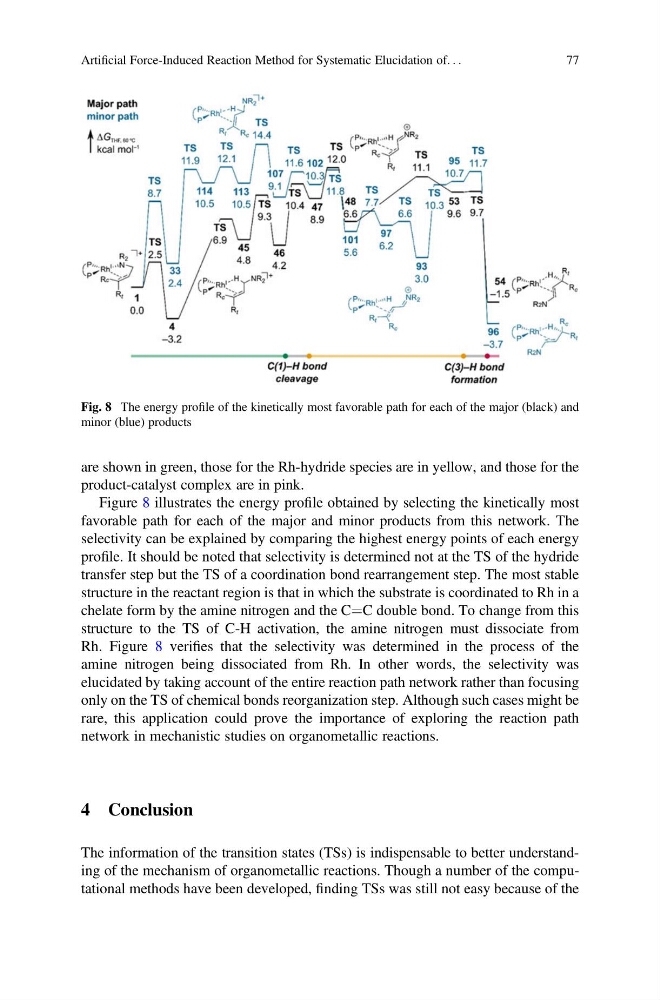
are shown in green, those for the Rh-hydride species are in yellow, and those for the
product-catalyst complex are in pink.
Figure 8 illustrates the energy profile obtained by selecting the kinetically most
favorable path for each of the major and minor products from this network. The
selectivity can be explained by comparing the highest energy points of each energy
profile. It should be noted that selectivity is determined not at the TS of the hydride
transfer step but the TS of a coordination bond rearrangement step. The most stable
structure in the reactant region is that in which the substrate is coordinated to Rh in a
chelate form by the amine nitrogen and the C¼C double bond. To change from this
structure to the TS of C-H activation, the amine nitrogen must dissociate from
Rh. Figure 8 verifies that the selectivity was determined in the process of the
amine nitrogen being dissociated from Rh. In other words, the selectivity was
elucidated by taking account of the entire reaction path network rather than focusing
only on the TS of chemical bonds reorganization step. Although such cases might be
rare, this application could prove the importance of exploring the reaction path
network in mechanistic studies on organometallic reactions.
4 Conclusion
The information of the transition states (TSs) is indispensable to better understanding of the mechanism of organometallic reactions. Though a number of the computational methods have been developed, finding TSs was still not easy because of the
Fig. 8 The energy profile of the kinetically most favorable path for each of the major (black) and
minor (blue) products
Artificial Force-Induced Reaction Method for Systematic Elucidation of. . .
77
product-catalyst complex are in pink.
Figure 8 illustrates the energy profile obtained by selecting the kinetically most
favorable path for each of the major and minor products from this network. The
selectivity can be explained by comparing the highest energy points of each energy
profile. It should be noted that selectivity is determined not at the TS of the hydride
transfer step but the TS of a coordination bond rearrangement step. The most stable
structure in the reactant region is that in which the substrate is coordinated to Rh in a
chelate form by the amine nitrogen and the C¼C double bond. To change from this
structure to the TS of C-H activation, the amine nitrogen must dissociate from
Rh. Figure 8 verifies that the selectivity was determined in the process of the
amine nitrogen being dissociated from Rh. In other words, the selectivity was
elucidated by taking account of the entire reaction path network rather than focusing
only on the TS of chemical bonds reorganization step. Although such cases might be
rare, this application could prove the importance of exploring the reaction path
network in mechanistic studies on organometallic reactions.
4 Conclusion
The information of the transition states (TSs) is indispensable to better understanding of the mechanism of organometallic reactions. Though a number of the computational methods have been developed, finding TSs was still not easy because of the
Fig. 8 The energy profile of the kinetically most favorable path for each of the major (black) and
minor (blue) products
Artificial Force-Induced Reaction Method for Systematic Elucidation of. . .
77