

surrounding CO. The chemical composition used in this calculation cannot describe
the coordination of CO after propionaldehyde is generated. Similarly, the addition of
H 2 to 226 and 1425 cannot be described by this calculation, either. There is a
previous calculation suggesting that the addition of C 2 H 4 and H 2 to 351 will produce
ketone [47], which this composition again cannot describe. To take all these into
consideration, a calculation must be done after adding at least one extra molecule of
each CO, H 2 , and C 2 H 4 , respectively. In addition, Co carbonyl complex is dimerized
at the beginning, and one more catalyst molecule is necessary for calculation
including its effect. Calculation considering two molecules each would be a future
subject.
Asymmetric Hydrogen Shift Lastly, we introduce an example of SC-AFIR study
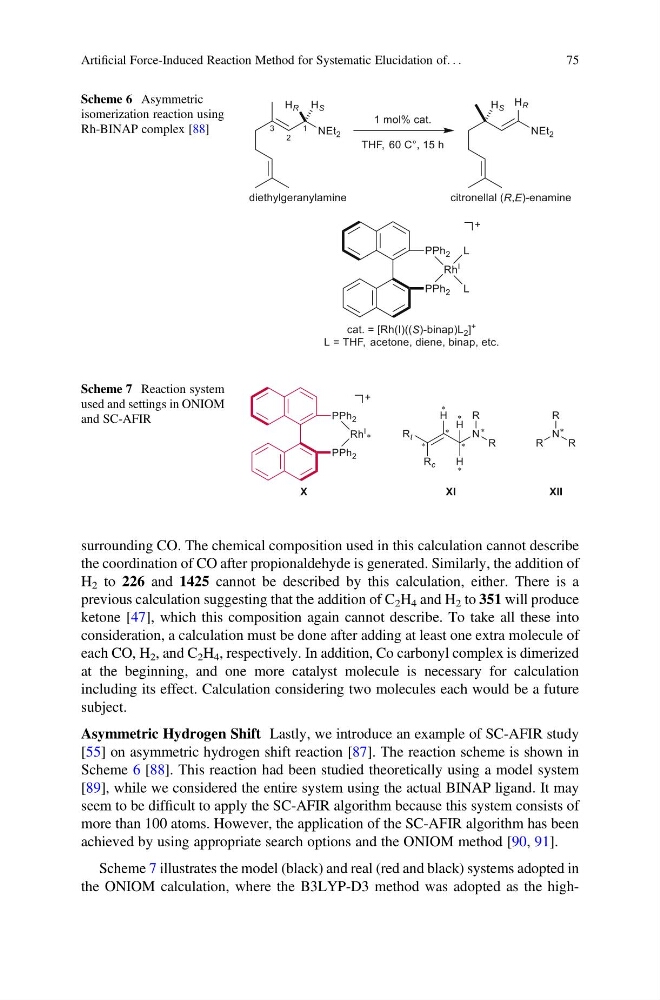
[55] on asymmetric hydrogen shift reaction [87]. The reaction scheme is shown in
Scheme 6 [88]. This reaction had been studied theoretically using a model system
[89], while we considered the entire system using the actual BINAP ligand. It may
seem to be difficult to apply the SC-AFIR algorithm because this system consists of
more than 100 atoms. However, the application of the SC-AFIR algorithm has been
achieved by using appropriate search options and the ONIOM method [90, 91].
Scheme 7 illustrates the model (black) and real (red and black) systems adopted in
the ONIOM calculation, where the B3LYP-D3 method was adopted as the highScheme 6 Asymmetric
isomerization reaction using
Rh-BINAP complex [88]
Scheme 7 Reaction system
used and settings in ONIOM
and SC-AFIR
Artificial Force-Induced Reaction Method for Systematic Elucidation of. . .
75
the coordination of CO after propionaldehyde is generated. Similarly, the addition of
H 2 to 226 and 1425 cannot be described by this calculation, either. There is a
previous calculation suggesting that the addition of C 2 H 4 and H 2 to 351 will produce
ketone [47], which this composition again cannot describe. To take all these into
consideration, a calculation must be done after adding at least one extra molecule of
each CO, H 2 , and C 2 H 4 , respectively. In addition, Co carbonyl complex is dimerized
at the beginning, and one more catalyst molecule is necessary for calculation
including its effect. Calculation considering two molecules each would be a future
subject.
Asymmetric Hydrogen Shift Lastly, we introduce an example of SC-AFIR study
[55] on asymmetric hydrogen shift reaction [87]. The reaction scheme is shown in
Scheme 6 [88]. This reaction had been studied theoretically using a model system
[89], while we considered the entire system using the actual BINAP ligand. It may
seem to be difficult to apply the SC-AFIR algorithm because this system consists of
more than 100 atoms. However, the application of the SC-AFIR algorithm has been
achieved by using appropriate search options and the ONIOM method [90, 91].
Scheme 7 illustrates the model (black) and real (red and black) systems adopted in
the ONIOM calculation, where the B3LYP-D3 method was adopted as the highScheme 6 Asymmetric
isomerization reaction using
Rh-BINAP complex [88]
Scheme 7 Reaction system
used and settings in ONIOM
and SC-AFIR
Artificial Force-Induced Reaction Method for Systematic Elucidation of. . .
75