

t MAX ¼ 10
n s (n ¼ À10 ~ 3). In the contraction at t MAX ¼ 10
3 s, the reactant 22 was
contracted to the superstate whose representative structure was 1425, which means
within 10
3 s, 22 transformed to 1425. The results were similar at t MAX ¼ 10
2 s and
10
1 s. At t MAX ¼ 10
0 s, however, 22 was contracted to the superstate where 22 itself
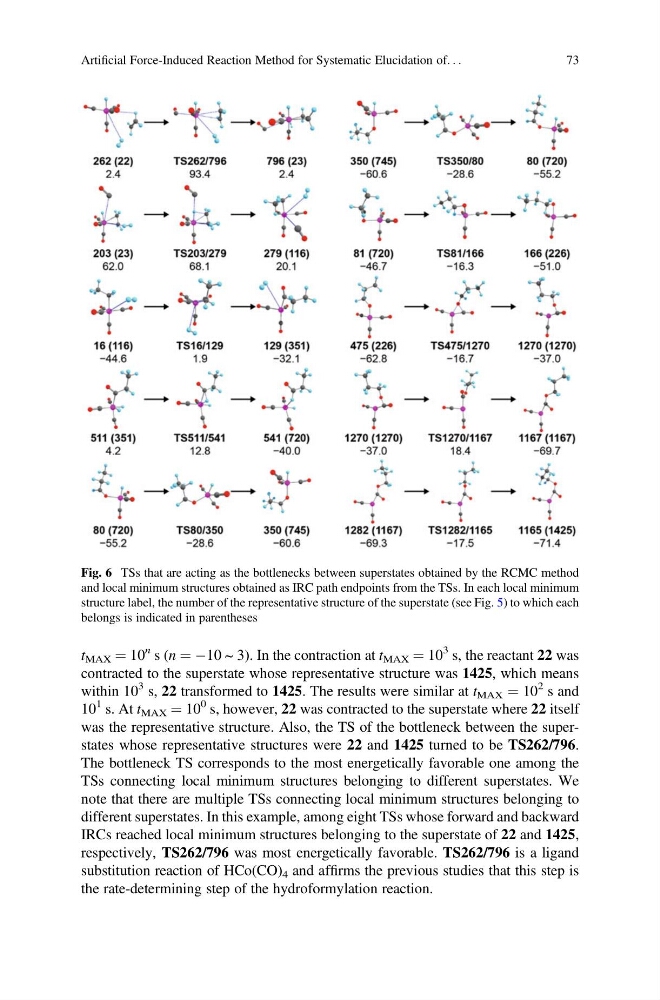
was the representative structure. Also, the TS of the bottleneck between the superstates whose representative structures were 22 and 1425 turned to be TS262/796.
The bottleneck TS corresponds to the most energetically favorable one among the
TSs connecting local minimum structures belonging to different superstates. We
note that there are multiple TSs connecting local minimum structures belonging to
different superstates. In this example, among eight TSs whose forward and backward
IRCs reached local minimum structures belonging to the superstate of 22 and 1425,
respectively, TS262/796 was most energetically favorable. TS262/796 is a ligand
substitution reaction of HCo(CO) 4 and affirms the previous studies that this step is
the rate-determining step of the hydroformylation reaction.
Fig. 6 TSs that are acting as the bottlenecks between superstates obtained by the RCMC method
and local minimum structures obtained as IRC path endpoints from the TSs. In each local minimum
structure label, the number of the representative structure of the superstate (see Fig. 5) to which each
belongs is indicated in parentheses
Artificial Force-Induced Reaction Method for Systematic Elucidation of. . .
73
n s (n ¼ À10 ~ 3). In the contraction at t MAX ¼ 10
3 s, the reactant 22 was
contracted to the superstate whose representative structure was 1425, which means
within 10
3 s, 22 transformed to 1425. The results were similar at t MAX ¼ 10
2 s and
10
1 s. At t MAX ¼ 10
0 s, however, 22 was contracted to the superstate where 22 itself
was the representative structure. Also, the TS of the bottleneck between the superstates whose representative structures were 22 and 1425 turned to be TS262/796.
The bottleneck TS corresponds to the most energetically favorable one among the
TSs connecting local minimum structures belonging to different superstates. We
note that there are multiple TSs connecting local minimum structures belonging to
different superstates. In this example, among eight TSs whose forward and backward
IRCs reached local minimum structures belonging to the superstate of 22 and 1425,
respectively, TS262/796 was most energetically favorable. TS262/796 is a ligand
substitution reaction of HCo(CO) 4 and affirms the previous studies that this step is
the rate-determining step of the hydroformylation reaction.
Fig. 6 TSs that are acting as the bottlenecks between superstates obtained by the RCMC method
and local minimum structures obtained as IRC path endpoints from the TSs. In each local minimum
structure label, the number of the representative structure of the superstate (see Fig. 5) to which each
belongs is indicated in parentheses
Artificial Force-Induced Reaction Method for Systematic Elucidation of. . .
73