

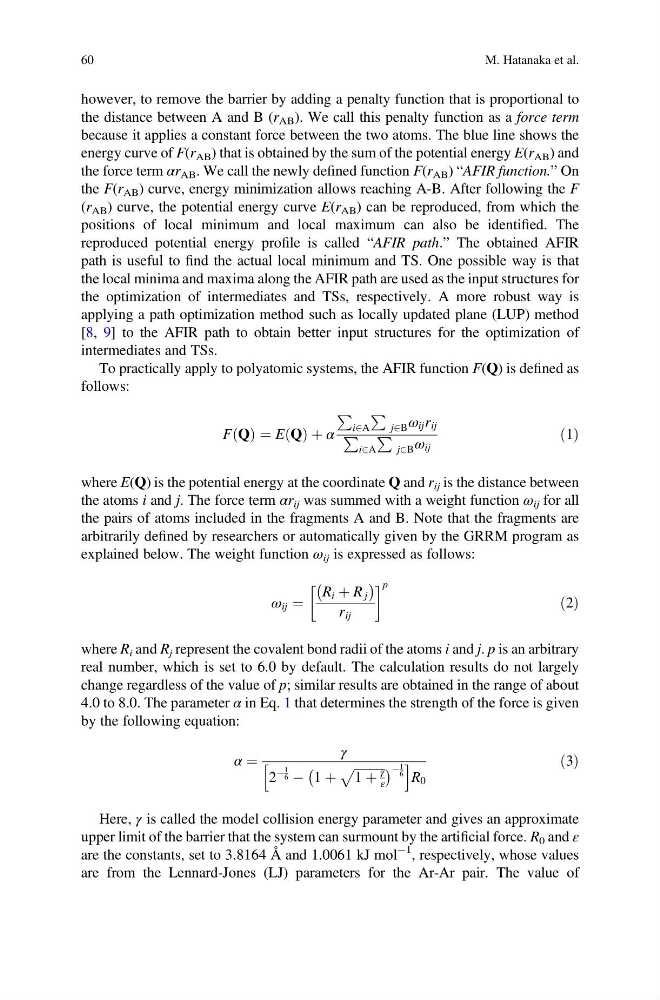
however, to remove the barrier by adding a penalty function that is proportional to
the distance between A and B (r AB ). We call this penalty function as a force term
because it applies a constant force between the two atoms. The blue line shows the
energy curve of F(r AB ) that is obtained by the sum of the potential energy E(r AB ) and
the force term αr AB . We call the newly defined function F(r AB ) “AFIR function.” On
the F(r AB ) curve, energy minimization allows reaching A-B. After following the F
(r AB ) curve, the potential energy curve E(r AB ) can be reproduced, from which the
positions of local minimum and local maximum can also be identified. The
reproduced potential energy profile is called “AFIR path.” The obtained AFIR
path is useful to find the actual local minimum and TS. One possible way is that
the local minima and maxima along the AFIR path are used as the input structures for
the optimization of intermediates and TSs, respectively. A more robust way is
applying a path optimization method such as locally updated plane (LUP) method
[8, 9] to the AFIR path to obtain better input structures for the optimization of
intermediates and TSs.
To practically apply to polyatomic systems, the AFIR function F(Q) is defined as
follows:
F Q
ð Þ ¼ E Q
ð Þ þ α
P
i2A
P
j2B ω ij r ij
P
i2A
P
j2B ω ij
ð1Þ
where E(Q) is the potential energy at the coordinate Q and r ij is the distance between
the atoms i and j. The force term αr ij was summed with a weight function ω ij for all
the pairs of atoms included in the fragments A and B. Note that the fragments are
arbitrarily defined by researchers or automatically given by the GRRM program as
explained below. The weight function ω ij is expressed as follows:
ω ij ¼
R i þ R j
À
Á
r ij
! p
ð2Þ
where R i and R j represent the covalent bond radii of the atoms i and j. p is an arbitrary
real number, which is set to 6.0 by default. The calculation results do not largely
change regardless of the value of p; similar results are obtained in the range of about
4.0 to 8.0. The parameter α in Eq. 1 that determines the strength of the force is given
by the following equation:
α ¼
γ
2
À
1
6 À 1 þ
ffiffiffiffiffiffiffiffiffiffi
1 þ
γ
ε
p
À
Á À
1
6
h
i
R 0
ð3Þ
Here, γ is called the model collision energy parameter and gives an approximate
upper limit of the barrier that the system can surmount by the artificial force. R 0 and ε
are the constants, set to 3.8164 Å and 1.0061 kJ mol
À1 , respectively, whose values
are from the Lennard-Jones (LJ) parameters for the Ar-Ar pair. The value of
60
M. Hatanaka et al.
the distance between A and B (r AB ). We call this penalty function as a force term
because it applies a constant force between the two atoms. The blue line shows the
energy curve of F(r AB ) that is obtained by the sum of the potential energy E(r AB ) and
the force term αr AB . We call the newly defined function F(r AB ) “AFIR function.” On
the F(r AB ) curve, energy minimization allows reaching A-B. After following the F
(r AB ) curve, the potential energy curve E(r AB ) can be reproduced, from which the
positions of local minimum and local maximum can also be identified. The
reproduced potential energy profile is called “AFIR path.” The obtained AFIR
path is useful to find the actual local minimum and TS. One possible way is that
the local minima and maxima along the AFIR path are used as the input structures for
the optimization of intermediates and TSs, respectively. A more robust way is
applying a path optimization method such as locally updated plane (LUP) method
[8, 9] to the AFIR path to obtain better input structures for the optimization of
intermediates and TSs.
To practically apply to polyatomic systems, the AFIR function F(Q) is defined as
follows:
F Q
ð Þ ¼ E Q
ð Þ þ α
P
i2A
P
j2B ω ij r ij
P
i2A
P
j2B ω ij
ð1Þ
where E(Q) is the potential energy at the coordinate Q and r ij is the distance between
the atoms i and j. The force term αr ij was summed with a weight function ω ij for all
the pairs of atoms included in the fragments A and B. Note that the fragments are
arbitrarily defined by researchers or automatically given by the GRRM program as
explained below. The weight function ω ij is expressed as follows:
ω ij ¼
R i þ R j
À
Á
r ij
! p
ð2Þ
where R i and R j represent the covalent bond radii of the atoms i and j. p is an arbitrary
real number, which is set to 6.0 by default. The calculation results do not largely
change regardless of the value of p; similar results are obtained in the range of about
4.0 to 8.0. The parameter α in Eq. 1 that determines the strength of the force is given
by the following equation:
α ¼
γ
2
À
1
6 À 1 þ
ffiffiffiffiffiffiffiffiffiffi
1 þ
γ
ε
p
À
Á À
1
6
h
i
R 0
ð3Þ
Here, γ is called the model collision energy parameter and gives an approximate
upper limit of the barrier that the system can surmount by the artificial force. R 0 and ε
are the constants, set to 3.8164 Å and 1.0061 kJ mol
À1 , respectively, whose values
are from the Lennard-Jones (LJ) parameters for the Ar-Ar pair. The value of
60
M. Hatanaka et al.