

similar activation barriers, they all contribute to the actual reaction mechanism.
Therefore, the comprehensive search for kinetically preferable paths is required.
Such an extensive search of reaction paths toward multiple types of products makes
it possible to semiquantitatively estimate their formation ratio (regio- and/or
stereoselectivity); thus, methods to extensively search for paths to designated products have also been actively pursued [15–22].
Besides the difficulty due to the existence of multiple paths, we often meet the
difficulty due to the lack of information on products, byproducts, and intermediates.
It depends on one’s experience and the degree of complexity of the system to be
analyzed whether one can presume an appropriate reaction mechanism. If it is
difficult to presume the reaction mechanism, it is necessary to use an automated
(unbiased) reaction path search method that systematically searches for reaction
paths leading to various (both known and unknown) intermediates and products.
Therefore, various methods have been developed for this purpose [23–46]. Although
some of these methods can also be applied to organometallic reactions, one that has
been used most successfully would be our artificial force-induced reaction (AFIR)
method [30]. It was in 2012 when this method was applied to the full catalytic cycle
for the first time [47]. Since then, its practical applications have been made to various
organometallic systems [19, 25, 48–60]. The AFIR method is available in the
GRRM17 program [44]. This chapter, therefore, focuses on the introduction of the
theory and applications of the AFIR method.
2 Theory
2.1 Concept of the Artificial Force-Induced Reaction (AFIR)
Method
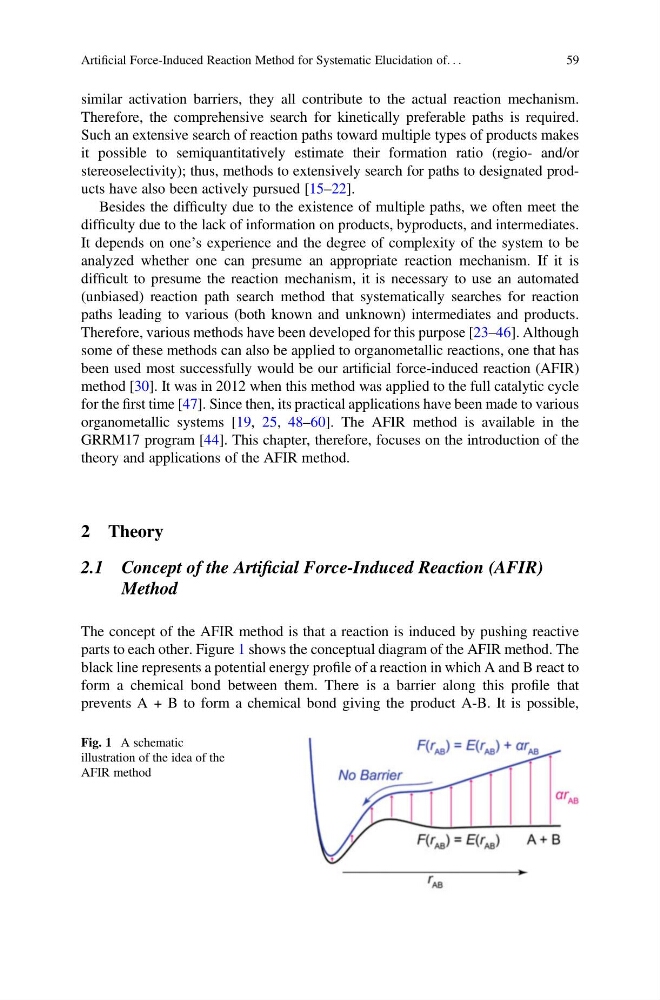
The concept of the AFIR method is that a reaction is induced by pushing reactive
parts to each other. Figure 1 shows the conceptual diagram of the AFIR method. The
black line represents a potential energy profile of a reaction in which A and B react to
form a chemical bond between them. There is a barrier along this profile that
prevents A + B to form a chemical bond giving the product A-B. It is possible,
Fig. 1 A schematic
illustration of the idea of the
AFIR method
Artificial Force-Induced Reaction Method for Systematic Elucidation of. . .
59
Therefore, the comprehensive search for kinetically preferable paths is required.
Such an extensive search of reaction paths toward multiple types of products makes
it possible to semiquantitatively estimate their formation ratio (regio- and/or
stereoselectivity); thus, methods to extensively search for paths to designated products have also been actively pursued [15–22].
Besides the difficulty due to the existence of multiple paths, we often meet the
difficulty due to the lack of information on products, byproducts, and intermediates.
It depends on one’s experience and the degree of complexity of the system to be
analyzed whether one can presume an appropriate reaction mechanism. If it is
difficult to presume the reaction mechanism, it is necessary to use an automated
(unbiased) reaction path search method that systematically searches for reaction
paths leading to various (both known and unknown) intermediates and products.
Therefore, various methods have been developed for this purpose [23–46]. Although
some of these methods can also be applied to organometallic reactions, one that has
been used most successfully would be our artificial force-induced reaction (AFIR)
method [30]. It was in 2012 when this method was applied to the full catalytic cycle
for the first time [47]. Since then, its practical applications have been made to various
organometallic systems [19, 25, 48–60]. The AFIR method is available in the
GRRM17 program [44]. This chapter, therefore, focuses on the introduction of the
theory and applications of the AFIR method.
2 Theory
2.1 Concept of the Artificial Force-Induced Reaction (AFIR)
Method
The concept of the AFIR method is that a reaction is induced by pushing reactive
parts to each other. Figure 1 shows the conceptual diagram of the AFIR method. The
black line represents a potential energy profile of a reaction in which A and B react to
form a chemical bond between them. There is a barrier along this profile that
prevents A + B to form a chemical bond giving the product A-B. It is possible,
Fig. 1 A schematic
illustration of the idea of the
AFIR method
Artificial Force-Induced Reaction Method for Systematic Elucidation of. . .
59