

oxyfluorination. The initial steps up to Int10 are identical, i.e., the carbene formation, O–H insertion, and proton transfer, giving the stable Rh-enol intermediate and
the concerted proton transfer-electrophilic addition. The next step has to differ,
however, because the trifluoromethyl group of 2 cannot coordinate to the rhodium
ion as the fluorine atom of 1 does. Therefore, the following isomerization step cannot
be catalyzed by the metal ion and takes place with a much higher barrier, making this
step rate-determining for the entire reaction, with an overall barrier of 24.8 kcal/mol.
The optimized structures of the TS9 CF3 , TS10 CF3 , and TS11 CF3 are also given in
Fig. 3.
5 Reactions with N–F and N–SCF 3 Reagents
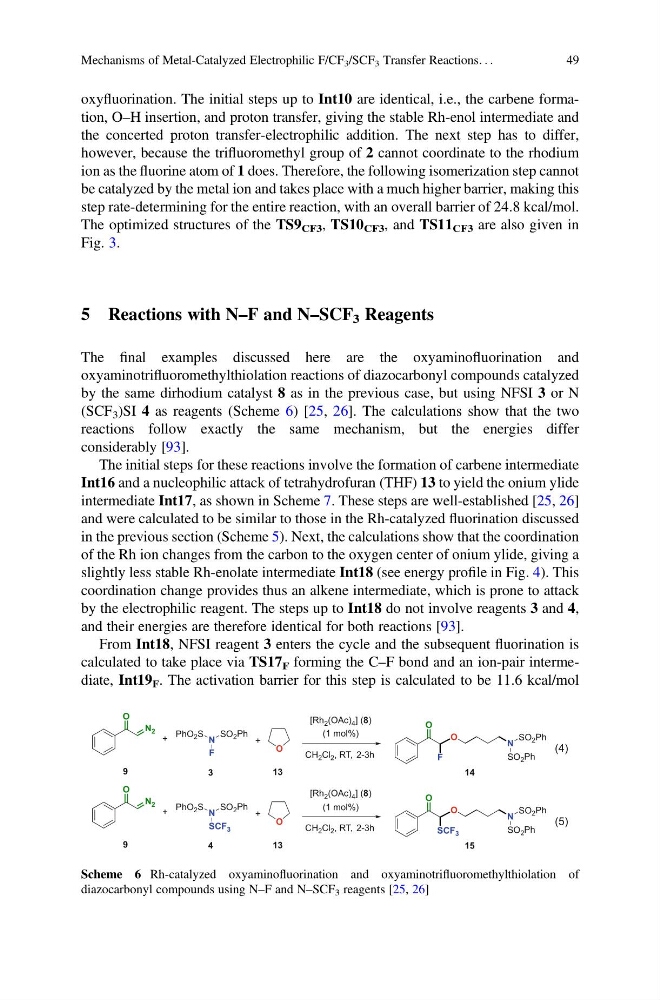
The final examples discussed here are the oxyaminofluorination and
oxyaminotrifluoromethylthiolation reactions of diazocarbonyl compounds catalyzed
by the same dirhodium catalyst 8 as in the previous case, but using NFSI 3 or N
(SCF 3 )SI 4 as reagents (Scheme 6) [25, 26]. The calculations show that the two
reactions follow exactly the same mechanism, but the energies differ
considerably [93].
The initial steps for these reactions involve the formation of carbene intermediate
Int16 and a nucleophilic attack of tetrahydrofuran (THF) 13 to yield the onium ylide
intermediate Int17, as shown in Scheme 7. These steps are well-established [25, 26]
and were calculated to be similar to those in the Rh-catalyzed fluorination discussed
in the previous section (Scheme 5). Next, the calculations show that the coordination
of the Rh ion changes from the carbon to the oxygen center of onium ylide, giving a
slightly less stable Rh-enolate intermediate Int18 (see energy profile in Fig. 4). This
coordination change provides thus an alkene intermediate, which is prone to attack
by the electrophilic reagent. The steps up to Int18 do not involve reagents 3 and 4,
and their energies are therefore identical for both reactions [93].
From Int18, NFSI reagent 3 enters the cycle and the subsequent fluorination is
calculated to take place via TS17 F forming the C–F bond and an ion-pair intermediate, Int19 F . The activation barrier for this step is calculated to be 11.6 kcal/mol
O
N 2 +
+
9
13
14
CH 2 Cl 2 , RT, 2-3h
[Rh 2 (OAc) 4 ] (8)
(1 mol%)
O
SO 2 Ph
PhO 2 S
F
N
3
O
O
F
N
SO 2 Ph
SO 2 Ph
(4)
O
N 2 +
+
9
13
15
CH 2 Cl 2 , RT, 2-3h
[Rh 2 (OAc) 4 ] (8)
(1 mol%)
O
SO 2 Ph
PhO 2 S
SCF 3
N
4
O
O
SCF 3
N
SO 2 Ph
SO 2 Ph
(5)
Scheme 6 Rh-catalyzed oxyaminofluorination and oxyaminotrifluoromethylthiolation of
diazocarbonyl compounds using N–F and N–SCF 3 reagents [25, 26]
Mechanisms of Metal-Catalyzed Electrophilic F/CF 3 /SCF 3 Transfer Reactions. . .
49
the concerted proton transfer-electrophilic addition. The next step has to differ,
however, because the trifluoromethyl group of 2 cannot coordinate to the rhodium
ion as the fluorine atom of 1 does. Therefore, the following isomerization step cannot
be catalyzed by the metal ion and takes place with a much higher barrier, making this
step rate-determining for the entire reaction, with an overall barrier of 24.8 kcal/mol.
The optimized structures of the TS9 CF3 , TS10 CF3 , and TS11 CF3 are also given in
Fig. 3.
5 Reactions with N–F and N–SCF 3 Reagents
The final examples discussed here are the oxyaminofluorination and
oxyaminotrifluoromethylthiolation reactions of diazocarbonyl compounds catalyzed
by the same dirhodium catalyst 8 as in the previous case, but using NFSI 3 or N
(SCF 3 )SI 4 as reagents (Scheme 6) [25, 26]. The calculations show that the two
reactions follow exactly the same mechanism, but the energies differ
considerably [93].
The initial steps for these reactions involve the formation of carbene intermediate
Int16 and a nucleophilic attack of tetrahydrofuran (THF) 13 to yield the onium ylide
intermediate Int17, as shown in Scheme 7. These steps are well-established [25, 26]
and were calculated to be similar to those in the Rh-catalyzed fluorination discussed
in the previous section (Scheme 5). Next, the calculations show that the coordination
of the Rh ion changes from the carbon to the oxygen center of onium ylide, giving a
slightly less stable Rh-enolate intermediate Int18 (see energy profile in Fig. 4). This
coordination change provides thus an alkene intermediate, which is prone to attack
by the electrophilic reagent. The steps up to Int18 do not involve reagents 3 and 4,
and their energies are therefore identical for both reactions [93].
From Int18, NFSI reagent 3 enters the cycle and the subsequent fluorination is
calculated to take place via TS17 F forming the C–F bond and an ion-pair intermediate, Int19 F . The activation barrier for this step is calculated to be 11.6 kcal/mol
O
N 2 +
+
9
13
14
CH 2 Cl 2 , RT, 2-3h
[Rh 2 (OAc) 4 ] (8)
(1 mol%)
O
SO 2 Ph
PhO 2 S
F
N
3
O
O
F
N
SO 2 Ph
SO 2 Ph
(4)
O
N 2 +
+
9
13
15
CH 2 Cl 2 , RT, 2-3h
[Rh 2 (OAc) 4 ] (8)
(1 mol%)
O
SO 2 Ph
PhO 2 S
SCF 3
N
4
O
O
SCF 3
N
SO 2 Ph
SO 2 Ph
(5)
Scheme 6 Rh-catalyzed oxyaminofluorination and oxyaminotrifluoromethylthiolation of
diazocarbonyl compounds using N–F and N–SCF 3 reagents [25, 26]
Mechanisms of Metal-Catalyzed Electrophilic F/CF 3 /SCF 3 Transfer Reactions. . .
49