

Based on the calculated energies, the rate-determining step was found to be the
carbene formation (TS6), with a barrier of 22.6 kcal/mol relative to Int5 (Scheme 5).
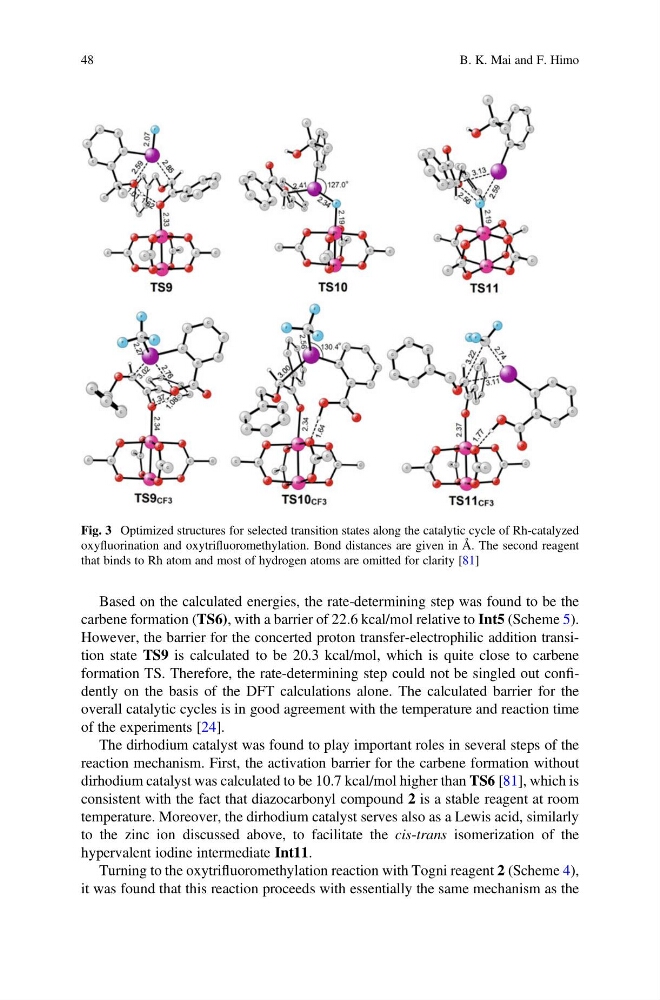
However, the barrier for the concerted proton transfer-electrophilic addition transition state TS9 is calculated to be 20.3 kcal/mol, which is quite close to carbene
formation TS. Therefore, the rate-determining step could not be singled out confidently on the basis of the DFT calculations alone. The calculated barrier for the
overall catalytic cycles is in good agreement with the temperature and reaction time
of the experiments [24].
The dirhodium catalyst was found to play important roles in several steps of the
reaction mechanism. First, the activation barrier for the carbene formation without
dirhodium catalyst was calculated to be 10.7 kcal/mol higher than TS6 [81], which is
consistent with the fact that diazocarbonyl compound 2 is a stable reagent at room
temperature. Moreover, the dirhodium catalyst serves also as a Lewis acid, similarly
to the zinc ion discussed above, to facilitate the cis-trans isomerization of the
hypervalent iodine intermediate Int11.
Turning to the oxytrifluoromethylation reaction with Togni reagent 2 (Scheme 4),
it was found that this reaction proceeds with essentially the same mechanism as the
Fig. 3 Optimized structures for selected transition states along the catalytic cycle of Rh-catalyzed
oxyfluorination and oxytrifluoromethylation. Bond distances are given in Å. The second reagent
that binds to Rh atom and most of hydrogen atoms are omitted for clarity [81]
48
B. K. Mai and F. Himo
carbene formation (TS6), with a barrier of 22.6 kcal/mol relative to Int5 (Scheme 5).
However, the barrier for the concerted proton transfer-electrophilic addition transition state TS9 is calculated to be 20.3 kcal/mol, which is quite close to carbene
formation TS. Therefore, the rate-determining step could not be singled out confidently on the basis of the DFT calculations alone. The calculated barrier for the
overall catalytic cycles is in good agreement with the temperature and reaction time
of the experiments [24].
The dirhodium catalyst was found to play important roles in several steps of the
reaction mechanism. First, the activation barrier for the carbene formation without
dirhodium catalyst was calculated to be 10.7 kcal/mol higher than TS6 [81], which is
consistent with the fact that diazocarbonyl compound 2 is a stable reagent at room
temperature. Moreover, the dirhodium catalyst serves also as a Lewis acid, similarly
to the zinc ion discussed above, to facilitate the cis-trans isomerization of the
hypervalent iodine intermediate Int11.
Turning to the oxytrifluoromethylation reaction with Togni reagent 2 (Scheme 4),
it was found that this reaction proceeds with essentially the same mechanism as the
Fig. 3 Optimized structures for selected transition states along the catalytic cycle of Rh-catalyzed
oxyfluorination and oxytrifluoromethylation. Bond distances are given in Å. The second reagent
that binds to Rh atom and most of hydrogen atoms are omitted for clarity [81]
48
B. K. Mai and F. Himo