

4 Rhodium-Catalyzed Oxyfluorination
and Trifluoromethylation of Diazocarbonyl Compounds
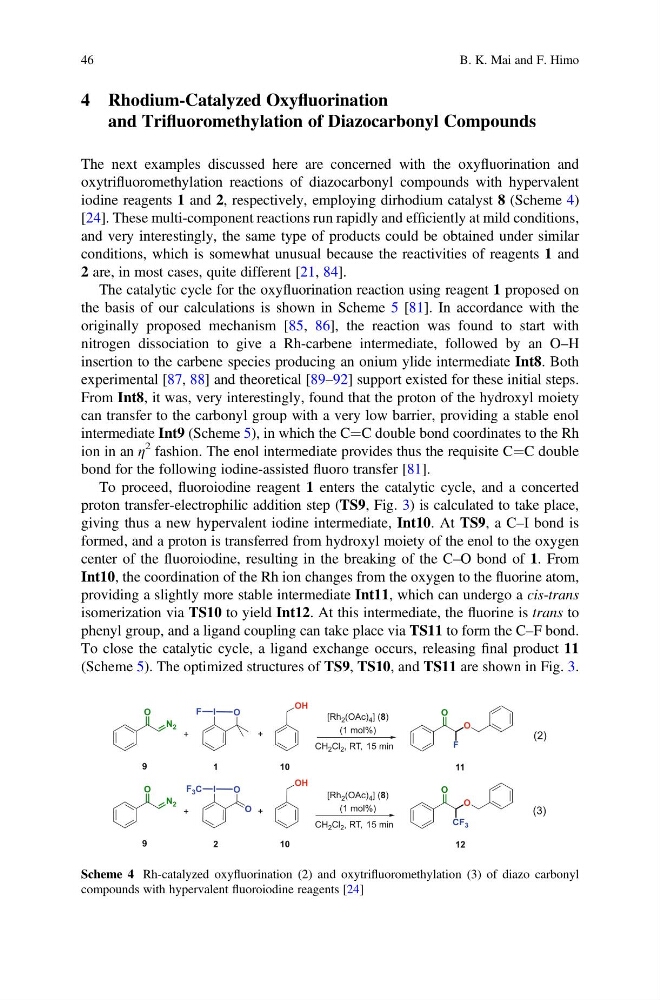
The next examples discussed here are concerned with the oxyfluorination and
oxytrifluoromethylation reactions of diazocarbonyl compounds with hypervalent
iodine reagents 1 and 2, respectively, employing dirhodium catalyst 8 (Scheme 4)
[24]. These multi-component reactions run rapidly and efficiently at mild conditions,
and very interestingly, the same type of products could be obtained under similar
conditions, which is somewhat unusual because the reactivities of reagents 1 and
2 are, in most cases, quite different [21, 84].
The catalytic cycle for the oxyfluorination reaction using reagent 1 proposed on
the basis of our calculations is shown in Scheme 5 [81]. In accordance with the
originally proposed mechanism [85, 86], the reaction was found to start with
nitrogen dissociation to give a Rh-carbene intermediate, followed by an O–H
insertion to the carbene species producing an onium ylide intermediate Int8. Both
experimental [87, 88] and theoretical [89–92] support existed for these initial steps.
From Int8, it was, very interestingly, found that the proton of the hydroxyl moiety
can transfer to the carbonyl group with a very low barrier, providing a stable enol
intermediate Int9 (Scheme 5), in which the C¼C double bond coordinates to the Rh
ion in an η
2 fashion. The enol intermediate provides thus the requisite C¼C double
bond for the following iodine-assisted fluoro transfer [81].
To proceed, fluoroiodine reagent 1 enters the catalytic cycle, and a concerted
proton transfer-electrophilic addition step (TS9, Fig. 3) is calculated to take place,
giving thus a new hypervalent iodine intermediate, Int10. At TS9, a C–I bond is
formed, and a proton is transferred from hydroxyl moiety of the enol to the oxygen
center of the fluoroiodine, resulting in the breaking of the C–O bond of 1. From
Int10, the coordination of the Rh ion changes from the oxygen to the fluorine atom,
providing a slightly more stable intermediate Int11, which can undergo a cis-trans
isomerization via TS10 to yield Int12. At this intermediate, the fluorine is trans to
phenyl group, and a ligand coupling can take place via TS11 to form the C–F bond.
To close the catalytic cycle, a ligand exchange occurs, releasing final product 11
(Scheme 5). The optimized structures of TS9, TS10, and TS11 are shown in Fig. 3.
O
N 2
O
I
F
OH
F
O
O
+
+
9
1
10
11
O
N 2
O
O
I
F 3 C
OH
CF 3
O
O
+
+
9
2
10
12
CH 2 Cl 2 , RT, 15 min
[Rh 2 (OAc) 4 ] (8)
(1 mol%)
CH 2 Cl 2 , RT, 15 min
[Rh 2 (OAc) 4 ] (8)
(1 mol%)
(2)
(3)
Scheme 4 Rh-catalyzed oxyfluorination (2) and oxytrifluoromethylation (3) of diazo carbonyl
compounds with hypervalent fluoroiodine reagents [24]
46
B. K. Mai and F. Himo
and Trifluoromethylation of Diazocarbonyl Compounds
The next examples discussed here are concerned with the oxyfluorination and
oxytrifluoromethylation reactions of diazocarbonyl compounds with hypervalent
iodine reagents 1 and 2, respectively, employing dirhodium catalyst 8 (Scheme 4)
[24]. These multi-component reactions run rapidly and efficiently at mild conditions,
and very interestingly, the same type of products could be obtained under similar
conditions, which is somewhat unusual because the reactivities of reagents 1 and
2 are, in most cases, quite different [21, 84].
The catalytic cycle for the oxyfluorination reaction using reagent 1 proposed on
the basis of our calculations is shown in Scheme 5 [81]. In accordance with the
originally proposed mechanism [85, 86], the reaction was found to start with
nitrogen dissociation to give a Rh-carbene intermediate, followed by an O–H
insertion to the carbene species producing an onium ylide intermediate Int8. Both
experimental [87, 88] and theoretical [89–92] support existed for these initial steps.
From Int8, it was, very interestingly, found that the proton of the hydroxyl moiety
can transfer to the carbonyl group with a very low barrier, providing a stable enol
intermediate Int9 (Scheme 5), in which the C¼C double bond coordinates to the Rh
ion in an η
2 fashion. The enol intermediate provides thus the requisite C¼C double
bond for the following iodine-assisted fluoro transfer [81].
To proceed, fluoroiodine reagent 1 enters the catalytic cycle, and a concerted
proton transfer-electrophilic addition step (TS9, Fig. 3) is calculated to take place,
giving thus a new hypervalent iodine intermediate, Int10. At TS9, a C–I bond is
formed, and a proton is transferred from hydroxyl moiety of the enol to the oxygen
center of the fluoroiodine, resulting in the breaking of the C–O bond of 1. From
Int10, the coordination of the Rh ion changes from the oxygen to the fluorine atom,
providing a slightly more stable intermediate Int11, which can undergo a cis-trans
isomerization via TS10 to yield Int12. At this intermediate, the fluorine is trans to
phenyl group, and a ligand coupling can take place via TS11 to form the C–F bond.
To close the catalytic cycle, a ligand exchange occurs, releasing final product 11
(Scheme 5). The optimized structures of TS9, TS10, and TS11 are shown in Fig. 3.
O
N 2
O
I
F
OH
F
O
O
+
+
9
1
10
11
O
N 2
O
O
I
F 3 C
OH
CF 3
O
O
+
+
9
2
10
12
CH 2 Cl 2 , RT, 15 min
[Rh 2 (OAc) 4 ] (8)
(1 mol%)
CH 2 Cl 2 , RT, 15 min
[Rh 2 (OAc) 4 ] (8)
(1 mol%)
(2)
(3)
Scheme 4 Rh-catalyzed oxyfluorination (2) and oxytrifluoromethylation (3) of diazo carbonyl
compounds with hypervalent fluoroiodine reagents [24]
46
B. K. Mai and F. Himo