

play an active role in the reaction. The reaction in solution may follow a different
mechanism than that in the gas phase [105]. In such a case the common computational approach of complementing a quantum-chemical description of the reacting
species with a continuum model of the solvent will fail to capture important effects.
A proper understanding of reactions in hydrogen-bonded solvents requires taking
into account the nearest solvating molecules on an atomistic level.
As discussed in the preceding paragraph, specific interactions with the solvent are
important in protic solvents such as methanol, particularly on proton transfer reactions. The importance of the proper description of the methanol solvent can be
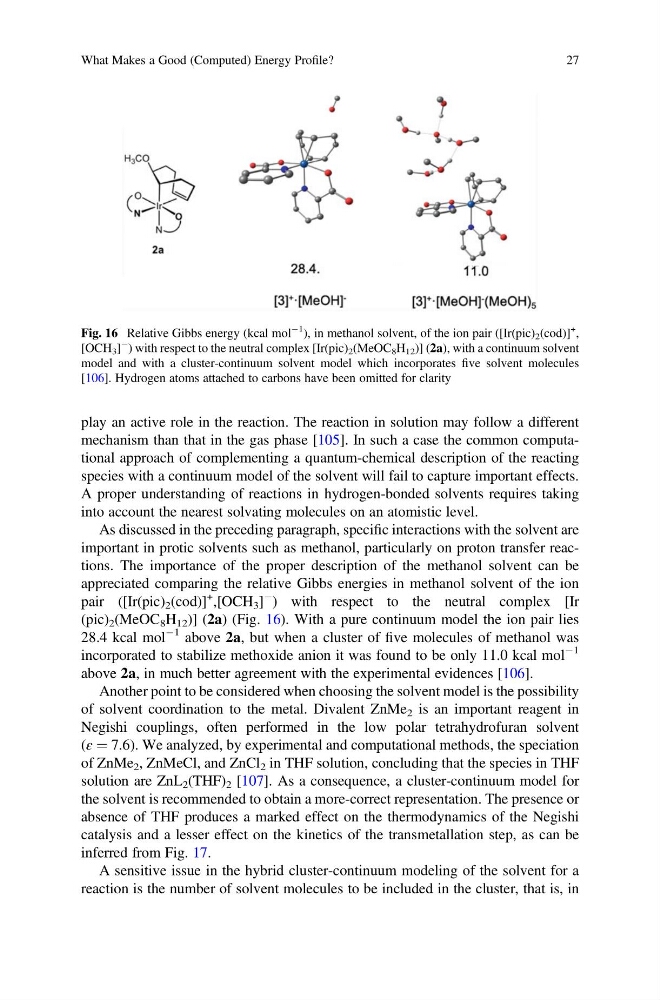
appreciated comparing the relative Gibbs energies in methanol solvent of the ion
pair ([Ir(pic) 2 (cod)]
+ ,[OCH 3 ]
À
) with respect to the neutral complex [Ir
(pic) 2 (MeOC 8 H 12 )] (2a) (Fig. 16). With a pure continuum model the ion pair lies
28.4 kcal mol
À1 above 2a, but when a cluster of five molecules of methanol was
incorporated to stabilize methoxide anion it was found to be only 11.0 kcal mol
À1
above 2a, in much better agreement with the experimental evidences [106].
Another point to be considered when choosing the solvent model is the possibility
of solvent coordination to the metal. Divalent ZnMe 2 is an important reagent in
Negishi couplings, often performed in the low polar tetrahydrofuran solvent
(ε ¼ 7.6). We analyzed, by experimental and computational methods, the speciation
of ZnMe 2 , ZnMeCl, and ZnCl 2 in THF solution, concluding that the species in THF
solution are ZnL 2 (THF) 2 [107]. As a consequence, a cluster-continuum model for
the solvent is recommended to obtain a more-correct representation. The presence or
absence of THF produces a marked effect on the thermodynamics of the Negishi
catalysis and a lesser effect on the kinetics of the transmetallation step, as can be
inferred from Fig. 17.
A sensitive issue in the hybrid cluster-continuum modeling of the solvent for a
reaction is the number of solvent molecules to be included in the cluster, that is, in
Fig. 16 Relative Gibbs energy (kcal mol
À1
), in methanol solvent, of the ion pair ([Ir(pic) 2 (cod)]
+ ,
[OCH 3 ]
À
) with respect to the neutral complex [Ir(pic) 2 (MeOC 8 H 12 )] (2a), with a continuum solvent
model and with a cluster-continuum solvent model which incorporates five solvent molecules
[106]. Hydrogen atoms attached to carbons have been omitted for clarity
What Makes a Good (Computed) Energy Profile?
27
mechanism than that in the gas phase [105]. In such a case the common computational approach of complementing a quantum-chemical description of the reacting
species with a continuum model of the solvent will fail to capture important effects.
A proper understanding of reactions in hydrogen-bonded solvents requires taking
into account the nearest solvating molecules on an atomistic level.
As discussed in the preceding paragraph, specific interactions with the solvent are
important in protic solvents such as methanol, particularly on proton transfer reactions. The importance of the proper description of the methanol solvent can be
appreciated comparing the relative Gibbs energies in methanol solvent of the ion
pair ([Ir(pic) 2 (cod)]
+ ,[OCH 3 ]
À
) with respect to the neutral complex [Ir
(pic) 2 (MeOC 8 H 12 )] (2a) (Fig. 16). With a pure continuum model the ion pair lies
28.4 kcal mol
À1 above 2a, but when a cluster of five molecules of methanol was
incorporated to stabilize methoxide anion it was found to be only 11.0 kcal mol
À1
above 2a, in much better agreement with the experimental evidences [106].
Another point to be considered when choosing the solvent model is the possibility
of solvent coordination to the metal. Divalent ZnMe 2 is an important reagent in
Negishi couplings, often performed in the low polar tetrahydrofuran solvent
(ε ¼ 7.6). We analyzed, by experimental and computational methods, the speciation
of ZnMe 2 , ZnMeCl, and ZnCl 2 in THF solution, concluding that the species in THF
solution are ZnL 2 (THF) 2 [107]. As a consequence, a cluster-continuum model for
the solvent is recommended to obtain a more-correct representation. The presence or
absence of THF produces a marked effect on the thermodynamics of the Negishi
catalysis and a lesser effect on the kinetics of the transmetallation step, as can be
inferred from Fig. 17.
A sensitive issue in the hybrid cluster-continuum modeling of the solvent for a
reaction is the number of solvent molecules to be included in the cluster, that is, in
Fig. 16 Relative Gibbs energy (kcal mol
À1
), in methanol solvent, of the ion pair ([Ir(pic) 2 (cod)]
+ ,
[OCH 3 ]
À
) with respect to the neutral complex [Ir(pic) 2 (MeOC 8 H 12 )] (2a), with a continuum solvent
model and with a cluster-continuum solvent model which incorporates five solvent molecules
[106]. Hydrogen atoms attached to carbons have been omitted for clarity
What Makes a Good (Computed) Energy Profile?
27