

Anionic
Ligands (L)
Cationic
Neutral
Calculated TEP
Measured TEP
Ligands (L)
Ligands (L)
Tolman Electronic Parameter TEP [cm -1
]
1900
1950
2000
2050
2100
2150
2200
2250
2300
Local Stretching Frequency
a (CO) [cm
-1
]
1900
2000
2100
2200
2300
A 1 -symmetrial CO
stretching frequency
O
C
Ni
L
O
Coupling error
Ideal TEP without
coupling
(a)
I
-
H
-
Cl
-
Br
-
F
-
CS
CH 2
C=CH 2
CF 2
CO
CH
+
CN
-
CCH
-
CH
-
3
NCH
N 2
NH 3 , NMe 3
NF 3
NCMe
NC
-
NO
+
NO
-
OH 2
OMe 2
SMe
-
SH
-
OMe
-
OH
-
PH 2 F
PCl 3
PF 3
PHF 2
PH 3
P(OMe) 3
PMe 3
PH 2 Me
SH 2
SMe 2
SiH
-
3
(C 2 H 4 )
(H 2 )
Coup (CO) [cm -1
]
20
40
60
80
100
a (CO) [cm -1 ]
2000
2100
2200
2300
O
C
Ni
L
O
(b)
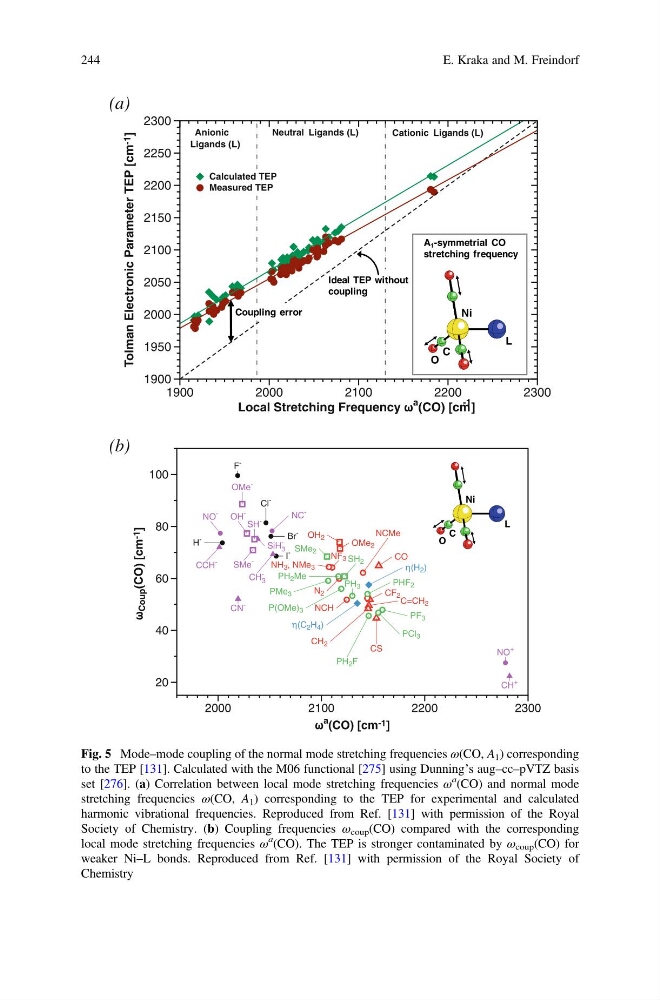
Fig. 5 Mode–mode coupling of the normal mode stretching frequencies ω(CO, A 1 ) corresponding
to the TEP [131]. Calculated with the M06 functional [275] using Dunning’s aug–cc–pVTZ basis
set [276]. (a) Correlation between local mode stretching frequencies ω
a
(CO) and normal mode
stretching frequencies ω(CO, A 1 ) corresponding to the TEP for experimental and calculated
harmonic vibrational frequencies. Reproduced from Ref. [131] with permission of the Royal
Society of Chemistry. (b) Coupling frequencies ω coup (CO) compared with the corresponding
local mode stretching frequencies ω
a
(CO). The TEP is stronger contaminated by ω coup (CO) for
weaker Ni–L bonds. Reproduced from Ref. [131] with permission of the Royal Society of
Chemistry
244
E. Kraka and M. Freindorf
Ligands (L)
Cationic
Neutral
Calculated TEP
Measured TEP
Ligands (L)
Ligands (L)
Tolman Electronic Parameter TEP [cm -1
]
1900
1950
2000
2050
2100
2150
2200
2250
2300
Local Stretching Frequency
a (CO) [cm
-1
]
1900
2000
2100
2200
2300
A 1 -symmetrial CO
stretching frequency
O
C
Ni
L
O
Coupling error
Ideal TEP without
coupling
(a)
I
-
H
-
Cl
-
Br
-
F
-
CS
CH 2
C=CH 2
CF 2
CO
CH
+
CN
-
CCH
-
CH
-
3
NCH
N 2
NH 3 , NMe 3
NF 3
NCMe
NC
-
NO
+
NO
-
OH 2
OMe 2
SMe
-
SH
-
OMe
-
OH
-
PH 2 F
PCl 3
PF 3
PHF 2
PH 3
P(OMe) 3
PMe 3
PH 2 Me
SH 2
SMe 2
SiH
-
3
(C 2 H 4 )
(H 2 )
Coup (CO) [cm -1
]
20
40
60
80
100
a (CO) [cm -1 ]
2000
2100
2200
2300
O
C
Ni
L
O
(b)
Fig. 5 Mode–mode coupling of the normal mode stretching frequencies ω(CO, A 1 ) corresponding
to the TEP [131]. Calculated with the M06 functional [275] using Dunning’s aug–cc–pVTZ basis
set [276]. (a) Correlation between local mode stretching frequencies ω
a
(CO) and normal mode
stretching frequencies ω(CO, A 1 ) corresponding to the TEP for experimental and calculated
harmonic vibrational frequencies. Reproduced from Ref. [131] with permission of the Royal
Society of Chemistry. (b) Coupling frequencies ω coup (CO) compared with the corresponding
local mode stretching frequencies ω
a
(CO). The TEP is stronger contaminated by ω coup (CO) for
weaker Ni–L bonds. Reproduced from Ref. [131] with permission of the Royal Society of
Chemistry
244
E. Kraka and M. Freindorf