

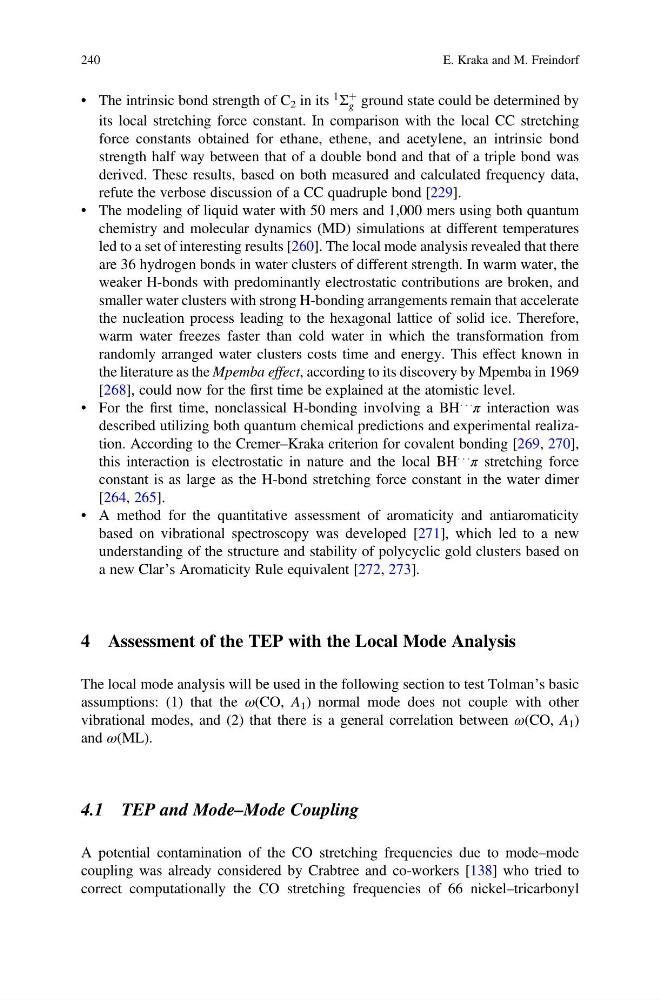
• The intrinsic bond strength of C 2 in its
1
Σ
þ
g ground state could be determined by
its local stretching force constant. In comparison with the local CC stretching
force constants obtained for ethane, ethene, and acetylene, an intrinsic bond
strength half way between that of a double bond and that of a triple bond was
derived. These results, based on both measured and calculated frequency data,
refute the verbose discussion of a CC quadruple bond [229].
• The modeling of liquid water with 50 mers and 1,000 mers using both quantum
chemistry and molecular dynamics (MD) simulations at different temperatures
led to a set of interesting results [260]. The local mode analysis revealed that there
are 36 hydrogen bonds in water clusters of different strength. In warm water, the
weaker H-bonds with predominantly electrostatic contributions are broken, and
smaller water clusters with strong H-bonding arrangements remain that accelerate
the nucleation process leading to the hexagonal lattice of solid ice. Therefore,
warm water freezes faster than cold water in which the transformation from
randomly arranged water clusters costs time and energy. This effect known in
the literature as the Mpemba effect, according to its discovery by Mpemba in 1969
[268], could now for the first time be explained at the atomistic level.
• For the first time, nonclassical H-bonding involving a BH
. . .
π interaction was
described utilizing both quantum chemical predictions and experimental realization. According to the Cremer–Kraka criterion for covalent bonding [269, 270],
this interaction is electrostatic in nature and the local BH
. . . π stretching force
constant is as large as the H-bond stretching force constant in the water dimer
[264, 265].
• A method for the quantitative assessment of aromaticity and antiaromaticity
based on vibrational spectroscopy was developed [271], which led to a new
understanding of the structure and stability of polycyclic gold clusters based on
a new Clar’s Aromaticity Rule equivalent [272, 273].
4 Assessment of the TEP with the Local Mode Analysis
The local mode analysis will be used in the following section to test Tolman’s basic
assumptions: (1) that the ω(CO, A 1 ) normal mode does not couple with other
vibrational modes, and (2) that there is a general correlation between ω(CO, A 1 )
and ω(ML).
4.1 TEP and Mode–Mode Coupling
A potential contamination of the CO stretching frequencies due to mode–mode
coupling was already considered by Crabtree and co-workers [138] who tried to
correct computationally the CO stretching frequencies of 66 nickel–tricarbonyl
240
E. Kraka and M. Freindorf
1
Σ
þ
g ground state could be determined by
its local stretching force constant. In comparison with the local CC stretching
force constants obtained for ethane, ethene, and acetylene, an intrinsic bond
strength half way between that of a double bond and that of a triple bond was
derived. These results, based on both measured and calculated frequency data,
refute the verbose discussion of a CC quadruple bond [229].
• The modeling of liquid water with 50 mers and 1,000 mers using both quantum
chemistry and molecular dynamics (MD) simulations at different temperatures
led to a set of interesting results [260]. The local mode analysis revealed that there
are 36 hydrogen bonds in water clusters of different strength. In warm water, the
weaker H-bonds with predominantly electrostatic contributions are broken, and
smaller water clusters with strong H-bonding arrangements remain that accelerate
the nucleation process leading to the hexagonal lattice of solid ice. Therefore,
warm water freezes faster than cold water in which the transformation from
randomly arranged water clusters costs time and energy. This effect known in
the literature as the Mpemba effect, according to its discovery by Mpemba in 1969
[268], could now for the first time be explained at the atomistic level.
• For the first time, nonclassical H-bonding involving a BH
. . .
π interaction was
described utilizing both quantum chemical predictions and experimental realization. According to the Cremer–Kraka criterion for covalent bonding [269, 270],
this interaction is electrostatic in nature and the local BH
. . . π stretching force
constant is as large as the H-bond stretching force constant in the water dimer
[264, 265].
• A method for the quantitative assessment of aromaticity and antiaromaticity
based on vibrational spectroscopy was developed [271], which led to a new
understanding of the structure and stability of polycyclic gold clusters based on
a new Clar’s Aromaticity Rule equivalent [272, 273].
4 Assessment of the TEP with the Local Mode Analysis
The local mode analysis will be used in the following section to test Tolman’s basic
assumptions: (1) that the ω(CO, A 1 ) normal mode does not couple with other
vibrational modes, and (2) that there is a general correlation between ω(CO, A 1 )
and ω(ML).
4.1 TEP and Mode–Mode Coupling
A potential contamination of the CO stretching frequencies due to mode–mode
coupling was already considered by Crabtree and co-workers [138] who tried to
correct computationally the CO stretching frequencies of 66 nickel–tricarbonyl
240
E. Kraka and M. Freindorf