

phosphines, for other ligands, a second ML bonding mechanism in a form of a strong
π-acceptor ability becomes dominant. A series of 14 linear relationships between the
TEP and the CO stretching frequencies of V, Cr, Mo, W, Mn, Fe, and Rh complexes
has been published by Kühl [134]:
TEP ¼ Aω M; CO, A 1
ð
ÞþB
ð2Þ
where each new type of a given transition metal complex (with the same transition
metal (M)) required a different relationship with correlation coefficients R
2 ranging
from 0.799 to 0.996. A significant data scattering suggested that for a given
transition metal (M), complexes of the type [R n M(CO) m L] may be subject to
different ML bonding mechanisms depending on the ligands R and L and the
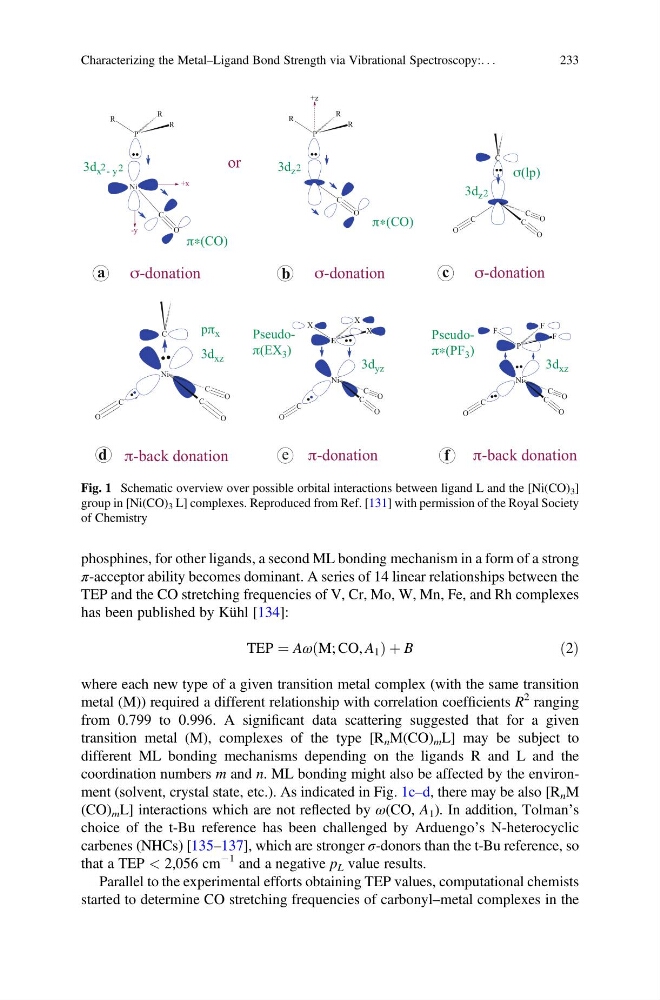
coordination numbers m and n. ML bonding might also be affected by the environment (solvent, crystal state, etc.). As indicated in Fig. 1c–d, there may be also [R n M
(CO) m L] interactions which are not reflected by ω(CO, A 1 ). In addition, Tolman’s
choice of the t-Bu reference has been challenged by Arduengo’s N-heterocyclic
carbenes (NHCs) [135–137], which are stronger σ-donors than the t-Bu reference, so
that a TEP < 2,056 cm
À1 and a negative p L value results.
Parallel to the experimental efforts obtaining TEP values, computational chemists
started to determine CO stretching frequencies of carbonyl–metal complexes in the
O
Ni
C
p x
3d xz
C
O
C
(lp)
3d z
C
2
-donation
-back donation
O
C
O
C
O
C
O
C
c
d
C
O
+x
-y
Ni
3d x - y 2
2
P
R
R
R
P
R
R
R
C
O
+z
3d z 2
or
(CO)
(CO)
a
-donation
b
-donation
O
C
P
Pseudo(PF 3 )
3d xz
F
F
F
-back donation
Ni
O
C
O
C
O
C
3d yz
-donation
E
Pseudo(EX 3 )
X
X
X
Ni
O
C
O
C
e
f
Fig. 1 Schematic overview over possible orbital interactions between ligand L and the [Ni(CO) 3 ]
group in [Ni(CO) 3 L] complexes. Reproduced from Ref. [131] with permission of the Royal Society
of Chemistry
Characterizing the Metal–Ligand Bond Strength via Vibrational Spectroscopy:. . .
233
π-acceptor ability becomes dominant. A series of 14 linear relationships between the
TEP and the CO stretching frequencies of V, Cr, Mo, W, Mn, Fe, and Rh complexes
has been published by Kühl [134]:
TEP ¼ Aω M; CO, A 1
ð
ÞþB
ð2Þ
where each new type of a given transition metal complex (with the same transition
metal (M)) required a different relationship with correlation coefficients R
2 ranging
from 0.799 to 0.996. A significant data scattering suggested that for a given
transition metal (M), complexes of the type [R n M(CO) m L] may be subject to
different ML bonding mechanisms depending on the ligands R and L and the
coordination numbers m and n. ML bonding might also be affected by the environment (solvent, crystal state, etc.). As indicated in Fig. 1c–d, there may be also [R n M
(CO) m L] interactions which are not reflected by ω(CO, A 1 ). In addition, Tolman’s
choice of the t-Bu reference has been challenged by Arduengo’s N-heterocyclic
carbenes (NHCs) [135–137], which are stronger σ-donors than the t-Bu reference, so
that a TEP < 2,056 cm
À1 and a negative p L value results.
Parallel to the experimental efforts obtaining TEP values, computational chemists
started to determine CO stretching frequencies of carbonyl–metal complexes in the
O
Ni
C
p x
3d xz
C
O
C
(lp)
3d z
C
2
-donation
-back donation
O
C
O
C
O
C
O
C
c
d
C
O
+x
-y
Ni
3d x - y 2
2
P
R
R
R
P
R
R
R
C
O
+z
3d z 2
or
(CO)
(CO)
a
-donation
b
-donation
O
C
P
Pseudo(PF 3 )
3d xz
F
F
F
-back donation
Ni
O
C
O
C
O
C
3d yz
-donation
E
Pseudo(EX 3 )
X
X
X
Ni
O
C
O
C
e
f
Fig. 1 Schematic overview over possible orbital interactions between ligand L and the [Ni(CO) 3 ]
group in [Ni(CO) 3 L] complexes. Reproduced from Ref. [131] with permission of the Royal Society
of Chemistry
Characterizing the Metal–Ligand Bond Strength via Vibrational Spectroscopy:. . .
233