

For both the TMCO and TMCH ligands, the S12g/TZ2P computed Mössbauer
parameters for the isomer shift (δ) and quadrupole splitting (ΔE q ) were in excellent
agreement with experiment.
5.2 Intradiol vs. Extradiol Selectivity
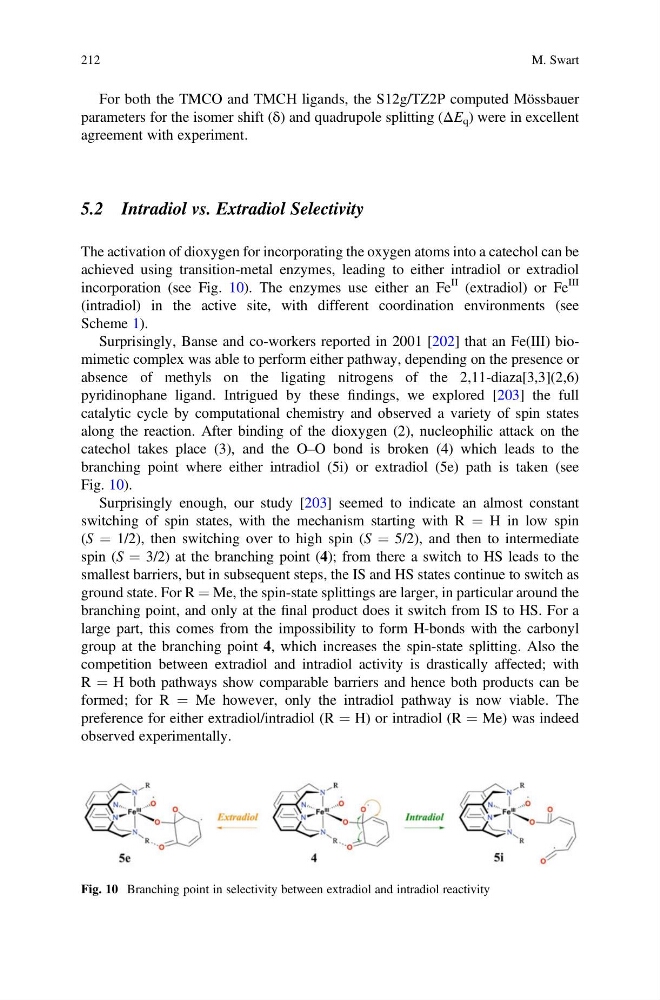
The activation of dioxygen for incorporating the oxygen atoms into a catechol can be
achieved using transition-metal enzymes, leading to either intradiol or extradiol
incorporation (see Fig. 10). The enzymes use either an Fe
II (extradiol) or Fe
III
(intradiol) in the active site, with different coordination environments (see
Scheme 1).
Surprisingly, Banse and co-workers reported in 2001 [202] that an Fe(III) biomimetic complex was able to perform either pathway, depending on the presence or
absence of methyls on the ligating nitrogens of the 2,11-diaza[3,3](2,6)
pyridinophane ligand. Intrigued by these findings, we explored [203] the full
catalytic cycle by computational chemistry and observed a variety of spin states
along the reaction. After binding of the dioxygen (2), nucleophilic attack on the
catechol takes place (3), and the O–O bond is broken (4) which leads to the
branching point where either intradiol (5i) or extradiol (5e) path is taken (see
Fig. 10).
Surprisingly enough, our study [203] seemed to indicate an almost constant
switching of spin states, with the mechanism starting with R ¼ H in low spin
(S ¼ 1/2), then switching over to high spin (S ¼ 5/2), and then to intermediate
spin (S ¼ 3/2) at the branching point (4); from there a switch to HS leads to the
smallest barriers, but in subsequent steps, the IS and HS states continue to switch as
ground state. For R ¼ Me, the spin-state splittings are larger, in particular around the
branching point, and only at the final product does it switch from IS to HS. For a
large part, this comes from the impossibility to form H-bonds with the carbonyl
group at the branching point 4, which increases the spin-state splitting. Also the
competition between extradiol and intradiol activity is drastically affected; with
R ¼ H both pathways show comparable barriers and hence both products can be
formed; for R ¼ Me however, only the intradiol pathway is now viable. The
preference for either extradiol/intradiol (R ¼ H) or intradiol (R ¼ Me) was indeed
observed experimentally.
Fig. 10 Branching point in selectivity between extradiol and intradiol reactivity
212
M. Swart
parameters for the isomer shift (δ) and quadrupole splitting (ΔE q ) were in excellent
agreement with experiment.
5.2 Intradiol vs. Extradiol Selectivity
The activation of dioxygen for incorporating the oxygen atoms into a catechol can be
achieved using transition-metal enzymes, leading to either intradiol or extradiol
incorporation (see Fig. 10). The enzymes use either an Fe
II (extradiol) or Fe
III
(intradiol) in the active site, with different coordination environments (see
Scheme 1).
Surprisingly, Banse and co-workers reported in 2001 [202] that an Fe(III) biomimetic complex was able to perform either pathway, depending on the presence or
absence of methyls on the ligating nitrogens of the 2,11-diaza[3,3](2,6)
pyridinophane ligand. Intrigued by these findings, we explored [203] the full
catalytic cycle by computational chemistry and observed a variety of spin states
along the reaction. After binding of the dioxygen (2), nucleophilic attack on the
catechol takes place (3), and the O–O bond is broken (4) which leads to the
branching point where either intradiol (5i) or extradiol (5e) path is taken (see
Fig. 10).
Surprisingly enough, our study [203] seemed to indicate an almost constant
switching of spin states, with the mechanism starting with R ¼ H in low spin
(S ¼ 1/2), then switching over to high spin (S ¼ 5/2), and then to intermediate
spin (S ¼ 3/2) at the branching point (4); from there a switch to HS leads to the
smallest barriers, but in subsequent steps, the IS and HS states continue to switch as
ground state. For R ¼ Me, the spin-state splittings are larger, in particular around the
branching point, and only at the final product does it switch from IS to HS. For a
large part, this comes from the impossibility to form H-bonds with the carbonyl
group at the branching point 4, which increases the spin-state splitting. Also the
competition between extradiol and intradiol activity is drastically affected; with
R ¼ H both pathways show comparable barriers and hence both products can be
formed; for R ¼ Me however, only the intradiol pathway is now viable. The
preference for either extradiol/intradiol (R ¼ H) or intradiol (R ¼ Me) was indeed
observed experimentally.
Fig. 10 Branching point in selectivity between extradiol and intradiol reactivity
212
M. Swart