

the electron flow associated with HAT is continuous and smooth [195]. Instead, for
the cPCET pathway of lipoxygenase, with an Fe(III)-hydroxo as active species, a
different picture was observed; the α electron of the C–H bond remains on the
substrate, while the β electron is transferred to the iron center and ends up in a
non-bonding d-orbital. Hence, the IBO view allows a nice visual representation of
the electron flow in these reactions, which helps both in our understanding of the
reactions that are taking place, and, as in this case, is able to distinguish between
different mechanisms such as HAT and cPCET.
5.1.2 Ligand Modification
As mentioned above, the [Fe
IV
(O)(TMC)]
2+ complex [190] (TMC ¼ 1,4,8,11tetramethyl-1,4,8,11-tetraazacyclotetradecane) is fairly stable and unable to oxidize
cyclohexane. Recently, together with the groups of Ray and Nam, we reported a
modification of the TMC ligand that was observed to be six orders of magnitude
faster [198]. One of the NMe groups of the TMC ring was replaced by oxygen
(TMCO), which changes the ligand field and lowers the σ* acceptor orbital; simultaneously, the spin state changed from a triplet state (S ¼ 1) for [Fe
IV
(O)(TMC)]
2+ to
quintet for [Fe
IV
(O)(TMCO)]
2+ (with the S12g DFA). The change in spin state
makes that a spin-switch is no longer needed to reach the spin state with the lowest
barrier along the oxidation pathway; however, most importantly, the barrier reduced
dramatically (ca. 12 kcal mol
À1 ) [199]. This change in barrier resulted as the
combination of two effects, an electronic one based on the energy of the σ* orbital
and a steric one based on the possibility of the substrate to reach the iron-oxo
moiety [199].
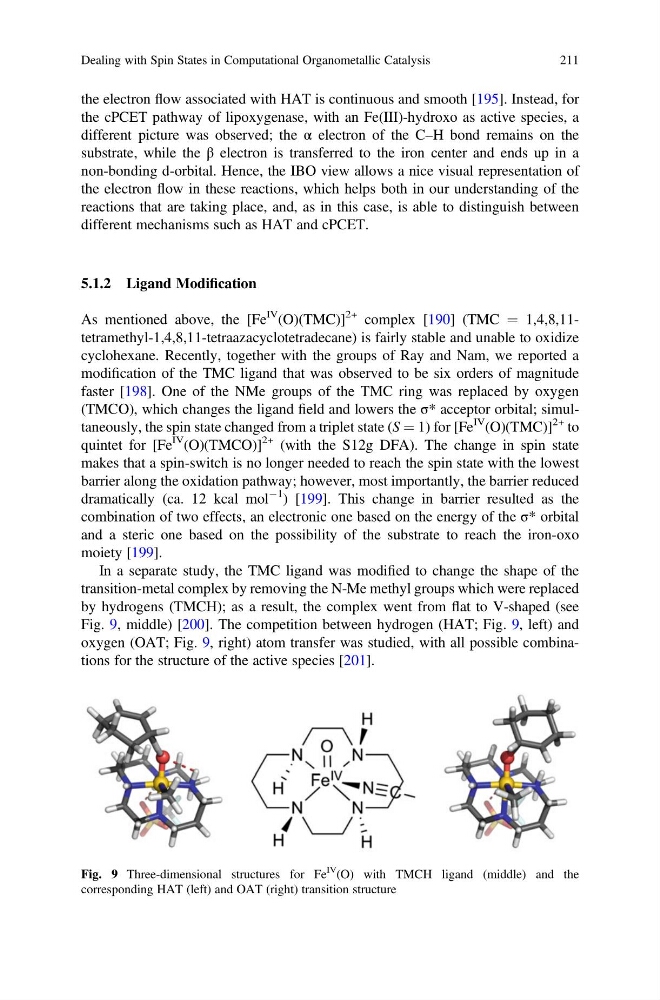
In a separate study, the TMC ligand was modified to change the shape of the
transition-metal complex by removing the N-Me methyl groups which were replaced
by hydrogens (TMCH); as a result, the complex went from flat to V-shaped (see
Fig. 9, middle) [200]. The competition between hydrogen (HAT; Fig. 9, left) and
oxygen (OAT; Fig. 9, right) atom transfer was studied, with all possible combinations for the structure of the active species [201].
Fig. 9 Three-dimensional structures for Fe
IV
(O) with TMCH ligand (middle) and the
corresponding HAT (left) and OAT (right) transition structure
Dealing with Spin States in Computational Organometallic Catalysis
211
the cPCET pathway of lipoxygenase, with an Fe(III)-hydroxo as active species, a
different picture was observed; the α electron of the C–H bond remains on the
substrate, while the β electron is transferred to the iron center and ends up in a
non-bonding d-orbital. Hence, the IBO view allows a nice visual representation of
the electron flow in these reactions, which helps both in our understanding of the
reactions that are taking place, and, as in this case, is able to distinguish between
different mechanisms such as HAT and cPCET.
5.1.2 Ligand Modification
As mentioned above, the [Fe
IV
(O)(TMC)]
2+ complex [190] (TMC ¼ 1,4,8,11tetramethyl-1,4,8,11-tetraazacyclotetradecane) is fairly stable and unable to oxidize
cyclohexane. Recently, together with the groups of Ray and Nam, we reported a
modification of the TMC ligand that was observed to be six orders of magnitude
faster [198]. One of the NMe groups of the TMC ring was replaced by oxygen
(TMCO), which changes the ligand field and lowers the σ* acceptor orbital; simultaneously, the spin state changed from a triplet state (S ¼ 1) for [Fe
IV
(O)(TMC)]
2+ to
quintet for [Fe
IV
(O)(TMCO)]
2+ (with the S12g DFA). The change in spin state
makes that a spin-switch is no longer needed to reach the spin state with the lowest
barrier along the oxidation pathway; however, most importantly, the barrier reduced
dramatically (ca. 12 kcal mol
À1 ) [199]. This change in barrier resulted as the
combination of two effects, an electronic one based on the energy of the σ* orbital
and a steric one based on the possibility of the substrate to reach the iron-oxo
moiety [199].
In a separate study, the TMC ligand was modified to change the shape of the
transition-metal complex by removing the N-Me methyl groups which were replaced
by hydrogens (TMCH); as a result, the complex went from flat to V-shaped (see
Fig. 9, middle) [200]. The competition between hydrogen (HAT; Fig. 9, left) and
oxygen (OAT; Fig. 9, right) atom transfer was studied, with all possible combinations for the structure of the active species [201].
Fig. 9 Three-dimensional structures for Fe
IV
(O) with TMCH ligand (middle) and the
corresponding HAT (left) and OAT (right) transition structure
Dealing with Spin States in Computational Organometallic Catalysis
211