

into the electronic Hamiltonian using a pre-defined coupling constant and investigated CO-association to a coordinatively unsaturated Fe(CO) 4 complex and
H-elimination from a W-complex. Recently [57], a comparison between MECP
and TS-SOC was made by Belanzoni and co-workers for three prototypical
transition-metal complex reactions: cycloaddition of ethylene to chromyl chloride,
iron oxide insertion into the hydrogen molecule, and H-abstraction from toluene by a
Mn
V -oxo-porphyrin cation complex. They concluded that for all three processes, the
spin-forbidden reactivity could be safely described by a MECP approach. However,
for the Mn-oxo system, the MECP and TS-SOC were found to be crucial for a
correct description of the mechanism.
3 Quantum Chemistry and Spin States
By definition, quantum chemistry (QC) is the method of choice for studying
reactions, since the flow of electrons should be accurately described along the
mechanistic pathways. How accurate this can be done depends largely on the choice
of QC method used in the study. For a long time, Hartree-Fock (HF) and semiempirical methods [28, 58] were the only choice to study reactions of real-size
molecules (10–100 atoms), with post-HF methods like CI, MP2 being used on
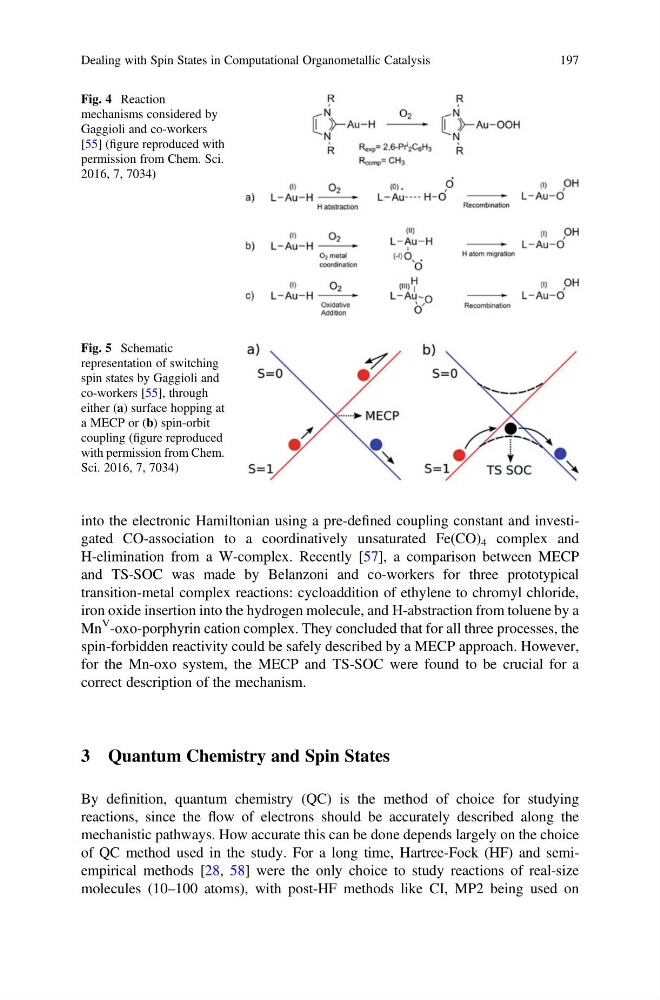
Fig. 4 Reaction
mechanisms considered by
Gaggioli and co-workers
[55] (figure reproduced with
permission from Chem. Sci.
2016, 7, 7034)
Fig. 5 Schematic
representation of switching
spin states by Gaggioli and
co-workers [55], through
either (a) surface hopping at
a MECP or (b) spin-orbit
coupling (figure reproduced
with permission from Chem.
Sci. 2016, 7, 7034)
Dealing with Spin States in Computational Organometallic Catalysis
197
H-elimination from a W-complex. Recently [57], a comparison between MECP
and TS-SOC was made by Belanzoni and co-workers for three prototypical
transition-metal complex reactions: cycloaddition of ethylene to chromyl chloride,
iron oxide insertion into the hydrogen molecule, and H-abstraction from toluene by a
Mn
V -oxo-porphyrin cation complex. They concluded that for all three processes, the
spin-forbidden reactivity could be safely described by a MECP approach. However,
for the Mn-oxo system, the MECP and TS-SOC were found to be crucial for a
correct description of the mechanism.
3 Quantum Chemistry and Spin States
By definition, quantum chemistry (QC) is the method of choice for studying
reactions, since the flow of electrons should be accurately described along the
mechanistic pathways. How accurate this can be done depends largely on the choice
of QC method used in the study. For a long time, Hartree-Fock (HF) and semiempirical methods [28, 58] were the only choice to study reactions of real-size
molecules (10–100 atoms), with post-HF methods like CI, MP2 being used on
Fig. 4 Reaction
mechanisms considered by
Gaggioli and co-workers
[55] (figure reproduced with
permission from Chem. Sci.
2016, 7, 7034)
Fig. 5 Schematic
representation of switching
spin states by Gaggioli and
co-workers [55], through
either (a) surface hopping at
a MECP or (b) spin-orbit
coupling (figure reproduced
with permission from Chem.
Sci. 2016, 7, 7034)
Dealing with Spin States in Computational Organometallic Catalysis
197