

2.1.2 Spin-Orbit Coupling
Once the MECP is reached, the switching from one spin-state surface to another
obviously is not automatic, but depends on many factors. The most important one is
the spin-orbit coupling, which determines to a large extent how easy it is to perform
the spin-state switching. This switching can nowadays also be followed by surfacehopping algorithms [52], pioneered by Tully [53], Robb and co-workers [45], and
the SHARC program by Gonzalez and co-workers [54], which allows to follow the
reaction in molecular dynamics simulations.
An elegant study by Belanzoni and co-workers [55] recently showed how spinorbit relativistic corrections can be invoked directly to follow the transition from
reactants to products. They focused on the spin-forbidden reaction of dioxygen
insertion into a gold (I) hydride bond using spin-orbit coupling; they investigated
hydrogen abstraction, metal coordination, and oxidative addition/recombination
mechanisms (see Fig. 4); the latter was the kinetically favored mechanism. Most
importantly, these spin-forbidden reactions can take place by “hopping” from the
diabatic potential energy surface of one spin state to that of another spin state
(Fig. 5a) or as involving a smooth transition from one spin state to the other
(Fig. 5b); this second description is preferred in case of strong spin-orbit coupling.
Strong spin-orbit coupling therefore facilitates a straightforward analysis of the
reaction barrier involved in the spin-forbidden reaction [46], which is moreover
more easily obtained using standard transition-state search strategies instead of the
more cumbersome MECP procedures that require two energy surfaces. This was also
shown by Yang, Gagliardi, and Truhlar [56] who introduced the spin-orbit coupling
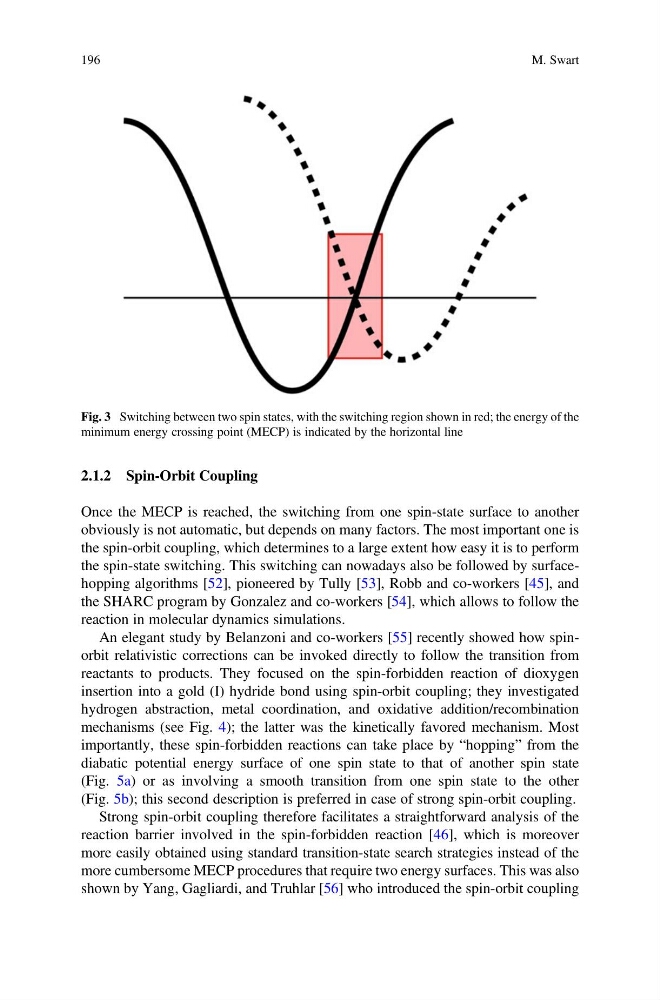
Fig. 3 Switching between two spin states, with the switching region shown in red; the energy of the
minimum energy crossing point (MECP) is indicated by the horizontal line
196
M. Swart
Once the MECP is reached, the switching from one spin-state surface to another
obviously is not automatic, but depends on many factors. The most important one is
the spin-orbit coupling, which determines to a large extent how easy it is to perform
the spin-state switching. This switching can nowadays also be followed by surfacehopping algorithms [52], pioneered by Tully [53], Robb and co-workers [45], and
the SHARC program by Gonzalez and co-workers [54], which allows to follow the
reaction in molecular dynamics simulations.
An elegant study by Belanzoni and co-workers [55] recently showed how spinorbit relativistic corrections can be invoked directly to follow the transition from
reactants to products. They focused on the spin-forbidden reaction of dioxygen
insertion into a gold (I) hydride bond using spin-orbit coupling; they investigated
hydrogen abstraction, metal coordination, and oxidative addition/recombination
mechanisms (see Fig. 4); the latter was the kinetically favored mechanism. Most
importantly, these spin-forbidden reactions can take place by “hopping” from the
diabatic potential energy surface of one spin state to that of another spin state
(Fig. 5a) or as involving a smooth transition from one spin state to the other
(Fig. 5b); this second description is preferred in case of strong spin-orbit coupling.
Strong spin-orbit coupling therefore facilitates a straightforward analysis of the
reaction barrier involved in the spin-forbidden reaction [46], which is moreover
more easily obtained using standard transition-state search strategies instead of the
more cumbersome MECP procedures that require two energy surfaces. This was also
shown by Yang, Gagliardi, and Truhlar [56] who introduced the spin-orbit coupling
Fig. 3 Switching between two spin states, with the switching region shown in red; the energy of the
minimum energy crossing point (MECP) is indicated by the horizontal line
196
M. Swart