

Apart from the structure, a change in spin state can bring about a change in
reactivity (smaller/larger barrier (vide infra) [1] or different pathways [11]) and
differences in spectroscopy [12–15] fingerprints (vide infra). This connection
between the active site electronic structure and the function of a metalloprotein
formed the basis for the development of the field of bioinorganic chemistry
[16, 17]. Recently [18–21], a number of groups have reported on specific vibrational
markers that indicate the spin and/or oxidation states of transition-metal complexes,
which in the case of iron can be used in combination with Mössbauer spectroscopy.
On the other hand, there is a wealth of studies that indicate the ranges observed
mainly through (resonance) Raman spectroscopy for, e.g., the difference between
side-on and end-on peroxo, superoxo, hydroperoxo species, which can be distinguished from oxo/oxyl species [5, 9, 22–24]. A clear difference is also observed in
the spectroscopy of low-spin and high-spin iron-hydroperoxo complexes: the
low-spin Fe(III)-OOH complex exhibits a Fe-O stretch around 630 cm
À1 with the
O-O stretch at ca. 790 cm
À1 [25]. In contrast, high-spin Fe(III)-OOH complexes
show vibrations at ca. 675 cm
À1 (Fe-O) and 870 cm
À1 (O-O) [26].
2.1 Where Do They Come From, Where Do They Go?
The manifestation of spin states in transition-metal complexes is ultimately a direct
consequence of the fermionic nature of electrons, leading to the Pauli exclusion
principle. That is, two electrons of equal spin (either both spin-up or both spin-down)
cannot be found at the same position at any given time (exchange hole); the same is
not true for two electrons of opposite spin (one spin-up, the other spin-down), which
can be found at the same position, but then with a reduced probability because of the
electrostatic repulsion between the two (Coulomb hole). There exists a delicate
balance between this electron-electron repulsion, the favorable exchange interaction
(purely quantum mechanical effect), and the electron pairing; this balancing act
manifests itself primarily for the first-row transition-metal series, where the
d-orbitals are close enough in energy that it occurs on a daily basis. Detailed
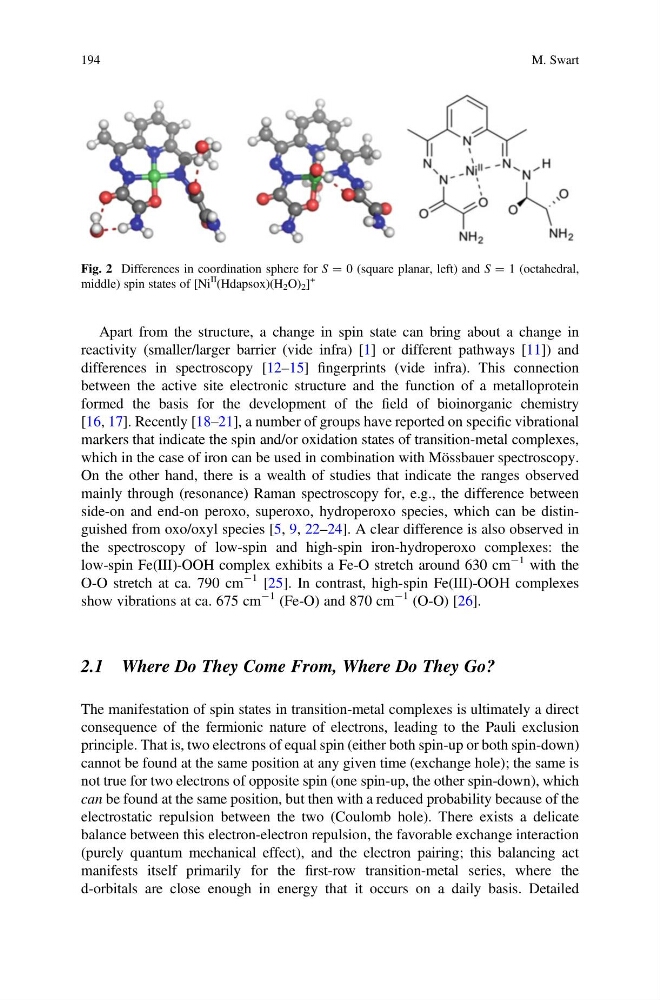
Fig. 2 Differences in coordination sphere for S ¼ 0 (square planar, left) and S ¼ 1 (octahedral,
middle) spin states of [Ni
II
(Hdapsox)(H 2 O) 2 ]
+
194
M. Swart
reactivity (smaller/larger barrier (vide infra) [1] or different pathways [11]) and
differences in spectroscopy [12–15] fingerprints (vide infra). This connection
between the active site electronic structure and the function of a metalloprotein
formed the basis for the development of the field of bioinorganic chemistry
[16, 17]. Recently [18–21], a number of groups have reported on specific vibrational
markers that indicate the spin and/or oxidation states of transition-metal complexes,
which in the case of iron can be used in combination with Mössbauer spectroscopy.
On the other hand, there is a wealth of studies that indicate the ranges observed
mainly through (resonance) Raman spectroscopy for, e.g., the difference between
side-on and end-on peroxo, superoxo, hydroperoxo species, which can be distinguished from oxo/oxyl species [5, 9, 22–24]. A clear difference is also observed in
the spectroscopy of low-spin and high-spin iron-hydroperoxo complexes: the
low-spin Fe(III)-OOH complex exhibits a Fe-O stretch around 630 cm
À1 with the
O-O stretch at ca. 790 cm
À1 [25]. In contrast, high-spin Fe(III)-OOH complexes
show vibrations at ca. 675 cm
À1 (Fe-O) and 870 cm
À1 (O-O) [26].
2.1 Where Do They Come From, Where Do They Go?
The manifestation of spin states in transition-metal complexes is ultimately a direct
consequence of the fermionic nature of electrons, leading to the Pauli exclusion
principle. That is, two electrons of equal spin (either both spin-up or both spin-down)
cannot be found at the same position at any given time (exchange hole); the same is
not true for two electrons of opposite spin (one spin-up, the other spin-down), which
can be found at the same position, but then with a reduced probability because of the
electrostatic repulsion between the two (Coulomb hole). There exists a delicate
balance between this electron-electron repulsion, the favorable exchange interaction
(purely quantum mechanical effect), and the electron pairing; this balancing act
manifests itself primarily for the first-row transition-metal series, where the
d-orbitals are close enough in energy that it occurs on a daily basis. Detailed
Fig. 2 Differences in coordination sphere for S ¼ 0 (square planar, left) and S ¼ 1 (octahedral,
middle) spin states of [Ni
II
(Hdapsox)(H 2 O) 2 ]
+
194
M. Swart