

from one spin to another (two-state reactivity [2], leading to exchange-enhanced
reactivity [3]) as will be discussed later in this chapter. Finally, the ligand can also be
involved in the distribution of the d-electrons, by either taking up an electron or
donating one; these so-called redox non-innocent ligands are often observed in
natural enzymes, and hence the chemical community has studied mimics of these
(e.g., biomimetic complexes) in the past decades [4–9].
2 Spin States
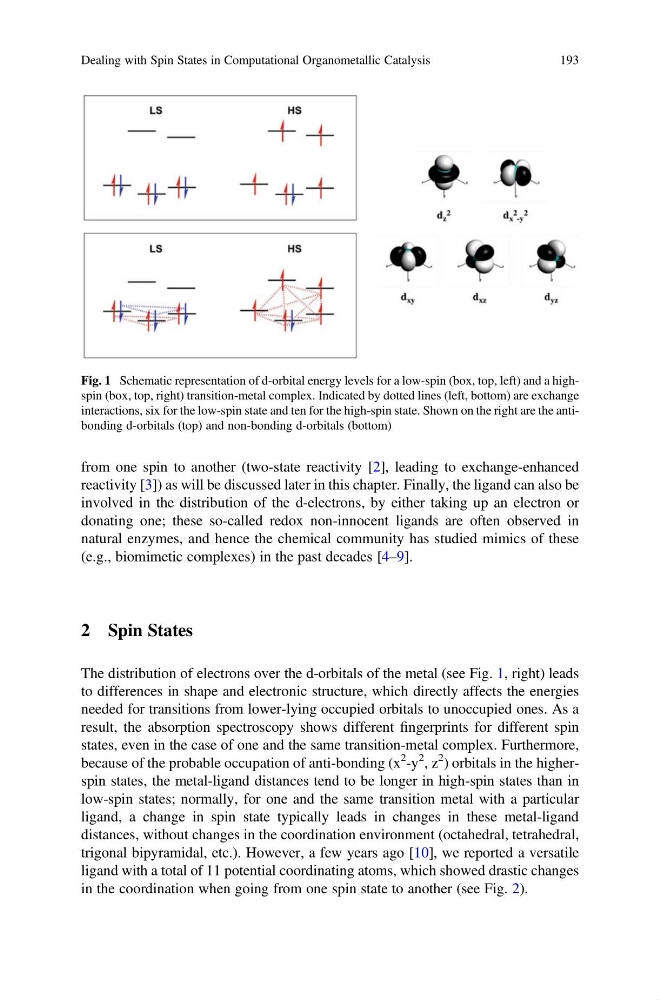
The distribution of electrons over the d-orbitals of the metal (see Fig. 1, right) leads
to differences in shape and electronic structure, which directly affects the energies
needed for transitions from lower-lying occupied orbitals to unoccupied ones. As a
result, the absorption spectroscopy shows different fingerprints for different spin
states, even in the case of one and the same transition-metal complex. Furthermore,
because of the probable occupation of anti-bonding (x
2 -y
2 , z
2 ) orbitals in the higherspin states, the metal-ligand distances tend to be longer in high-spin states than in
low-spin states; normally, for one and the same transition metal with a particular
ligand, a change in spin state typically leads in changes in these metal-ligand
distances, without changes in the coordination environment (octahedral, tetrahedral,
trigonal bipyramidal, etc.). However, a few years ago [10], we reported a versatile
ligand with a total of 11 potential coordinating atoms, which showed drastic changes
in the coordination when going from one spin state to another (see Fig. 2).
Fig. 1 Schematic representation of d-orbital energy levels for a low-spin (box, top, left) and a highspin (box, top, right) transition-metal complex. Indicated by dotted lines (left, bottom) are exchange
interactions, six for the low-spin state and ten for the high-spin state. Shown on the right are the antibonding d-orbitals (top) and non-bonding d-orbitals (bottom)
Dealing with Spin States in Computational Organometallic Catalysis
193
reactivity [3]) as will be discussed later in this chapter. Finally, the ligand can also be
involved in the distribution of the d-electrons, by either taking up an electron or
donating one; these so-called redox non-innocent ligands are often observed in
natural enzymes, and hence the chemical community has studied mimics of these
(e.g., biomimetic complexes) in the past decades [4–9].
2 Spin States
The distribution of electrons over the d-orbitals of the metal (see Fig. 1, right) leads
to differences in shape and electronic structure, which directly affects the energies
needed for transitions from lower-lying occupied orbitals to unoccupied ones. As a
result, the absorption spectroscopy shows different fingerprints for different spin
states, even in the case of one and the same transition-metal complex. Furthermore,
because of the probable occupation of anti-bonding (x
2 -y
2 , z
2 ) orbitals in the higherspin states, the metal-ligand distances tend to be longer in high-spin states than in
low-spin states; normally, for one and the same transition metal with a particular
ligand, a change in spin state typically leads in changes in these metal-ligand
distances, without changes in the coordination environment (octahedral, tetrahedral,
trigonal bipyramidal, etc.). However, a few years ago [10], we reported a versatile
ligand with a total of 11 potential coordinating atoms, which showed drastic changes
in the coordination when going from one spin state to another (see Fig. 2).
Fig. 1 Schematic representation of d-orbital energy levels for a low-spin (box, top, left) and a highspin (box, top, right) transition-metal complex. Indicated by dotted lines (left, bottom) are exchange
interactions, six for the low-spin state and ten for the high-spin state. Shown on the right are the antibonding d-orbitals (top) and non-bonding d-orbitals (bottom)
Dealing with Spin States in Computational Organometallic Catalysis
193