

any promising results – it is impossible to find the needle if we are looking in the
wrong haystack! Also, in the absence of a statistical or mechanistically informed
approach, these approaches do not offer a systematic way forwards in the context of
reaction development. HTS will, however, generate lots of data – both positive and
negative (i.e. successful and unsuccessful reactions). In conjunction with approaches
to interpret this data, this can be highly valuable (Sect. 5).
4.2 Mechanistically Driven Ligand Discovery
Mechanistic information provides a ‘bottom-up’ approach to chiral ligand design.
This approach is based on drawing logical assumptions from previous and ongoing
mechanistic study (which may be experiment, computational or both), particularly
how enantioselectivity is induced by the catalyst. For small-molecule catalysts,
modern computational tools are firmly embedded in the first line of attack in catalyst
design [40]. However, this is not (yet) a panacea. Computational studies of asymmetric catalysis face similar challenges as other areas of study, relating to finding the
plausible reaction pathway(s) from multiple possibilities, accurately describing the
effects of non-covalent interactions (e.g. dispersion, hydrogen bonding, etc.) and
solvation, sampling the conformations of flexible species, describing the vibrational
and entropic contributions to the Gibbs energies/chemical potentials of reacting
species, the effects of numerical approximations in standard computational chemistry programs and the breakdown of statistical rate theories [41]. As discussed later,
these challenges are perhaps more acute given the relatively small energetic differences of a few kcal/mol underlying much of asymmetric catalysis. In
conformationally flexible catalysts, the energy changes due to the change in conformation alone could overwhelm the actual energy difference underlying the
Ph
OMe
O
NHAc
Ph
OMe
O
NHAc
Rh(COD) 2 BF 4 ,
H 2 (6 bar), DCM
32 chiral ligands
in 96 vials reactor
O
O
P NR 2
chiral ligands
a)
b)
upto 95% ee
upto 87% ee
N
H
S
O
O N
Cl
Acetone
reflux, overnight
in 96 well plates
HN
S
O
O N
Cl
B
HO
OH
Rh(acac)(C 2 H 4 ) 2
20 chiral ligands
+
R = H,
alkyls,
acyls, aryls,
heteroaryls,
etc.
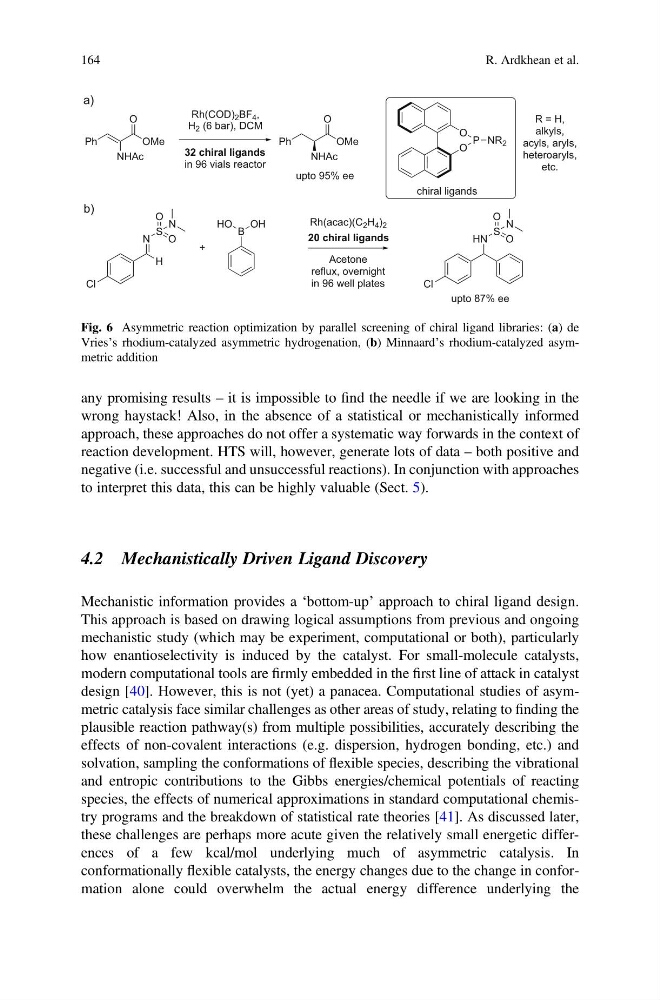
Fig. 6 Asymmetric reaction optimization by parallel screening of chiral ligand libraries: (a) de
Vries’s rhodium-catalyzed asymmetric hydrogenation, (b) Minnaard’s rhodium-catalyzed asymmetric addition
164
R. Ardkhean et al.
wrong haystack! Also, in the absence of a statistical or mechanistically informed
approach, these approaches do not offer a systematic way forwards in the context of
reaction development. HTS will, however, generate lots of data – both positive and
negative (i.e. successful and unsuccessful reactions). In conjunction with approaches
to interpret this data, this can be highly valuable (Sect. 5).
4.2 Mechanistically Driven Ligand Discovery
Mechanistic information provides a ‘bottom-up’ approach to chiral ligand design.
This approach is based on drawing logical assumptions from previous and ongoing
mechanistic study (which may be experiment, computational or both), particularly
how enantioselectivity is induced by the catalyst. For small-molecule catalysts,
modern computational tools are firmly embedded in the first line of attack in catalyst
design [40]. However, this is not (yet) a panacea. Computational studies of asymmetric catalysis face similar challenges as other areas of study, relating to finding the
plausible reaction pathway(s) from multiple possibilities, accurately describing the
effects of non-covalent interactions (e.g. dispersion, hydrogen bonding, etc.) and
solvation, sampling the conformations of flexible species, describing the vibrational
and entropic contributions to the Gibbs energies/chemical potentials of reacting
species, the effects of numerical approximations in standard computational chemistry programs and the breakdown of statistical rate theories [41]. As discussed later,
these challenges are perhaps more acute given the relatively small energetic differences of a few kcal/mol underlying much of asymmetric catalysis. In
conformationally flexible catalysts, the energy changes due to the change in conformation alone could overwhelm the actual energy difference underlying the
Ph
OMe
O
NHAc
Ph
OMe
O
NHAc
Rh(COD) 2 BF 4 ,
H 2 (6 bar), DCM
32 chiral ligands
in 96 vials reactor
O
O
P NR 2
chiral ligands
a)
b)
upto 95% ee
upto 87% ee
N
H
S
O
O N
Cl
Acetone
reflux, overnight
in 96 well plates
HN
S
O
O N
Cl
B
HO
OH
Rh(acac)(C 2 H 4 ) 2
20 chiral ligands
+
R = H,
alkyls,
acyls, aryls,
heteroaryls,
etc.
Fig. 6 Asymmetric reaction optimization by parallel screening of chiral ligand libraries: (a) de
Vries’s rhodium-catalyzed asymmetric hydrogenation, (b) Minnaard’s rhodium-catalyzed asymmetric addition
164
R. Ardkhean et al.