

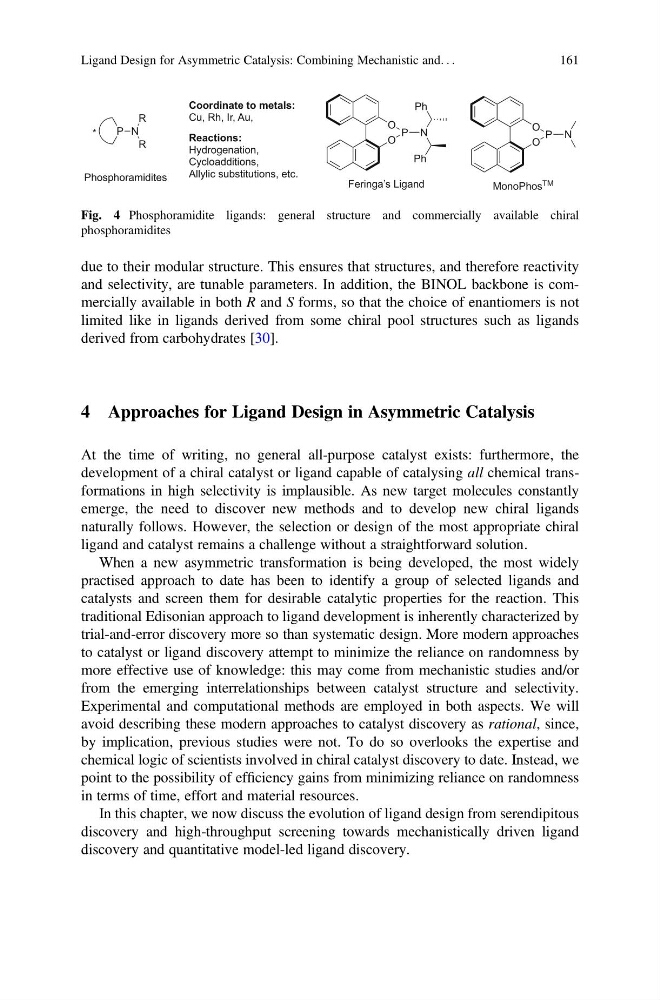
due to their modular structure. This ensures that structures, and therefore reactivity
and selectivity, are tunable parameters. In addition, the BINOL backbone is commercially available in both R and S forms, so that the choice of enantiomers is not
limited like in ligands derived from some chiral pool structures such as ligands
derived from carbohydrates [30].
4 Approaches for Ligand Design in Asymmetric Catalysis
At the time of writing, no general all-purpose catalyst exists: furthermore, the
development of a chiral catalyst or ligand capable of catalysing all chemical transformations in high selectivity is implausible. As new target molecules constantly
emerge, the need to discover new methods and to develop new chiral ligands
naturally follows. However, the selection or design of the most appropriate chiral
ligand and catalyst remains a challenge without a straightforward solution.
When a new asymmetric transformation is being developed, the most widely
practised approach to date has been to identify a group of selected ligands and
catalysts and screen them for desirable catalytic properties for the reaction. This
traditional Edisonian approach to ligand development is inherently characterized by
trial-and-error discovery more so than systematic design. More modern approaches
to catalyst or ligand discovery attempt to minimize the reliance on randomness by
more effective use of knowledge: this may come from mechanistic studies and/or
from the emerging interrelationships between catalyst structure and selectivity.
Experimental and computational methods are employed in both aspects. We will
avoid describing these modern approaches to catalyst discovery as rational, since,
by implication, previous studies were not. To do so overlooks the expertise and
chemical logic of scientists involved in chiral catalyst discovery to date. Instead, we
point to the possibility of efficiency gains from minimizing reliance on randomness
in terms of time, effort and material resources.
In this chapter, we now discuss the evolution of ligand design from serendipitous
discovery and high-throughput screening towards mechanistically driven ligand
discovery and quantitative model-led ligand discovery.
Phosphoramidites
N
R
P
R
*
O
O P N
MonoPhos TM
Coordinate to metals:
Cu, Rh, Ir, Au,
Reactions:
Hydrogenation,
Cycloadditions,
Allylic substitutions, etc.
O
O
P N
Ph
Ph
Feringa’s Ligand
Fig. 4 Phosphoramidite ligands: general structure and commercially available chiral
phosphoramidites
Ligand Design for Asymmetric Catalysis: Combining Mechanistic and. . .
161
and selectivity, are tunable parameters. In addition, the BINOL backbone is commercially available in both R and S forms, so that the choice of enantiomers is not
limited like in ligands derived from some chiral pool structures such as ligands
derived from carbohydrates [30].
4 Approaches for Ligand Design in Asymmetric Catalysis
At the time of writing, no general all-purpose catalyst exists: furthermore, the
development of a chiral catalyst or ligand capable of catalysing all chemical transformations in high selectivity is implausible. As new target molecules constantly
emerge, the need to discover new methods and to develop new chiral ligands
naturally follows. However, the selection or design of the most appropriate chiral
ligand and catalyst remains a challenge without a straightforward solution.
When a new asymmetric transformation is being developed, the most widely
practised approach to date has been to identify a group of selected ligands and
catalysts and screen them for desirable catalytic properties for the reaction. This
traditional Edisonian approach to ligand development is inherently characterized by
trial-and-error discovery more so than systematic design. More modern approaches
to catalyst or ligand discovery attempt to minimize the reliance on randomness by
more effective use of knowledge: this may come from mechanistic studies and/or
from the emerging interrelationships between catalyst structure and selectivity.
Experimental and computational methods are employed in both aspects. We will
avoid describing these modern approaches to catalyst discovery as rational, since,
by implication, previous studies were not. To do so overlooks the expertise and
chemical logic of scientists involved in chiral catalyst discovery to date. Instead, we
point to the possibility of efficiency gains from minimizing reliance on randomness
in terms of time, effort and material resources.
In this chapter, we now discuss the evolution of ligand design from serendipitous
discovery and high-throughput screening towards mechanistically driven ligand
discovery and quantitative model-led ligand discovery.
Phosphoramidites
N
R
P
R
*
O
O P N
MonoPhos TM
Coordinate to metals:
Cu, Rh, Ir, Au,
Reactions:
Hydrogenation,
Cycloadditions,
Allylic substitutions, etc.
O
O
P N
Ph
Ph
Feringa’s Ligand
Fig. 4 Phosphoramidite ligands: general structure and commercially available chiral
phosphoramidites
Ligand Design for Asymmetric Catalysis: Combining Mechanistic and. . .
161