

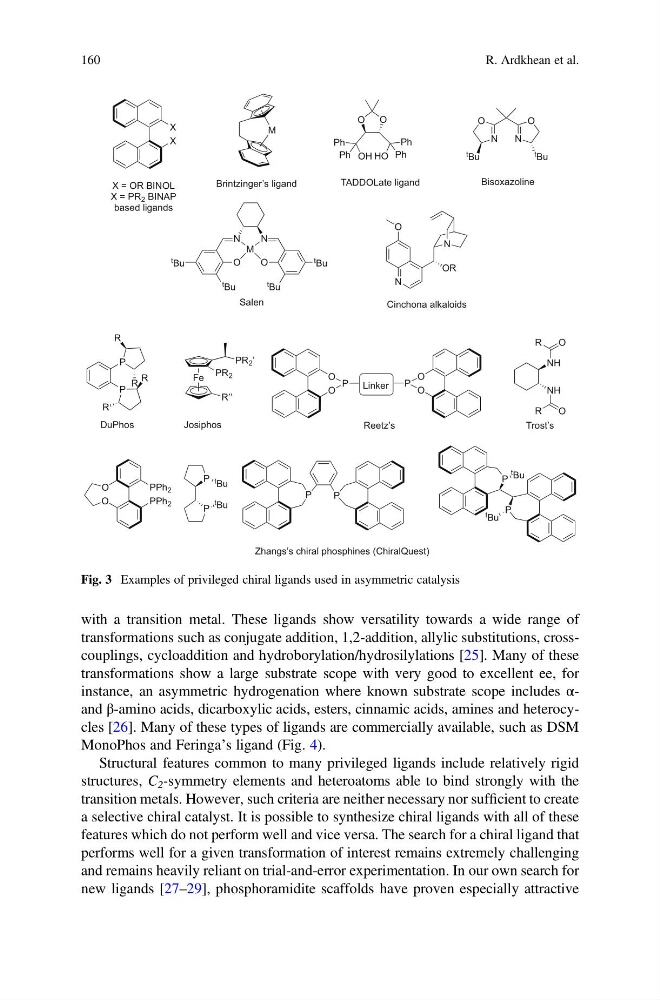
with a transition metal. These ligands show versatility towards a wide range of
transformations such as conjugate addition, 1,2-addition, allylic substitutions, crosscouplings, cycloaddition and hydroborylation/hydrosilylations [25]. Many of these
transformations show a large substrate scope with very good to excellent ee, for
instance, an asymmetric hydrogenation where known substrate scope includes αand β-amino acids, dicarboxylic acids, esters, cinnamic acids, amines and heterocycles [26]. Many of these types of ligands are commercially available, such as DSM
MonoPhos and Feringa’s ligand (Fig. 4).
Structural features common to many privileged ligands include relatively rigid
structures, C 2 -symmetry elements and heteroatoms able to bind strongly with the
transition metals. However, such criteria are neither necessary nor sufficient to create
a selective chiral catalyst. It is possible to synthesize chiral ligands with all of these
features which do not perform well and vice versa. The search for a chiral ligand that
performs well for a given transformation of interest remains extremely challenging
and remains heavily reliant on trial-and-error experimentation. In our own search for
new ligands [27–29], phosphoramidite scaffolds have proven especially attractive
P
P
R
R
R
R
DuPhos
Fe
R’’
PR 2
PR 2 ’
Josiphos
O
O P
O
O
P
Linker
Reetz’s
NH
NH
O
R
O
R
Trost’s
Zhangs’s chiral phosphines (ChiralQuest)
PPh 2
PPh 2
O
O
P
P
t Bu
t Bu
P
P
P
P
t Bu
t Bu
X
X
X = OR BINOL
X = PR 2 BINAP
based ligands
M
Brintzinger’s ligand
O
O
Ph
Ph
HO
Ph
Ph OH
TADDOLate ligand
N
N
O
O
t Bu
t Bu
Bisoxazoline
N
N
O
t Bu
t Bu
O
t Bu
t Bu
M
Salen
N
OR
N
O
Cinchona alkaloids
Fig. 3 Examples of privileged chiral ligands used in asymmetric catalysis
160
R. Ardkhean et al.
transformations such as conjugate addition, 1,2-addition, allylic substitutions, crosscouplings, cycloaddition and hydroborylation/hydrosilylations [25]. Many of these
transformations show a large substrate scope with very good to excellent ee, for
instance, an asymmetric hydrogenation where known substrate scope includes αand β-amino acids, dicarboxylic acids, esters, cinnamic acids, amines and heterocycles [26]. Many of these types of ligands are commercially available, such as DSM
MonoPhos and Feringa’s ligand (Fig. 4).
Structural features common to many privileged ligands include relatively rigid
structures, C 2 -symmetry elements and heteroatoms able to bind strongly with the
transition metals. However, such criteria are neither necessary nor sufficient to create
a selective chiral catalyst. It is possible to synthesize chiral ligands with all of these
features which do not perform well and vice versa. The search for a chiral ligand that
performs well for a given transformation of interest remains extremely challenging
and remains heavily reliant on trial-and-error experimentation. In our own search for
new ligands [27–29], phosphoramidite scaffolds have proven especially attractive
P
P
R
R
R
R
DuPhos
Fe
R’’
PR 2
PR 2 ’
Josiphos
O
O P
O
O
P
Linker
Reetz’s
NH
NH
O
R
O
R
Trost’s
Zhangs’s chiral phosphines (ChiralQuest)
PPh 2
PPh 2
O
O
P
P
t Bu
t Bu
P
P
P
P
t Bu
t Bu
X
X
X = OR BINOL
X = PR 2 BINAP
based ligands
M
Brintzinger’s ligand
O
O
Ph
Ph
HO
Ph
Ph OH
TADDOLate ligand
N
N
O
O
t Bu
t Bu
Bisoxazoline
N
N
O
t Bu
t Bu
O
t Bu
t Bu
M
Salen
N
OR
N
O
Cinchona alkaloids
Fig. 3 Examples of privileged chiral ligands used in asymmetric catalysis
160
R. Ardkhean et al.