

ligands that make these complexes function as chiral catalysts for asymmetric
synthesis. The quest for novel, efficient chiral transition metal catalysts has been
an ongoing endeavour for the past 40 years. The impact of asymmetric catalysis in
chemistry was recognized by the 2001 Nobel Prize, awarded to Knowles, Noyori
and Sharpless for their work on catalytic asymmetric hydrogenation and oxidation
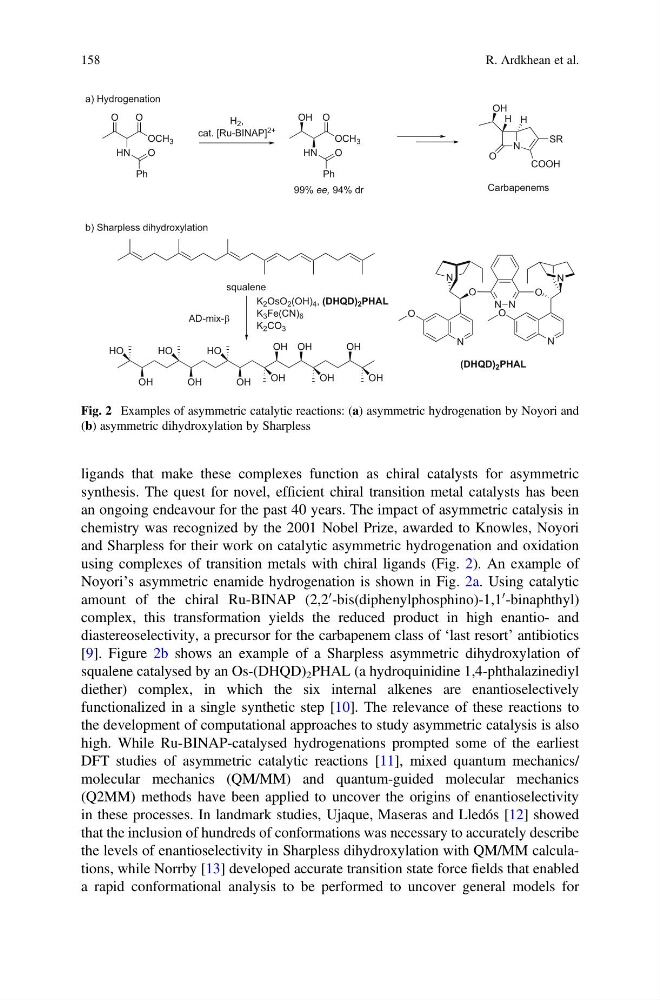
using complexes of transition metals with chiral ligands (Fig. 2). An example of
Noyori’s asymmetric enamide hydrogenation is shown in Fig. 2a. Using catalytic
amount of the chiral Ru-BINAP (2,2
0 -bis(diphenylphosphino)-1,1
0 -binaphthyl)
complex, this transformation yields the reduced product in high enantio- and
diastereoselectivity, a precursor for the carbapenem class of ‘last resort’ antibiotics
[9]. Figure 2b shows an example of a Sharpless asymmetric dihydroxylation of
squalene catalysed by an Os-(DHQD) 2 PHAL (a hydroquinidine 1,4-phthalazinediyl
diether) complex, in which the six internal alkenes are enantioselectively
functionalized in a single synthetic step [10]. The relevance of these reactions to
the development of computational approaches to study asymmetric catalysis is also
high. While Ru-BINAP-catalysed hydrogenations prompted some of the earliest
DFT studies of asymmetric catalytic reactions [11], mixed quantum mechanics/
molecular mechanics (QM/MM) and quantum-guided molecular mechanics
(Q2MM) methods have been applied to uncover the origins of enantioselectivity
in these processes. In landmark studies, Ujaque, Maseras and Lledós [12] showed
that the inclusion of hundreds of conformations was necessary to accurately describe
the levels of enantioselectivity in Sharpless dihydroxylation with QM/MM calculations, while Norrby [13] developed accurate transition state force fields that enabled
a rapid conformational analysis to be performed to uncover general models for
OCH 3
O
O
HN
Ph
O
H 2 ,
cat. [Ru-BINAP] 2+
OCH 3
OH O
HN
Ph
O
99% ee, 94% dr
N
O
COOH
SR
OH
H H
Carbapenems
HO
OH
HO
OH
OH
HO
OH
OH
OH
OH
OH
OH
AD-mix-β
squalene
K 2 OsO 2 (OH) 4 , (DHQD) 2 PHAL
K 3 Fe(CN) 6
K 2 CO 3
N
O
N
O
N
N
O
O
(DHQD) 2 PHAL
N
N
a) Hydrogenation
b) Sharpless dihydroxylation
Fig. 2 Examples of asymmetric catalytic reactions: (a) asymmetric hydrogenation by Noyori and
(b) asymmetric dihydroxylation by Sharpless
158
R. Ardkhean et al.
synthesis. The quest for novel, efficient chiral transition metal catalysts has been
an ongoing endeavour for the past 40 years. The impact of asymmetric catalysis in
chemistry was recognized by the 2001 Nobel Prize, awarded to Knowles, Noyori
and Sharpless for their work on catalytic asymmetric hydrogenation and oxidation
using complexes of transition metals with chiral ligands (Fig. 2). An example of
Noyori’s asymmetric enamide hydrogenation is shown in Fig. 2a. Using catalytic
amount of the chiral Ru-BINAP (2,2
0 -bis(diphenylphosphino)-1,1
0 -binaphthyl)
complex, this transformation yields the reduced product in high enantio- and
diastereoselectivity, a precursor for the carbapenem class of ‘last resort’ antibiotics
[9]. Figure 2b shows an example of a Sharpless asymmetric dihydroxylation of
squalene catalysed by an Os-(DHQD) 2 PHAL (a hydroquinidine 1,4-phthalazinediyl
diether) complex, in which the six internal alkenes are enantioselectively
functionalized in a single synthetic step [10]. The relevance of these reactions to
the development of computational approaches to study asymmetric catalysis is also
high. While Ru-BINAP-catalysed hydrogenations prompted some of the earliest
DFT studies of asymmetric catalytic reactions [11], mixed quantum mechanics/
molecular mechanics (QM/MM) and quantum-guided molecular mechanics
(Q2MM) methods have been applied to uncover the origins of enantioselectivity
in these processes. In landmark studies, Ujaque, Maseras and Lledós [12] showed
that the inclusion of hundreds of conformations was necessary to accurately describe
the levels of enantioselectivity in Sharpless dihydroxylation with QM/MM calculations, while Norrby [13] developed accurate transition state force fields that enabled
a rapid conformational analysis to be performed to uncover general models for
OCH 3
O
O
HN
Ph
O
H 2 ,
cat. [Ru-BINAP] 2+
OCH 3
OH O
HN
Ph
O
99% ee, 94% dr
N
O
COOH
SR
OH
H H
Carbapenems
HO
OH
HO
OH
OH
HO
OH
OH
OH
OH
OH
OH
AD-mix-β
squalene
K 2 OsO 2 (OH) 4 , (DHQD) 2 PHAL
K 3 Fe(CN) 6
K 2 CO 3
N
O
N
O
N
N
O
O
(DHQD) 2 PHAL
N
N
a) Hydrogenation
b) Sharpless dihydroxylation
Fig. 2 Examples of asymmetric catalytic reactions: (a) asymmetric hydrogenation by Noyori and
(b) asymmetric dihydroxylation by Sharpless
158
R. Ardkhean et al.