

1892, becoming Baron Kelvin, the first British scientist to be elevated to the House
of Lords [1]. Kelvin’s definition of chirality was later refined by Eliel and Wilen to
mean ‘Not superposable with its mirror image, as applied to molecules, conformations, as well as macroscopic objects such as crystals’ [2]. The left- and right‘handed’ forms of a molecule are called enantiomers (from ἐναντίoς (enantios),
meaning opposite). The composition of a mixture of enantiomers can be quantified
in terms of the enantiomeric excess (ee), the percentage difference between one
enantiomer and the other equated with optical purity, or the enantiomeric ratio (er).
Both terms are commonly encountered in current literature as expressions of
enantioselectivity and the relative merits debated [3]. The sense of chirality can be
assigned based on different rules, of which the Cahn-Ingold-Prelog (CIP) system,
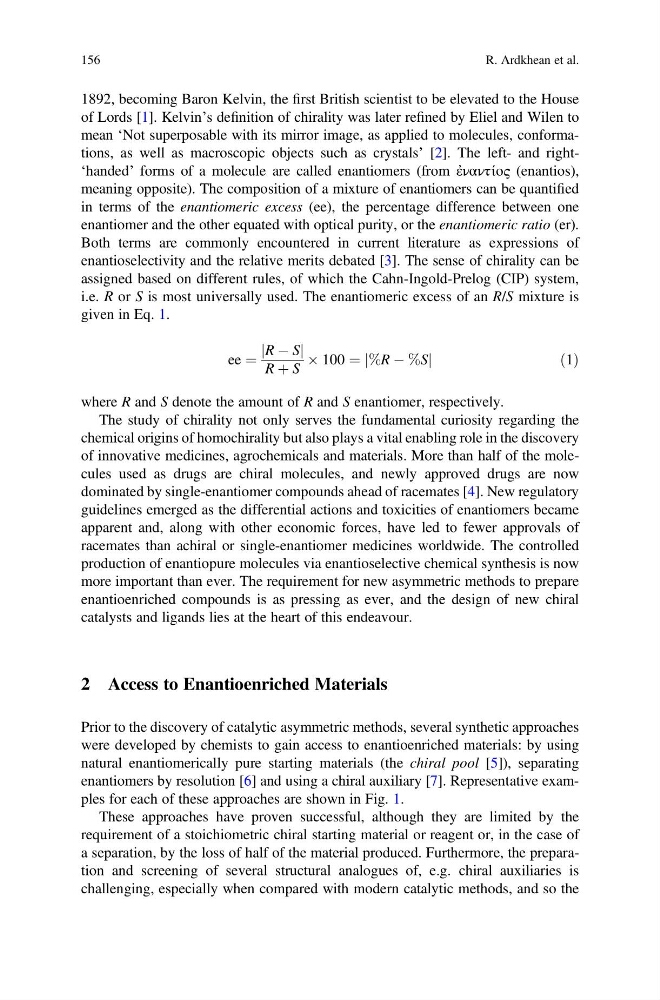
i.e. R or S is most universally used. The enantiomeric excess of an R/S mixture is
given in Eq. 1.
ee ¼
R À S
j
j
R þ S
 100 ¼ %R À %S
j
j
ð1Þ
where R and S denote the amount of R and S enantiomer, respectively.
The study of chirality not only serves the fundamental curiosity regarding the
chemical origins of homochirality but also plays a vital enabling role in the discovery
of innovative medicines, agrochemicals and materials. More than half of the molecules used as drugs are chiral molecules, and newly approved drugs are now
dominated by single-enantiomer compounds ahead of racemates [4]. New regulatory
guidelines emerged as the differential actions and toxicities of enantiomers became
apparent and, along with other economic forces, have led to fewer approvals of
racemates than achiral or single-enantiomer medicines worldwide. The controlled
production of enantiopure molecules via enantioselective chemical synthesis is now
more important than ever. The requirement for new asymmetric methods to prepare
enantioenriched compounds is as pressing as ever, and the design of new chiral
catalysts and ligands lies at the heart of this endeavour.
2 Access to Enantioenriched Materials
Prior to the discovery of catalytic asymmetric methods, several synthetic approaches
were developed by chemists to gain access to enantioenriched materials: by using
natural enantiomerically pure starting materials (the chiral pool [5]), separating
enantiomers by resolution [6] and using a chiral auxiliary [7]. Representative examples for each of these approaches are shown in Fig. 1.
These approaches have proven successful, although they are limited by the
requirement of a stoichiometric chiral starting material or reagent or, in the case of
a separation, by the loss of half of the material produced. Furthermore, the preparation and screening of several structural analogues of, e.g. chiral auxiliaries is
challenging, especially when compared with modern catalytic methods, and so the
156
R. Ardkhean et al.
of Lords [1]. Kelvin’s definition of chirality was later refined by Eliel and Wilen to
mean ‘Not superposable with its mirror image, as applied to molecules, conformations, as well as macroscopic objects such as crystals’ [2]. The left- and right‘handed’ forms of a molecule are called enantiomers (from ἐναντίoς (enantios),
meaning opposite). The composition of a mixture of enantiomers can be quantified
in terms of the enantiomeric excess (ee), the percentage difference between one
enantiomer and the other equated with optical purity, or the enantiomeric ratio (er).
Both terms are commonly encountered in current literature as expressions of
enantioselectivity and the relative merits debated [3]. The sense of chirality can be
assigned based on different rules, of which the Cahn-Ingold-Prelog (CIP) system,
i.e. R or S is most universally used. The enantiomeric excess of an R/S mixture is
given in Eq. 1.
ee ¼
R À S
j
j
R þ S
 100 ¼ %R À %S
j
j
ð1Þ
where R and S denote the amount of R and S enantiomer, respectively.
The study of chirality not only serves the fundamental curiosity regarding the
chemical origins of homochirality but also plays a vital enabling role in the discovery
of innovative medicines, agrochemicals and materials. More than half of the molecules used as drugs are chiral molecules, and newly approved drugs are now
dominated by single-enantiomer compounds ahead of racemates [4]. New regulatory
guidelines emerged as the differential actions and toxicities of enantiomers became
apparent and, along with other economic forces, have led to fewer approvals of
racemates than achiral or single-enantiomer medicines worldwide. The controlled
production of enantiopure molecules via enantioselective chemical synthesis is now
more important than ever. The requirement for new asymmetric methods to prepare
enantioenriched compounds is as pressing as ever, and the design of new chiral
catalysts and ligands lies at the heart of this endeavour.
2 Access to Enantioenriched Materials
Prior to the discovery of catalytic asymmetric methods, several synthetic approaches
were developed by chemists to gain access to enantioenriched materials: by using
natural enantiomerically pure starting materials (the chiral pool [5]), separating
enantiomers by resolution [6] and using a chiral auxiliary [7]. Representative examples for each of these approaches are shown in Fig. 1.
These approaches have proven successful, although they are limited by the
requirement of a stoichiometric chiral starting material or reagent or, in the case of
a separation, by the loss of half of the material produced. Furthermore, the preparation and screening of several structural analogues of, e.g. chiral auxiliaries is
challenging, especially when compared with modern catalytic methods, and so the
156
R. Ardkhean et al.